Unlocking Connectivity: The Satellite Industry’s Approach to Achieving Interoperability with Telco


BAE Systems wins $450 million contract to build weather satellite instrument


NASA study provides new look at orbital debris, potential solutions
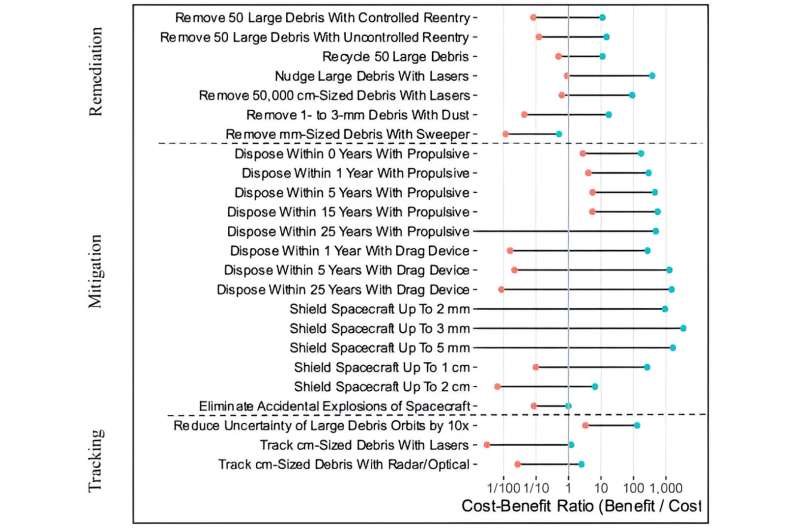
New data analysis indicates that NASA and its partners could have more cost-effective methods for dealing with the growing issue of orbital debris than previously thought.
A new report from NASA's Office of Technology, Policy, and Strategy provides agency leadership with new insight about how to measure the risks presented by orbital debris.
"Growing activity in Earth's orbit has brought us everything from faster terrestrial communications to a better understanding of our changing climate," said Charity Weeden, who leads NASA's OTPS. "These blossoming opportunities are resulting in a more crowded space environment. This study is part of NASA's work to rapidly improve our understanding of that environment as outlined in NASA's recently released Space Sustainability Strategy, by applying an economic lens to this critical issue.
Appropriate exercise is an important part of crew health during space missions
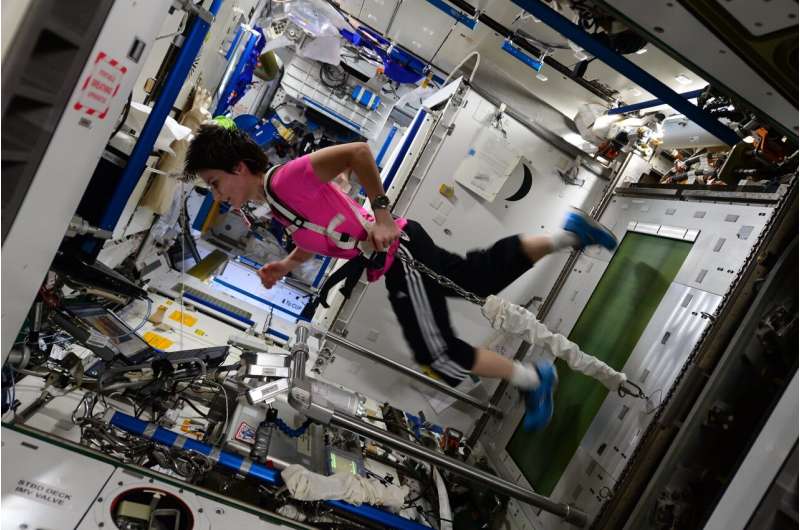
Future missions to the moon and Mars must address many challenges, including preventing loss of bone and muscle tissue in astronauts. Research on the International Space Station is helping to address this challenge.
Without Earth's gravity, both bone and muscle atrophy, or become smaller and weaker. Early on, scientists realized that exercise is a critical part of maintaining healthy bones and muscles in space, just as it is on Earth. From simple elastic bands on early missions, exercise hardware has become increasingly advanced. Current equipment includes the Advanced Resistive Exercise Device (ARED) weight-lifting system, a second generation-treadmill called T2, and the Cycle Ergometer with Vibration Isolation and Stabilization System (CEVIS) cycling machine. Studies continue to refine this equipment as well as the intensity and duration of how astronauts use it, with crew members now averaging two hours of exercise per day.
Installed in 2008, ARED uses a piston and flywheel system to provide loading that essentially mimics weightlifting in weightlessness.
What is "time" for quantum particles
 Physicists from Darmstadt propose a new method to measure the time it takes for particles to tunnel, challenging previous experiments that suggested particles could move faster than the speed of light. This phenomenon, known as quantum tunneling, allows particles to pass through barriers even if they don't have enough energy to go over them. This effect has practical applications, such as in fla
 Ariane 6 inaugural launch planned for first half of July


China to expand commercial spaceport to support upcoming launch surge

U.S. claims recently launched Russian satellite is an ASAT


New Horizons expand research with unique observations
 Scientists with NASA's New Horizons mission are pursuing new research goals and making unique astrophysical and heliospheric observations with the suite of instruments onboard the New Horizons spacecraft. This project takes advantage of the spacecraft's position in the distant Kuiper Belt, avoiding viewing obscurations closer to Earth.
Launched in 2006, New Horizons aimed to understand the
Scientists with NASA's New Horizons mission are pursuing new research goals and making unique astrophysical and heliospheric observations with the suite of instruments onboard the New Horizons spacecraft. This project takes advantage of the spacecraft's position in the distant Kuiper Belt, avoiding viewing obscurations closer to Earth.
Launched in 2006, New Horizons aimed to understand the Starfish Space secures $37M contract for Otter satellite mission
 Space Systems Command (SSC) awarded Starfish Space a $37.5 million Strategic Funding Increase (STRATFI) contract to develop, launch, and operate an Otter satellite vehicle for a docking mission to provide two years of augmented maneuver for National Security Space assets.
In collaboration with the Air Force Research Laboratory's (AFRL) SpaceWERX Program, Starfish Space, Space Safari, and S
Space Systems Command (SSC) awarded Starfish Space a $37.5 million Strategic Funding Increase (STRATFI) contract to develop, launch, and operate an Otter satellite vehicle for a docking mission to provide two years of augmented maneuver for National Security Space assets.
In collaboration with the Air Force Research Laboratory's (AFRL) SpaceWERX Program, Starfish Space, Space Safari, and S