

New insights into the potential for early steps of biological evolution on Mars
 That the planet Mars had habitable surface environments early in its existence has been firmly established by the scientific community. These environments provided water, energy sources, elements like carbon, hydrogen, nitrogen, oxygen, phosphorus, and sulfur, as well as critical catalytic transition metals associated with life as we know it. However, whether that potential stimulated further pr
 New technique measures structured light in a single shot
 Structured light waves with spiral phase fronts carry orbital angular momentum (OAM), attributed to the rotational motion of photons. Recently, scientists have been using light waves with OAM, and these special "helical" light beams have become very important in various advanced technologies like communication, imaging, and quantum information processing. In these technologies, it's crucial to k
 Gaia telescope data challenges long-held gravity theories
 A groundbreaking study, harnessing observations from the European Space Agency's Gaia space telescope, has revealed evidence of discrepancies between observed stellar motions and predictions from Newton's universal law of gravitation and Einstein's general relativity.
The research, spearheaded by Professor Kyu-Hyun Chae of Sejong University, Seoul, scrutinized the orbital dynamics of appro
A groundbreaking study, harnessing observations from the European Space Agency's Gaia space telescope, has revealed evidence of discrepancies between observed stellar motions and predictions from Newton's universal law of gravitation and Einstein's general relativity.
The research, spearheaded by Professor Kyu-Hyun Chae of Sejong University, Seoul, scrutinized the orbital dynamics of appro U.S. military and allies get a feel for the value of commercial satellite imagery

U.S. Space Force imagery specialists during a recent military exercise in South America helped locate illegal fishing boats and track other activities using commercial sensor satellites.
Illuminating Earth’s shine

A climate experiment called Earthshine is part of ESA astronaut Andreas Mogensen’s Huginn mission. The experiment aims to understand how Earth reflects sunlight to improve climate models. And you can help Andreas and the scientists!
Rocket Lab sees Virgin Orbit facility as “scaling enabler” for Neutron

Putting the S in the first Meteosat Third Generation Sounder
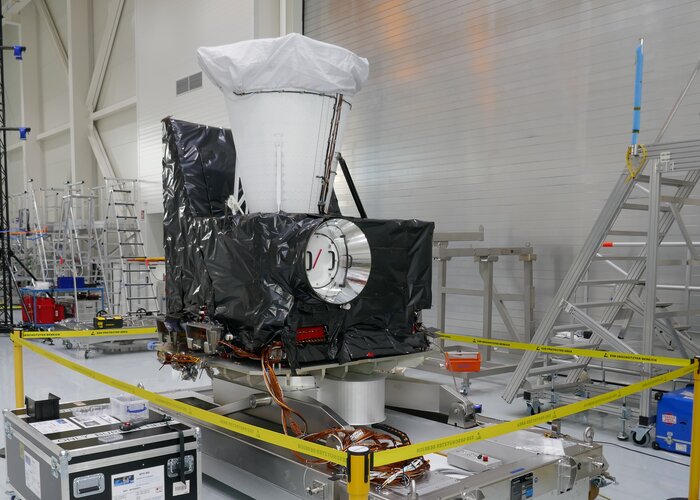
Following on from the launch of the first Meteosat Third Generation weather satellite, MTG-I1, last December, the focus is now on getting its partner satellite, MTG-S1, ready for liftoff next year – and a significant milestone has been reached. The satellite has been equipped with its main instrument, the Infrared Sounder, hence the satellite’s name, and also the Copernicus Sentinel-4 instrument, an ultraviolet, visible, near-infrared light spectrometer, or UVN for short.
Earth observation evolution: Bigger satellites promise bigger payoff for imagery operators

More cost-effective satellites on the larger Rideshare strains end of the smallsat scale are opening up new capabilities for the Earth observation industry.
China launches first geosynchronous orbit radar satellite

China launched what is thought to be the world’s first geosynchronous orbit synthetic aperture radar satellite on Saturday.
An improved radioisotope thermoelectric generator could dramatically reduce the weight of interplanetary missions
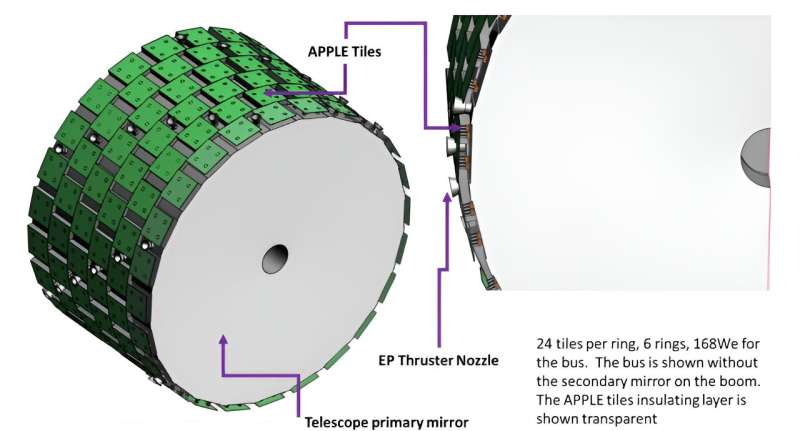
Radioisotope thermoelectric generators (RTGs) are the power plants of the interplanetary spacecraft. Or at least they have been for going on 50 years now. But they have significant drawbacks, the primary one being that they're heavy. Even modern-day RTG designs run into the hundreds of kilograms, making them useful for large-scale missions like Perseverance but prohibitively large for any small-scale mission that wants to get to the outer planets. Solar sails aren't much better, with a combined solar sail and battery system, like the one on Juno, coming in at more than twice the weight of a similarly powered RTG.
To solve this problem, a group of engineers from the Aerospace Corporation and the US Department of Energy's Oak Ridge National Lab came up with a way to take the underlying idea of an RTG and shrink it dramatically to the point where it could not potentially be used for much smaller missions.


