

NASA's ComPair balloon mission readies for flight
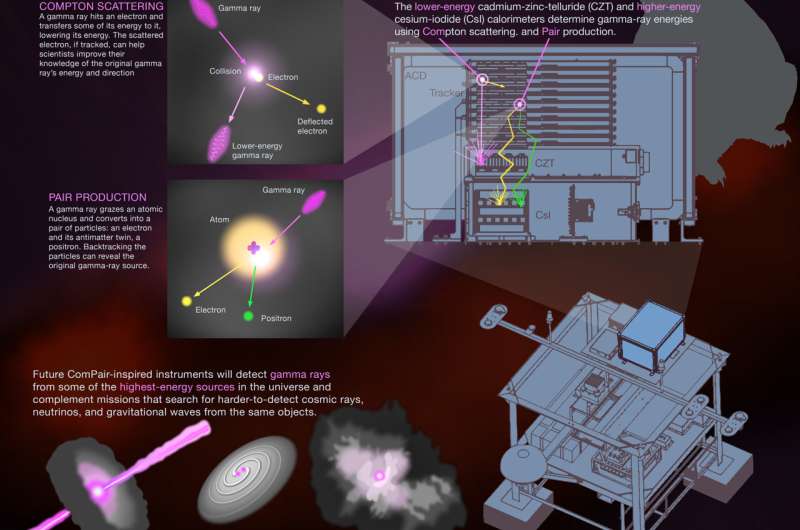
A team in Fort Sumner, New Mexico, is preparing to fly a balloon-borne science instrument called ComPair, which will test new technologies for detecting gamma rays, the highest-energy form of light.
ComPair is slated to fly early in NASA's 2023 fall scientific balloon campaign, which opens on Thursday, Aug. 10, weather permitting.
"Lots of interesting science happens in the energy range that ComPair is designed to study," said Nicholas Kirschner, a graduate student at George Washington University in Washington and NASA's Goddard Space Flight Center in Greenbelt, Maryland, who works on the mission. "These gamma rays are hard to capture with existing methods, so we need to create and test new ones. ComPair's flight gets us one step closer to putting a similar detector in space."
ComPair detects gamma rays with energies between 200,000 and 20 million electron volts. Visible light's energy falls between 2 and 3 electron volts, for comparison.
Supernovae and powerful explosions called gamma-ray bursts shine the brightest in this energy range.
NASA scientific balloons take to the sky in New Mexico
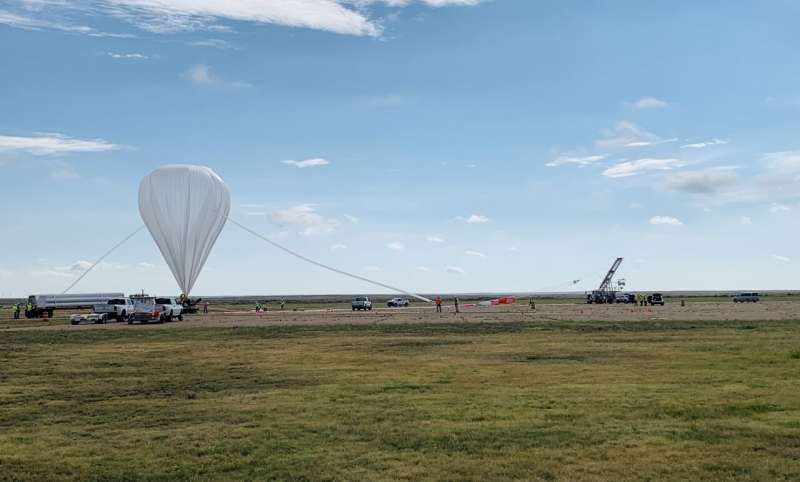
NASA's Scientific Balloon Program will take flight with eight planned launches from the agency's balloon launch facility in Fort Sumner, New Mexico, flying scientific experiments to a near-space environment via a football-stadium-sized NASA balloon.
The 2023 fall balloon campaign window opens August 10 and features 24 payloads led by teams of scientists, engineers, and students.
"Our annual Fort Sumner campaign is always our most ambitious and packed with cutting-edge science developed from teams here in the United States and around the world," said Debbie Fairbrother, Scientific Balloon Program chief at NASA's Wallops Flight Facility in Virginia.
One mission on deck is the Exoplanet Climate Infrared Telescope (EXCITE). The mission features a suborbital astronomical telescope developed to study Jupiter-type exoplanets orbiting other stars.
Dish Network plots two-way fixed broadband services in Ku-band

Dish Network is seeking permission to use 12 GHz spectrum for fixed terrestrial broadband in the United States, three months after regulators denied its plans for mobile services in the band following interference concerns from Starlink and other satellite operators.
DCubed reveals in-space manufacturing demonstration

DCubed, a German startup specializing in deployable satellite structures, plans to conduct an in-space manufacturing demonstration later this year.
The post DCubed reveals in-space manufacturing demonstration appeared first on SpaceNews.
Clogged propellant lines doomed NASA lunar cubesat mission

A NASA lunar cubesat mission failed to go into orbit around the moon earlier this year when debris blocked propellant lines for the spacecraft’s thrusters.
ReOrbit: autonomous and inter-networking satellites for data flow needs in space. What, Why, How

When designing satellites, ReOrbit puts software in the spotlight. What is the rationale behind that approach? Typically, following the initial evolution of technology, you can see a prevailing pattern of […]
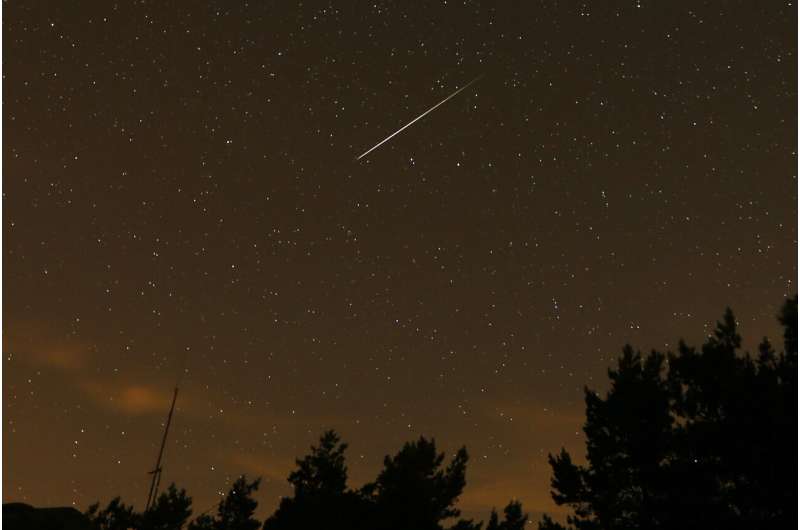
The Perseid meteor shower peaks this weekend and it's even better this year
Video: The universe in a box: Preparing for Euclid's survey
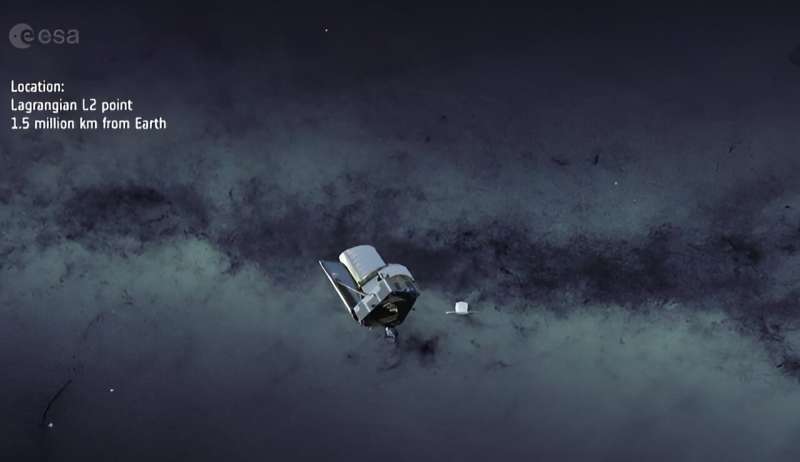
ESA's Euclid mission will create a 3D-map of the universe that scientists will use to measure the properties of dark energy and dark matter and uncover the nature of these mysterious components. The map will contain a vast amount of data, it will cover more than a third of the sky and its third dimension will represent time spanning 10 billion years of cosmic history.
But dealing with the huge and detailed set of novel data that Euclid observations will produce is not an easy task. To prepare for this, scientists in the Euclid Consortium have developed one of the most accurate and comprehensive computer simulations of the large-scale structure of the universe ever produced. They named this the Euclid Flagship simulation.
Running on large banks of advanced processors, computer simulations provide a unique laboratory to model the formation and evolution of large-scale structures in the universe, such as galaxies, galaxy clusters, and the filamentary cosmic web they form. These state-of-the-art computational techniques allow astrophysicists to trace the motion and behavior of an extremely large number of dark-matter particles over cosmological volumes under the influence of their own gravitational pull.
Viasat not ready to declare Viasat-3 Americas a total loss

Viasat is holding off on a contingency plan for ViaSat-3 Americas in the hope it could still get some capacity from the broadband satellite despite its defective antenna, the operator’s chair and CEO Mark Dankberg said Aug.
Japan’s Interstellar aims for orbital launch in 2025

Japanese launch startup Interstellar Technologies is preparing for a static fire test later this year that could pave the way for orbital launch of its Zero rocket in 2025.


