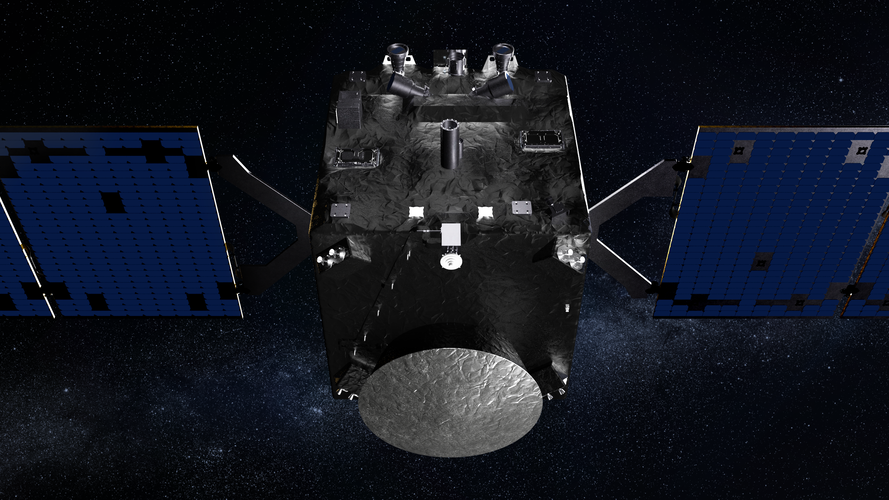
ESA and JAXA meet online to agree future cooperation
ESA Director General Jan Wörner and President of the Japan Aerospace Exploration Agency (JAXA) Dr Hiroshi Yamakawa took part in an online bilateral meeting on 4 February, confirming the status of cooperative activities between the two agencies.
NOAA taps L3Harris for space weather command and control
SAN FRANCISCO – The National Oceanic and Atmospheric Administration awarded a $43.8 million space weather contract to L3 Harris Technologies.
Under the five-year, cost-plus contract, Melbourne, Florida-based L3Harris will develop, deploy and operate a command and control system for NOAA’s Space Weather Follow On-Lagrange 1 observatory, scheduled to launch in 2025 on NASA’s Interstellar Mapping and Acceleration Probe.
Op-ed | The FAA and SpaceX
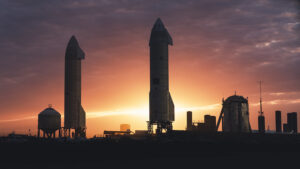
Fifty years ago, Boeing was the gold standard for aviation and aerospace engineering excellence. And the FAA led the world in setting aircraft and airspace safety standards. No longer.
Today, the fate of the SpaceX Starship offers an example of how government oversight agencies can stifle innovation when they are unable to distinguish between innovation and execution and throw roadblocks in front of the single company that has transformed access to space.
Hope prepares to enter orbit around Mars
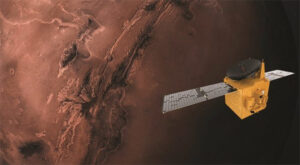
WASHINGTON — As the United Arab Emirates’ Hope spacecraft arrives at Mars, those involved with the mission have a mix of confidence and concern about the chances of successfully entering orbit.
The Emirates Mars Mission, or Hope, spacecraft will arrive at Mars Feb.
Out of this world: Shepard put golf on moon 50 years ago
")
White House to realign responsibilities for space policy oversight
WASHINGTON — The Biden administration is giving the White House National Security Council oversight responsibilities for space policy, giving credence to speculation that the National Space Council will be discontinued.
The White House in a Feb.
China's space probe sends back its first image of Mars
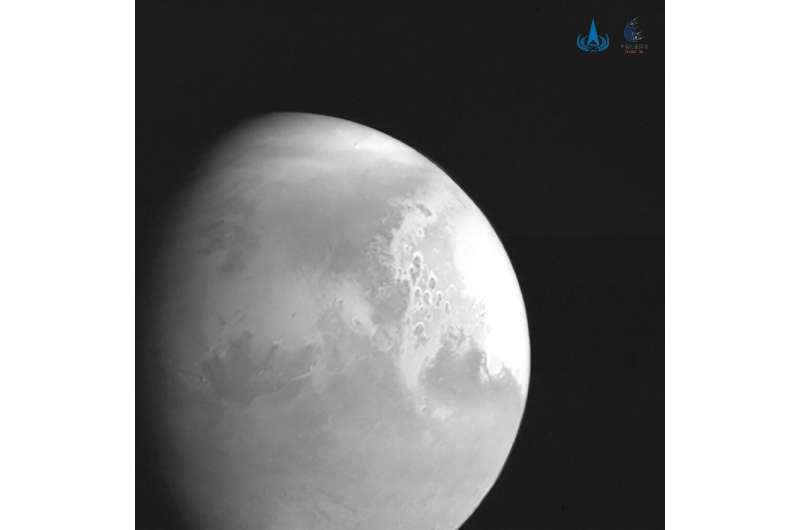
China's Tianwen-1 probe has sent back its first image of Mars, the national space agency said, as the mission prepares to touch down on the Red Planet later this year.
The spacecraft, launched in July around the same time as a rival US mission, is expected to enter Mars orbit around February 10.
The black-and-white photo released late Friday by the China National Space Administration showed geological features including the Schiaparelli crater and the Valles Marineris, a vast stretch of canyons on the Martian surface.
The photo was taken about 2.2 million kilometres (1.4 million miles) from Mars, according to CNSA, which said the spacecraft was now 1.1 million kilometres from the planet.
Harvard astronomer argues that alien vessel paid us a visit

Discovering there's intelligent life beyond our planet could be the most transformative event in human history— but what if scientists decided to collectively ignore evidence suggesting it already happened?
That's the premise of a new book by a top astronomer, who argues that the simplest and best explanation for the highly unusual characteristics of an interstellar object that sped through our solar system in 2017 is that it was alien technology.
Sound kooky? Avi Loeb says the evidence holds otherwise, and is convinced his peers in the scientific community are so consumed by groupthink they're unwilling to wield Occam's razor.
Loeb's stellar credentials—he was the longest-serving chair of astronomy at Harvard, has published hundreds of pioneering papers, and has collaborated with greats like the late Stephen Hawking—make him difficult to dismiss outright.
Tianwen 1 makes orbital correction as Mars arrival draws near
 China's Tianwen 1 Mars probe conducted its fourth orbital correction on Friday evening, as the spacecraft makes ready for its arrival in orbit around Feb 10, according to the China National Space Administration.
The robotic vehicle ignited one of its engines at 8 pm to make an orbital correction and ensure it would be flying in the right direction toward the Martian gravitational field, th
China's Tianwen 1 Mars probe conducted its fourth orbital correction on Friday evening, as the spacecraft makes ready for its arrival in orbit around Feb 10, according to the China National Space Administration.
The robotic vehicle ignited one of its engines at 8 pm to make an orbital correction and ensure it would be flying in the right direction toward the Martian gravitational field, th Best way to get around the Solar System
 There is currently a great interest in going someplace in the Solar System. NASA wants to go to the Moon. Elon Musk wants to go to Mars. Still others just want to go to an asteroid. These destinations require extremely complex systems and mission scenarios.
In order to get to any of these places, the easiest way is to first get into Earth orbit. This first step requires leaving the terrest
There is currently a great interest in going someplace in the Solar System. NASA wants to go to the Moon. Elon Musk wants to go to Mars. Still others just want to go to an asteroid. These destinations require extremely complex systems and mission scenarios.
In order to get to any of these places, the easiest way is to first get into Earth orbit. This first step requires leaving the terrest