

Next-Gen relay ground stations to transform Pacific's Missile-Warning System
 Northrop Grumman Corporation has announced a major step towards upgrading the U.S. Naval Information Warfare Center's (NIWC Pacific) ground station relay in Asia. After a successful preliminary design review (PDR) of the Relay Ground Station-Asia (RGS-A), the company is set to connect both legacy and next-generation satellites with end users, marking an important milestone in the transformation
 Space investment rebounding, but more selectively

After a recent downturn, there are signs of a rebound in space investment, but analysts and investors see a new focus on smaller, more selective rounds.
25 times Copernicus made the headlines

Twenty-five years ago, Copernicus set out to transform the way we see our planet. Now, well established as the largest environmental monitoring programme in the world, it returns a whopping 16 terabytes of high-quality data every single day. To mark a quarter-century of European success in space, we look back at a selection of 25 Copernicus highlights.
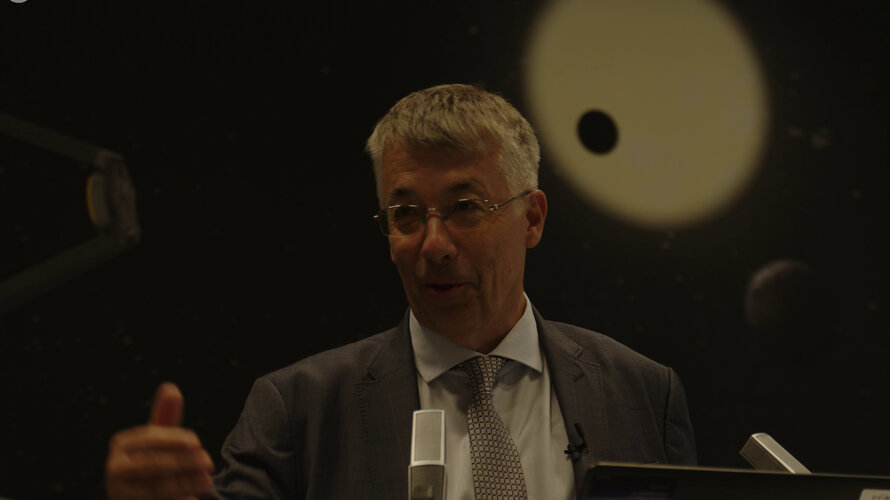
Nicolas Bobrinsky on space safety | ESA Masterclass
 Video:
00:13:21
Video:
00:13:21
Satellites in orbit underpin our modern lives. They are used in many areas and disciplines, including space science, Earth observation, meteorology, climate research, telecommunication, navigation and human space exploration. However, as space activities have increased, a new and unexpected hazard has started to emerge: space debris.
If space debris – uncontrolled human-made objects such as spent upper stages of rockets and pieces of satellites – hits a satellite, it could cause serious damage, which can even end a mission (as has happened in the past). If debris crashes on Earth’s surface, it could potentially hit populated areas.
In this second video, Nicolas looks back on the first key
Chinese commercial rocket firm launches 26 satellites, sets national record

A Chinese commercial launch firm conducted its second orbital mission Wednesday, sending a reported record 26 satellites into orbit.
York Space Systems acquires Emergent Space Technologies

Satellite manufacturer York Space Systems announced June 7 it has acquired Emergent Space Technologies, a small business that develops flight software and engineering tools for space missions.
Parker Solar Probe flies into the fast solar wind and finds its source
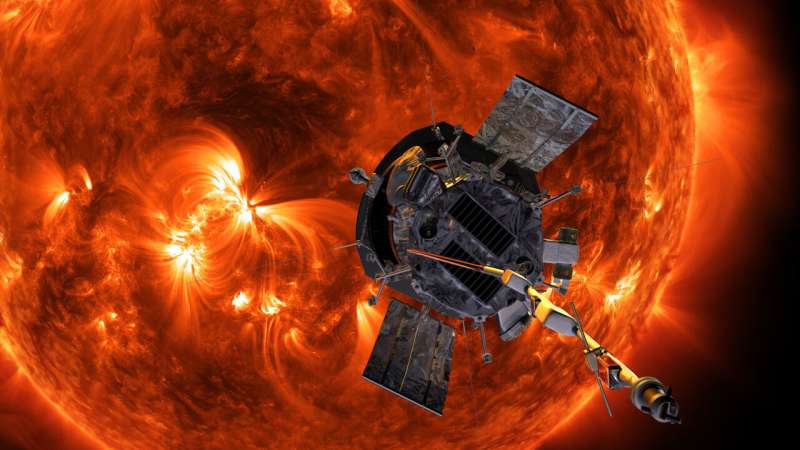
NASA's Parker Solar Probe (PSP) has flown close enough to the sun to detect the fine structure of the solar wind close to where it is generated at the sun's surface, revealing details that are lost as the wind exits the corona as a uniform blast of charged particles.
It's like seeing jets of water emanating from a showerhead through the blast of water hitting you in the face.
In a paper to be published in the journal Nature, a team of scientists led by Stuart D.
First Mars livestream: the movie
 Image:
First Mars livestream: the movie
Image:
First Mars livestream: the movie ESA launches AI project to monitor organic cotton supplies

The European Space Agency has launched a demonstration project to show how artificial intelligence could use satellite data to help certify organic cotton farms in India to prevent fraud.
Airbus develops a system to extract oxygen and metal from lunar regolith
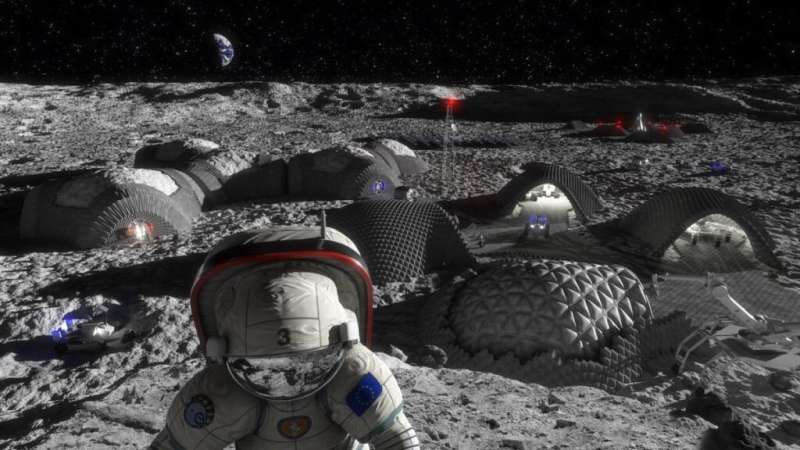
New technologies using material found in space are constantly popping up, sometimes from smaller companies and sometimes from larger ones. Back in 2020, one of the largest companies of them all announced a technology that could have significant implications for the future lunar exploration missions planned over the next ten years. The European aerospace giant Airbus developed the Regolith to OXYgen and Metals Conversion (ROXY) system.
ROXY creates not only oxygen, a resource vital for humans to breathe and also for rocket fuel, but also makes metals that can be used to manufacture tools, equipment, and even structures on the Moon. And it does it simply from the regolith that is present everywhere on the lunar surface.


