

Satellite manufacturer LeoStella focused on defense market as commercial demand softens

LeoStella, a manufacturer of small satellites, is pursuing U.S.
European space giants join forces for IRIS²

Europe’s largest space companies have banded together to bid for a role in the European Union’s proposed multi-orbit connectivity constellation.
Euclid arrives at launch site

ESA’s Euclid spacecraft finished its ocean cruise safe and sound on 30 April at Port Canaveral in Florida. Subsequently, the satellite was moved by road to the Astrotech facility near Cape Canaveral.
TTTech: Secure networking for safety-critical space systems

Ambitious international programs like NASA Artemis are leading the way into the next era of space exploration and human space flight driven by new technologies and commercial partnerships.
ESA astronaut candidates of the class of 2022
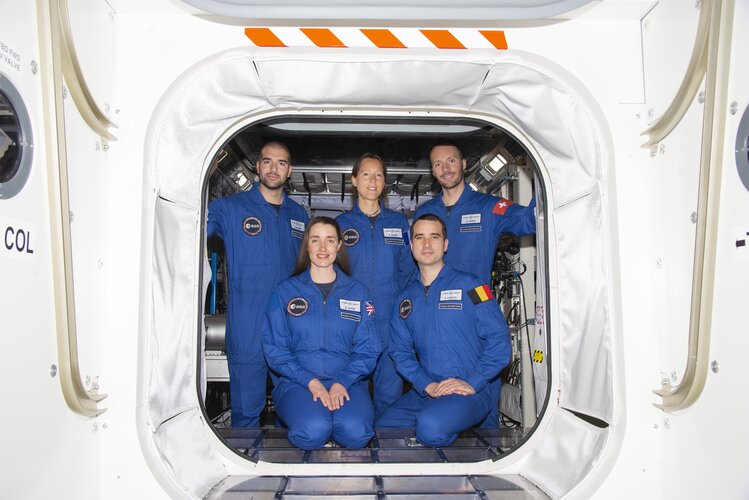 Image:
ESA's astronaut candidates of the class of 2022 at the European Astronaut Centre in Cologne, Germany.
The five candidates are Sophie Adenot, Pablo Álvarez Fernández, Rosemary Coogan, Raphaël Liégeois, and Marco Sieber. The group is part of the 17-member astronaut class of 2022, selected from 22 500 applicants from across ESA Member States.
The astronaut candidates will be trained to the highest level for future space missions. Basic training includes learning about space exploration, technical and scientific disciplines, space systems and operations, as well as spacewalks and survival training.
Can ET detect us
 What would the Earth look like to an alien civilization located light years away? A team of researchers from Mauritius and Manchester University has used crowd-sourced data to simulate radio leakage from mobile towers and predict what an alien civilization might detect from various nearby stars, including Barnard's star, six light years away from Earth. Ramiro Saide, currently an intern at the S
 Ground wide angle camera array detects prompt optical emission of gamma-ray burst
 Researchers led by Dr. XIN Liping from the Space-based Multi-band Astronomical Variable Objects Monitor (SVOM) research team, National Astronomical Observatories of the Chinese Academy of Sciences (NAOC), have detected the prompt optical emission and its transition to the early afterglow of a gamma-ray burst (GRB 201223A), using the Ground Wide Angle Camera Array (GWAC) located at Xinglong Obser
 A stormy, active sun may have kickstarted life on Earth
 The first building blocks of life on Earth may have formed thanks to eruptions from our Sun, a new study finds.
A series of chemical experiments show how solar particles, colliding with gases in Earth's early atmosphere, can form amino acids and carboxylic acids, the basic building blocks of proteins and organic life. The findings were published in the journal Life.
To understand the
The first building blocks of life on Earth may have formed thanks to eruptions from our Sun, a new study finds.
A series of chemical experiments show how solar particles, colliding with gases in Earth's early atmosphere, can form amino acids and carboxylic acids, the basic building blocks of proteins and organic life. The findings were published in the journal Life.
To understand the Examining a Potential Drill Spot: Sols 3817-3818
 Our weekend drive got us into a good position to attempt to examine a block we might attempt to drill. We don't dive right in; we have to make sure this is in fact where we want to drill. This means contact science on "Ubajara," which you can see on the left of the image above. The GEO team spent some time picking a special target name, which involved looking at pictures of national parks. Ubaja
 Sidus Space and Lulav Space team up for navigation and control of lunar spacecraft
 Sidus Space, Inc. (NASDAQ:SIDU), a Space and Defense-as-a-Service satellite company focused on mission-critical hardware manufacturing; multi-disciplinary engineering services; satellite design, production, launch planning, mission operations; and in-orbit support, is pleased to announce it has signed a memorandum of understanding with Lulav Space, an Israeli robotics company specializing in spa


