World's first optical atomic clock with highly charged ions
 Highly charged ions are a common form of matter in the cosmos, where they are found, for example, in the sun or other stars. They are so called because they have lost many electrons and therefore have a high positive charge. This is why the outermost electrons are more strongly bound to the atomic nucleus than in neutral or weakly charged atoms. For this reason, highly charged ions react less st
 NASA fieldwork studies signs of climate change in Arctic boreal regions
 From the window of a NASA Gulfstream III research aircraft, Alaska looks like a pristine wilderness untouched by humans. The land is covered in lush, green vegetation and dotted with bright blue lakes. Snow-capped mountains reach toward the sky, and chocolate milk-colored rivers snake across the landscape. The obvious signs of human activity - cities, roads, infrastructure - are hard to spot.
 Geophysicist Leigh Royden looks at Earth from the top down
 The German Academy of Sciences Leopoldina has counted some of the greatest scientists in history among its ranks. Founded in 1652, and named in honor of the Holy Roman Emperor Leopold I, the scientific organization has included among its members Marie Curie, Albert Einstein, Alexander von Humboldt, and Charles Darwin, to name a few.
But when Department of Earth, Atmospheric and Planetary S
The German Academy of Sciences Leopoldina has counted some of the greatest scientists in history among its ranks. Founded in 1652, and named in honor of the Holy Roman Emperor Leopold I, the scientific organization has included among its members Marie Curie, Albert Einstein, Alexander von Humboldt, and Charles Darwin, to name a few.
But when Department of Earth, Atmospheric and Planetary S Ticket to ride with Boost!
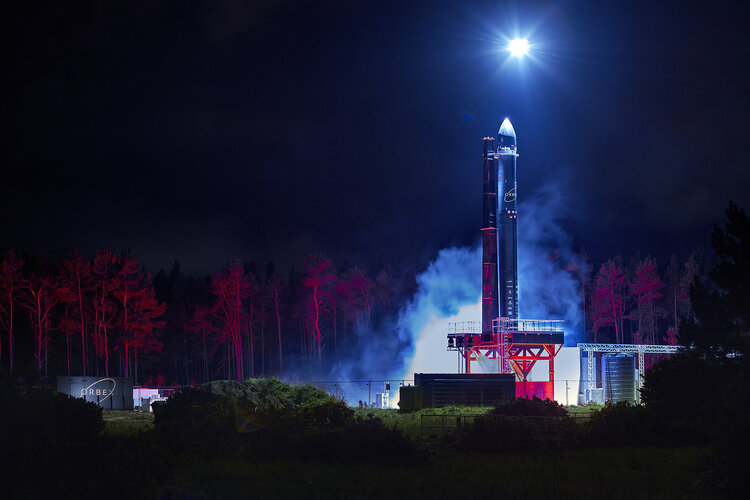
In line with global trends, the European space transportation sector is under transformation – with more and more commercial actors taking the entrepreneurial challenge of proposing, developing and operating new services under private leadership. Acknowledging that a thriving commercial space transportation sector is of benefit to Europe, ESA is actively fostering new European privately-led space transportation services through its
Antares launches Cygnus cargo mission to ISS
A Northrop Grumman Cygnus cargo spacecraft is on its way to the International Space Station after a successful launch Nov. 7 on the next-to-last flight of the current version of the company’s Antares rocket.
Intelsat orders small GEO satellite from 3D printing specialist
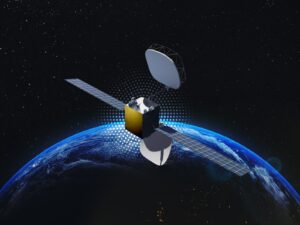
3D printing specialist Swissto12 said Nov. 7 it has sold its first small satellite to Intelsat for a launch to geostationary orbit in 2025.
The post Intelsat orders small GEO satellite from 3D printing specialist appeared first on SpaceNews.
Inmarsat wins $410 million U.S. Army contract to connect tracking devices
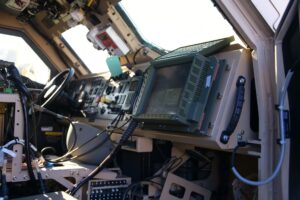
Inmarsat Government won a $410 million, five-year contract extension to provide internet-of-things satellite connectivity for U.S. Army battlefield tracking devices.
The post Inmarsat wins $410 million U.S. Army contract to connect tracking devices appeared first on SpaceNews.
Space Force official: We need the Commerce Department’s space traffic office to be successful

Maj. Gen. DeAnna Burt said discussions between DoD and the Department of Commerce are picking up momentum as both agencies work to figure out how to transition space traffic management to the Office of Space Commerce.
Experiments to study gravity's impact on bone cells are heading to the International Space Station
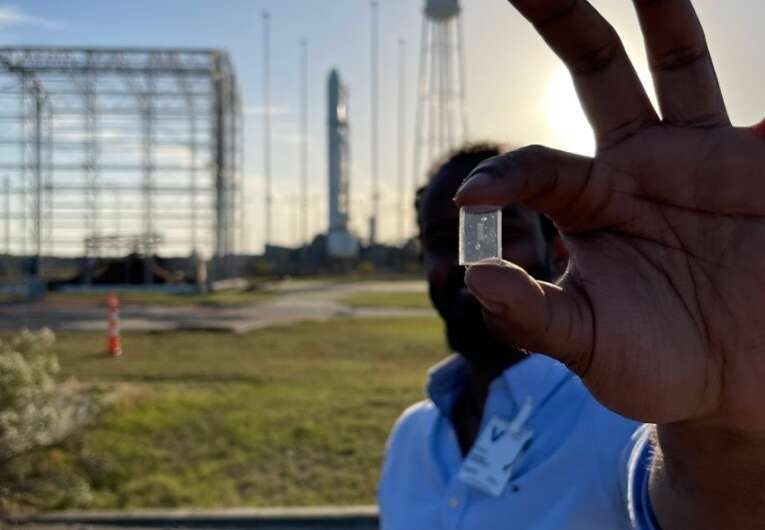
A pair of experiments exploring bone density, designed by engineers at the University of Michigan, has left the Wallops Island, Virginia launchpad aboard a Northrop Grumman Corp. Antares rocket for the International Space Station (ISS).
Allen Liu, U-M associate professor of mechanical engineering, and members of his research team detail how experiments in space can shed light on osteoporosis, a condition affecting hundreds of millions of people around the world—as well as how to keep astronauts safer.
What's the connection between bone density, osteoporosis and gravity that makes this space-based research relevant to regular people?
Zimbabwe launches first nano-satellite
Zimbabwe on Monday announced the launch of its first nano-satellite into space in a bid to help collect data to monitor disasters, boost agriculture and enhance mineral mapping.
A rocket carrying the tiny satellite, dubbed ZIMSAT-1, successfully launched from Virginia in the United States alongside Uganda's first satellite as part of the Japan Aerospace Exploration Agency (JAXA) multi-nation project.
"History unfolding.#ZimSat1 now space bound!" government spokesman Nick Mangwana wrote in a tweet. "This is a scientific milestone for the country."
The US National Aeronautics and Space Administration (NASA) tweeted Monday the rocket "will carry experiments about plant mutations and mudflow structure, as well as satellites from Japan, Uganda & Zimbabwe".
Zimbabwe's plans to launch the satellite started in 2018, less than a year after President Emmerson Mnangagwa came into office following the removal of veteran ruler Robert Mugabe through a military coup.
He created the Zimbabwean National Geospatial and Space Agency (ZINGSA) to promote research and innovation in the embattled southern African nation.
The launch of the satellite—barely the size of a shoebox—sparked much debate on social media with some hailing the government for the achievement while others mocked the effort.
"Launching a satellite when the economy is fragile is stupidity.