Connecting the Countryside

Because most people live in cities and suburbs, broadband and mobile service tend to be good there. But not everyone everywhere has the same opportunities.
The post Connecting the Countryside appeared first on SpaceNews.
SOAR Telescope catches Dimorphos's expanding comet-like tail after DART spacecraft impact

NASA's Double Asteroid Redirection Test (DART) spacecraft intentionally crashed into Dimorphos, the asteroid moonlet in the double-asteroid system of Didymos, on Monday, 26 September 2022. This was the first planetary defense test in which an impact of a spacecraft attempted to modify the orbit of an asteroid.
Two days after DART's impact, astronomers Teddy Kareta (Lowell Observatory) and Matthew Knight (US Naval Academy) used the 4.1-meter Southern Astrophysical Research (SOAR) Telescope at NSF's NOIRLab's Cerro Tololo Inter-American Observatory in Chile to capture the vast plume of dust and debris blasted from the asteroid's surface. In this new image, the dust trail—the ejecta that has been pushed away by the sun's radiation pressure, not unlike the tail of a comet—can be seen stretching from the center to the right-hand edge of the field of view, which at SOAR is about 3.1 arcminutes using the Goodman High Throughput Spectrograph. At Didymos's distance from Earth at the time of the observation, that would equate to at least 10,000 kilometers (6,000 miles) from the point of impact.
How does NASA plan to keep samples from Mars safe from contamination (and contaminating Earth)?
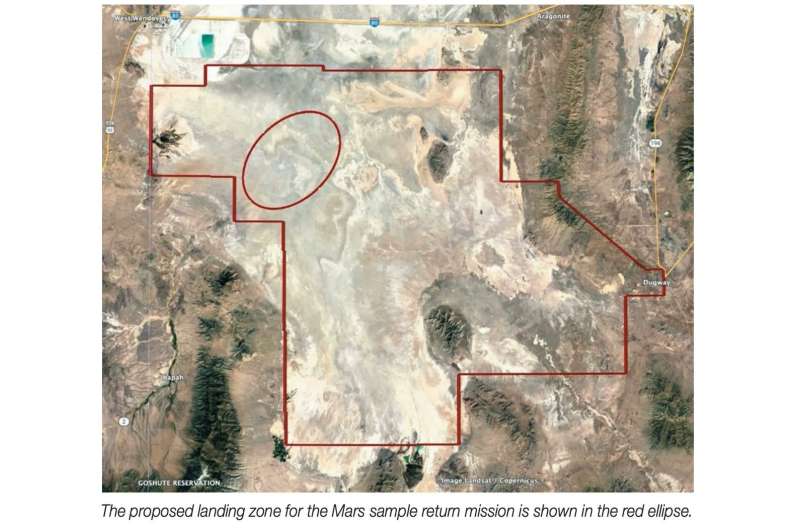
NASA's Mars Sample Return Mission is inching closer and closer. The overall mission architecture just hit a new milestone when Perseverance collected the first sample that will be sent back. But what happens once that sample actually gets here? NASA and its partner, ESA, are still working on that, but recently they released a fact sheet that covers what will happen during the first stage of that process—returning to the ground.
That return will take place in the middle of the desert in the western U.S., in an area called the Utah Test and Training Range (UTTR). While this may seem like an obscure place to land such an important mission, it does have several things going for it.
Studying yeast DNA in space may help protect astronauts from cosmic radiation

Nuclear fusion reactions in the sun are the source of heat and light we receive on Earth. These reactions release a massive amount of cosmic radiation—including X-rays and gamma rays—and charged particles that can be harmful for any living organisms.
Life on Earth has been protected thanks to a magnetic field that forces charged particles to bounce from pole to pole as well as an atmosphere that filters harmful radiation.
During space travel, however, it is a different situation. To find out what happens in a cell when traveling in outer space, scientists are sending baker's yeast to the moon as part of NASA's Artemis 1 mission.
Cosmic damage
Cosmic radiation can damage cell DNA, significantly increasing human risk of neurodegenerative disorders and fatal diseases, like cancer.
SpaceX to upgrade Cape Canaveral pad for crew and cargo missions
As SpaceX prepares to launch a new crew to the International Space Station from one pad at the Kennedy Space Center, it is starting work to upgrade another pad at Cape Canaveral as a backup.
Redwire back on acquisition trail with deal for QinetiQ Space
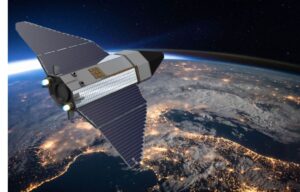
British defense firm Qinetiq is selling its Belgian commercial satellite systems division to Redwire, a U.S.-based consolidator of space infrastructure.
The post Redwire back on acquisition trail with deal for QinetiQ Space appeared first on SpaceNews.
EnerStar Solutions announces third Starlink enterprise reseller deal

Canada-based EnerStar Solutions, a rental company for the energy sector, said Oct. 3 it has reached a deal to add SpaceX’s Starlink broadband to the services it provides industrial workers.
The post EnerStar Solutions announces third Starlink enterprise reseller deal appeared first on SpaceNews.
BeetleSat announces next steps for world's first LEO satellite network with expandable antennas
 BeetleSat, a global provider of telecommunications and satellite technology, unveiled the next phases of development for its much-anticipated LEO broadband satellite constellation. The announcement was made at the 25th edition of the World Satellite Business Week, the leading conference for the satellite industry, which this year brought together the biggest names in the industry and over 1,500
 Russia space agency seeking to extend ISS participation past 2024: official
 Russia's space agency is discussing with Moscow a continuation of its participation in the International Space Station past 2024, a Roscosmos official said Monday.
Sergei Krikalev, head of Russia's human space flight programs, told reporters that Roscosmos had started "to discuss extending our participation in ISS program with our government and hope to have permission to continue next year.
Russia's space agency is discussing with Moscow a continuation of its participation in the International Space Station past 2024, a Roscosmos official said Monday.
Sergei Krikalev, head of Russia's human space flight programs, told reporters that Roscosmos had started "to discuss extending our participation in ISS program with our government and hope to have permission to continue next year. India loses contact with budget Mars orbiter after eight years
 India has lost contact with its Mars orbiter, eight years after the low-cost probe made it the first Asian nation with a spacecraft circling the red planet, its space agency said.
Although "designed for a life-span of six months as a technology demonstrator, the Mars Orbiter Mission has lived for about eight years in the Martian orbit with a gamut of significant scientific results", the Indi
India has lost contact with its Mars orbiter, eight years after the low-cost probe made it the first Asian nation with a spacecraft circling the red planet, its space agency said.
Although "designed for a life-span of six months as a technology demonstrator, the Mars Orbiter Mission has lived for about eight years in the Martian orbit with a gamut of significant scientific results", the Indi