

Greece battles wildfires on Lesbos island
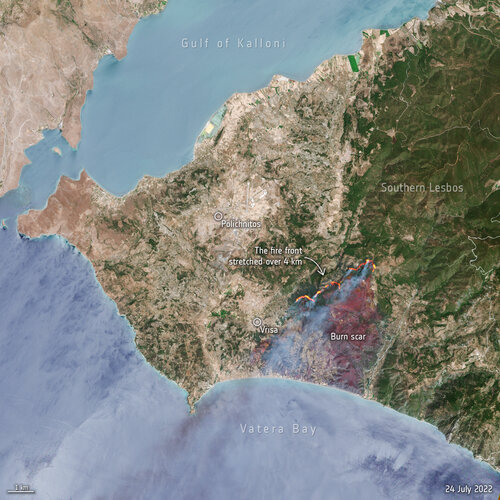 Image:
Hundreds of residents and tourists have been evacuated from the Greek island of Lesbos after a wildfire broke out on the morning of 23 July. This image, captured by Sentinel-2, shows the active fire front which stretches for more than four km.
Image:
Hundreds of residents and tourists have been evacuated from the Greek island of Lesbos after a wildfire broke out on the morning of 23 July. This image, captured by Sentinel-2, shows the active fire front which stretches for more than four km. Eutelsat and OneWeb discussing multi-orbit merger plan

Eutelsat said July 25 it is in talks to merge with OneWeb to create a global multi-orbit satellite broadband operator.
The post Eutelsat and OneWeb discussing multi-orbit merger plan appeared first on SpaceNews.
Explosive volcanic eruption produced rare mineral on Mars
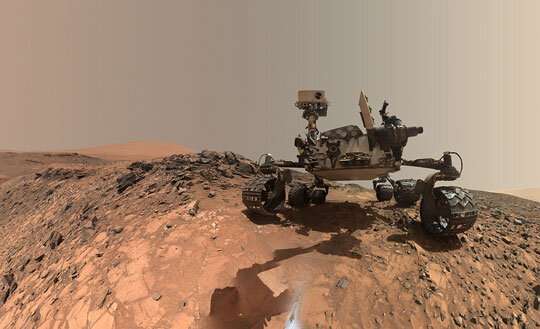
Planetary scientists from Rice University, NASA's Johnson Space Center and the California Institute of Technology have an answer to a mystery that's puzzled the Mars research community since NASA's Curiosity rover discovered a mineral called tridymite in Gale Crater in 2016.
Tridymite is a high-temperature, low-pressure form of quartz that is extremely rare on Earth, and it wasn't immediately clear how a concentrated chunk of it ended up in the crater. Gale Crater was chosen as Curiosity's landing site due to the likelihood that it once held liquid water, and Curiosity found evidence that confirmed Gale Crater was a lake as recently as 1 billion years ago.
NASA wants your help designing a starshade to observe exoplanets
The field of exoplanet study has come a long way in recent decades. To date, 5,063 exoplanets have been confirmed in 3,794 systems beyond our own, with another 8,819 candidates awaiting confirmation. In the coming years, tens of thousands of more planets are expected to be found, thanks to next-generation observatories. The ultimate goal in this search is to find planets that are "Earth-like," meaning they have a good chance of supporting life. This is no easy task, as rocky planets located within their parent star's habitable zones (HZs) tend to orbit closely, making them harder to see.
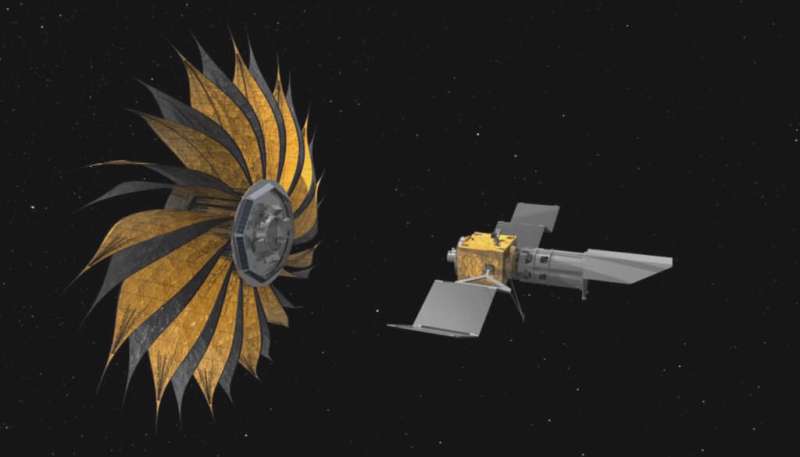
To make this process easier, NASA is designing a hybrid observatory consisting of a "Starshade" that will block out a star's light so that a ground-based telescope can directly image planets orbiting it.
DoD signaling demand for satellite support services in geostationary orbit

The Defense Innovation Unit is funding space projects that the agency hopes will spur commercial investments in satellite refueling technologies and support services for geostationary satellites.
The post DoD signaling demand for satellite support services in geostationary orbit appeared first on SpaceNews.
HawkEye 360 opens satellite manufacturing facility in Virginia

HawkEye 360 has opened a new manufacturing facility near its northern Virginia headquarters that will help the company accelerate the deployment of its constellation of radio-frequency (RF) monitoring satellites.
The post HawkEye 360 opens satellite manufacturing facility in Virginia appeared first on SpaceNews.
Eutelsat and OneWeb agree multi-orbit merger plan
Eutelsat and OneWeb said July 26 they have agreed a plan to merge their businesses to create a global multi-orbit satellite broadband operator.
The post Eutelsat and OneWeb agree multi-orbit merger plan appeared first on SpaceNews.
ESA showcases its space ambition at Farnborough airshow

ESA’s efforts to ensure European citizens reap the benefits of space have been highlighted at a global aerospace event held in the UK.
Russia to quit International Space Station 'after 2024'
 Russia has decided to quit the International Space Station "after 2024", the newly-appointed chief of Moscow's space agency told President Vladimir Putin on Tuesday.
"Of course, we will fulfil all our obligations to our partners, but the decision to leave this station after 2024 has been made," Roscosmos chief Yury Borisov told Putin in comments released by the Kremlin.
Russia has decided to quit the International Space Station "after 2024", the newly-appointed chief of Moscow's space agency told President Vladimir Putin on Tuesday.
"Of course, we will fulfil all our obligations to our partners, but the decision to leave this station after 2024 has been made," Roscosmos chief Yury Borisov told Putin in comments released by the Kremlin. Preparing for the World's biggest radio telescope
 An international team of researchers has demonstrated that the Square Kilometre Array Observatory (SKAO) is capable of detecting radio emissions from normal spiral galaxies in the early universe. The SKAO, whose construction began this year, will soon be the largest radio telescope in the world. The astronomers, who are part of the SKAO's "Extragalactic Continuum" working group, are looking for


