
Monday, 30 May 2022 15:40
Lawmakers seek another big increase for DoD ‘responsive launch’
A bipartisan group of House members is proposing to increase funding for tactically responsive launch to $150 million in 2023
The post Lawmakers seek another big increase for DoD ‘responsive launch’ appeared first on SpaceNews.
Published in
News
Monday, 30 May 2022 21:26
Ingenuity “hunkering down” during Martian dust storms and winter
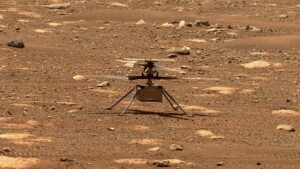
Dust storms and changing seasons will limit the ability of NASA’s Ingenuity helicopter to fly for the next several months, a project engineer said May 27.
The post Ingenuity “hunkering down” during Martian dust storms and winter appeared first on SpaceNews.
Published in
News
Tuesday, 31 May 2022 09:34
Astrocast acquires Hiber, accelerates OEM strategy.
Lausanne, Switzerland (SPX) May 31, 2022
 Astrocast, a leading global nanosatellite IoT network operator, has announced the signature of an agreement to acquire Hiber, a Netherlands-based, IoT-as-a-Service provider. Under the agreement, Astrocast agreed to acquire all of Hiber's shares in exchange for the issuance of new Astrocast shares, representing 16.5% of Astrocast's share capital, calculated prior to its previously announced publi
Astrocast, a leading global nanosatellite IoT network operator, has announced the signature of an agreement to acquire Hiber, a Netherlands-based, IoT-as-a-Service provider. Under the agreement, Astrocast agreed to acquire all of Hiber's shares in exchange for the issuance of new Astrocast shares, representing 16.5% of Astrocast's share capital, calculated prior to its previously announced publi
Published in
News
Tuesday, 31 May 2022 09:34
Omnispace Spark-2 satellite launched into orbit
Tysons VA (SPX) May 31, 2022
 Omnispace and Thales Alenia Space, a joint venture between Thales (67%) and Leonardo (33%), reports a successful launch and delivery of "Omnispace Spark-2" satellite into orbit. This marks the completion of the deployment phase of the "Omnispace Spark" program, the initial phase in the company's development and delivery of the world's first 5G capable satellite network.
Omnispace Spark-1,
Omnispace and Thales Alenia Space, a joint venture between Thales (67%) and Leonardo (33%), reports a successful launch and delivery of "Omnispace Spark-2" satellite into orbit. This marks the completion of the deployment phase of the "Omnispace Spark" program, the initial phase in the company's development and delivery of the world's first 5G capable satellite network.
Omnispace Spark-1,
Omnispace and Thales Alenia Space, a joint venture between Thales (67%) and Leonardo (33%), reports a successful launch and delivery of "Omnispace Spark-2" satellite into orbit. This marks the completion of the deployment phase of the "Omnispace Spark" program, the initial phase in the company's development and delivery of the world's first 5G capable satellite network.
Omnispace Spark-1,
Published in
News
Tuesday, 31 May 2022 09:34
Axiom Space signs MOU with Italy to expand commercial utilization of space
Houston TX (SPX) May 31, 2022
 Axiom Space, a leader in human spaceflight currently building the world's first commercial space station, has signed a memorandum of understanding (MOU) with the Italian government to further their existing collaboration, including the potential for the development of space infrastructure integrated with the future Axiom Station. The agreement was signed by the President and CEO of Axiom Space,
Axiom Space, a leader in human spaceflight currently building the world's first commercial space station, has signed a memorandum of understanding (MOU) with the Italian government to further their existing collaboration, including the potential for the development of space infrastructure integrated with the future Axiom Station. The agreement was signed by the President and CEO of Axiom Space,
Published in
News
Tuesday, 31 May 2022 09:34
ILC Dover becomes a provider of spacesuits for Boeing's Starliner
Newark DE (SPX) May 31, 2022
 ILC Dover, the leading provider of spacesuits since the Apollo era, has announced that it was selected to be one of two providers of Boeing's Ascent/Entry Suit (AES) for the company's Commercial Crew Program and has developed a bespoke AES spacesuit for CST-100 Starliner crews.
"We are proud to utilize our expertise to create a new AES for the Starliner spacecraft," said Patty Stoll, Presi
ILC Dover, the leading provider of spacesuits since the Apollo era, has announced that it was selected to be one of two providers of Boeing's Ascent/Entry Suit (AES) for the company's Commercial Crew Program and has developed a bespoke AES spacesuit for CST-100 Starliner crews.
"We are proud to utilize our expertise to create a new AES for the Starliner spacecraft," said Patty Stoll, Presi
ILC Dover, the leading provider of spacesuits since the Apollo era, has announced that it was selected to be one of two providers of Boeing's Ascent/Entry Suit (AES) for the company's Commercial Crew Program and has developed a bespoke AES spacesuit for CST-100 Starliner crews.
"We are proud to utilize our expertise to create a new AES for the Starliner spacecraft," said Patty Stoll, Presi
Published in
News
Tuesday, 31 May 2022 09:34
Southern Launch receives further Government funding
Adelaide, Australia (SPX) May 31, 2022
 Australian spaceport and space mission provider, Southern Launch, has been awarded an Australian Space Agency Moon to Mars Grant for their mobile launch rail.
The almost $1 million grant will enable Southern Launch to design, construct, and commission a mobile launch rail that will be capable of launching sub-orbital vehicles ranging in mass from 20kg to 3,500kg. The mobility of the rocket
Australian spaceport and space mission provider, Southern Launch, has been awarded an Australian Space Agency Moon to Mars Grant for their mobile launch rail.
The almost $1 million grant will enable Southern Launch to design, construct, and commission a mobile launch rail that will be capable of launching sub-orbital vehicles ranging in mass from 20kg to 3,500kg. The mobility of the rocket
Australian spaceport and space mission provider, Southern Launch, has been awarded an Australian Space Agency Moon to Mars Grant for their mobile launch rail.
The almost $1 million grant will enable Southern Launch to design, construct, and commission a mobile launch rail that will be capable of launching sub-orbital vehicles ranging in mass from 20kg to 3,500kg. The mobility of the rocket
Published in
News
Tuesday, 31 May 2022 09:34
Bern flies to Jupiter
Bern, Switzerland (SPX) May 31, 2022
 In spring 2023, the time will have come: The JUICE (JUpiter ICy moons Explorer) space probe of the European Space Agency ESA will begin its journey into space. The Jupiter system is almost 780 million kilometers away from the sun and an icy, dark world: The average temperature on the surface of the icy moons is below minus 140 degrees Celsius.
After an almost eight-year journey, JUICE will
In spring 2023, the time will have come: The JUICE (JUpiter ICy moons Explorer) space probe of the European Space Agency ESA will begin its journey into space. The Jupiter system is almost 780 million kilometers away from the sun and an icy, dark world: The average temperature on the surface of the icy moons is below minus 140 degrees Celsius.
After an almost eight-year journey, JUICE will
In spring 2023, the time will have come: The JUICE (JUpiter ICy moons Explorer) space probe of the European Space Agency ESA will begin its journey into space. The Jupiter system is almost 780 million kilometers away from the sun and an icy, dark world: The average temperature on the surface of the icy moons is below minus 140 degrees Celsius.
After an almost eight-year journey, JUICE will
Published in
News
Tuesday, 31 May 2022 09:34
Solar Wind a Major Driver of Atmospheric Sodium at Mercury
Washington DC (SPX) May 31, 2022
 No object in the solar system experiences the Sun's solar wind more powerfully than Mercury. The planet's magnetic field deflects the Sun's stream of electrically charged particles at a distance of only 1,000 kilometers from Mercury's surface, a point called the magnetopause.
The Sun's magnetic field lines are carried by the solar wind and bend as they collide with those of Mercury. When c
No object in the solar system experiences the Sun's solar wind more powerfully than Mercury. The planet's magnetic field deflects the Sun's stream of electrically charged particles at a distance of only 1,000 kilometers from Mercury's surface, a point called the magnetopause.
The Sun's magnetic field lines are carried by the solar wind and bend as they collide with those of Mercury. When c
No object in the solar system experiences the Sun's solar wind more powerfully than Mercury. The planet's magnetic field deflects the Sun's stream of electrically charged particles at a distance of only 1,000 kilometers from Mercury's surface, a point called the magnetopause.
The Sun's magnetic field lines are carried by the solar wind and bend as they collide with those of Mercury. When c
Published in
News
Tuesday, 31 May 2022 09:34
Artificial Intelligence helps in the identification of astronomical objects
Lisbon, Portugal (SPX) May 31, 2022
 Classifying celestial objects is a long standing problem. With sources at near unimaginable distances, sometimes it's difficult for researchers to distinguish, for example, between stars, galaxies, quasars1 or supernovae2.
Instituto de Astrofisica e Ciencias do Espaco's (IA3) researchers Pedro Cunha and Andrew Humphrey tried to solve this classical problem by creating SHEEP, a machine lear
Classifying celestial objects is a long standing problem. With sources at near unimaginable distances, sometimes it's difficult for researchers to distinguish, for example, between stars, galaxies, quasars1 or supernovae2.
Instituto de Astrofisica e Ciencias do Espaco's (IA3) researchers Pedro Cunha and Andrew Humphrey tried to solve this classical problem by creating SHEEP, a machine lear
Classifying celestial objects is a long standing problem. With sources at near unimaginable distances, sometimes it's difficult for researchers to distinguish, for example, between stars, galaxies, quasars1 or supernovae2.
Instituto de Astrofisica e Ciencias do Espaco's (IA3) researchers Pedro Cunha and Andrew Humphrey tried to solve this classical problem by creating SHEEP, a machine lear
Published in
News