

Rogozin delays decision on space station future

After Western nations refused his demand to end sanctions on Russian companies involved in the International Space Station, the head of Roscosmos said he will make recommendations in the “near future” on Russia’s continued participation in the station, but there are no signs of any near-term changes in station operations.
Telesat gets security clearance to serve US government directly

Canada’s Telesat said April 4 it has gained the security clearances it needs to sell directly to U.S. government customers.
The post Telesat gets security clearance to serve US government directly appeared first on SpaceNews.
The space arms race keeps accelerating, new reports warn

As space becomes increasingly important to terrestrial activities, the tools and weapons available to disrupt and damage satellites are proliferating around the world, according to two reports released April 4.
The post The space arms race keeps accelerating, new reports warn appeared first on SpaceNews.
Space experiment to push standardization in small satellites
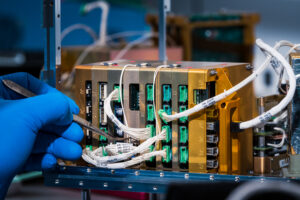
An experiment scheduled to launch this fall on Virgin Orbit’s LauncherOne rocket will try to show a faster and cheaper way for the space industry to test technologies on orbit.
The post Space experiment to push standardization in small satellites appeared first on SpaceNews.
Telesat adjusts polar satellite design to tackle supply issues
Telesat has upgraded a quarter of its planned low Earth orbit constellation as supply chain issues force it to consider ordering fewer satellites for the delayed broadband network.
The post Telesat adjusts polar satellite design to tackle supply issues appeared first on SpaceNews.
Op-ed | Assembling America’s Future in Space

From satellite refueling, to recycling of orbital debris, to increasing capability delivered on order through robotic manufacturing and assembly in space, in-space servicing, assembly, and manufacturing will transform space architectures and provide strategic and commercial advantages to those who lead in its development and implementation.
Download the free April issue of SpaceNews magazine

Download the free April issue of SpaceNews magazine
The post Download the free April issue of SpaceNews magazine appeared first on SpaceNews.
Lockheed Martin releases open-source satellite interface for on-orbit docking

Lockheed Martin on April 4 released the technical specifications of a docking adapter that could be used by manufacturers to make satellites interoperable and easier to update on orbit with new technology.
Space debris found in rural India likely from 'China rocket'
A large metal ring and sphere that villagers in rural western India said fell from the sky over the weekend could be from a Chinese rocket launched into space last year, officials told local media.
The metal ring—reportedly two to three metres (6.5-10 feet) in diameter and weighing over 40 kilogrammes (90 pounds)—was discovered in a village field in Maharashtra state late on Saturday, district collector Ajay Gulhane told the Press Trust of India.
"We were preparing a community feast, when the sky blazed with the red disc which fell with a bang on an open plot in the village," an unnamed woman in Maharashtra's Chandrapur district told The Times of India.
"People ran to their home fearing (an) explosion and remained inside for nearly half an hour."
Another object—a large, metal ball around half a metre (1.5 feet) in diameter—fell in another village in the district, Gulhane told PTI.
"It has been collected for examination. We had sent (junior officials) to every village in the district to find if more parts of objects, if any, are lying scattered."
There were no reports of injuries or structural damage.
An Indian Space Research Organisation (ISRO) official told the Times that the timing of the objects' arrival was the "closest match" to the re-entry times on Saturday for debris from a Chinese rocket launched in February 2021.
Webb Telescope completes first multi-instrument alignment
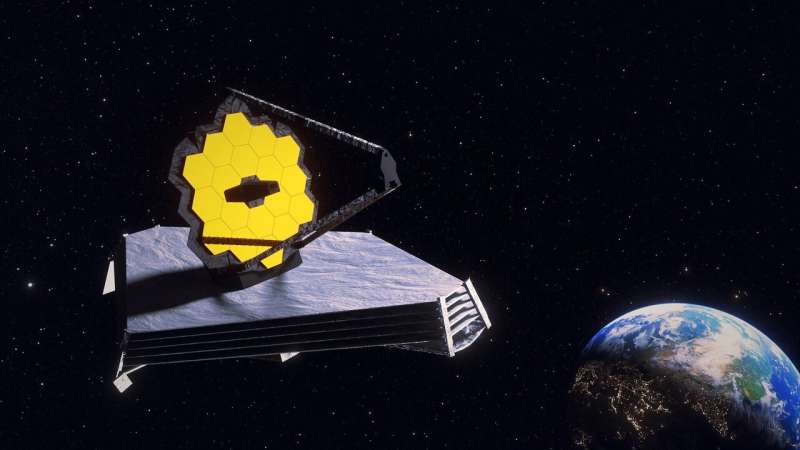
The sixth stage of aligning NASA's James Webb Space Telescope's mirrors to its scientific instruments so they will create the most accurate and focused images possible has concluded. While the Mid-Infrared Instrument (MIRI) continues its cooldown, optics teams have successfully aligned the rest of the observatory's onboard instruments to Webb's mirrors. Previous alignment efforts were so accurate that the team concluded no additional adjustments to the secondary mirror are necessary until the seventh and final stage, which will involve MIRI when it has fully cooled.
"As a general rule, the commissioning process starts with coarse corrections and then moves into fine corrections. The early secondary mirror coarse corrections, however, were so successful that the fine corrections in the first iteration of Phase Six were unnecessary," said Chanda Walker, Webb wavefront sensing and control scientist, Ball Aerospace. "This accomplishment was due to many years of planning and great teamwork among the wavefront sensing team."
Throughout the majority of the alignment process, Webb's 18 hexagonal mirrors and secondary mirror were focused into alignment to the Near-Infrared Camera (NIRCam) instrument only.


