

Thousands of new astronomical images highlighted in latest release of AAS WorldWide Telescope
 The American Astronomical Society (AAS) has launched WWT 2022, the latest version of AAS WorldWide Telescope (WWT), revealing new data and capabilities and providing an even more powerful astronomy visualization toolkit for astronomers, educators, and enthusiasts alike.
WWT isn't a physical telescope, but rather a suite of free and open-source software that integrates data and images from
The American Astronomical Society (AAS) has launched WWT 2022, the latest version of AAS WorldWide Telescope (WWT), revealing new data and capabilities and providing an even more powerful astronomy visualization toolkit for astronomers, educators, and enthusiasts alike.
WWT isn't a physical telescope, but rather a suite of free and open-source software that integrates data and images from UK candidates make it through to next round of European Space Agency's astronaut call
 The window to apply for ESA's astronaut vacancy opened on 31 March 2021 and closed 18 June. This is the first call for new astronauts in over 10 years and the first-time candidates with a physical disability had been invited to apply.
Of the 22,523 valid astronaut applications received by ESA, 2,000 of these were from the UK.
Following a comprehensive screening phase, 1,361 people we
The window to apply for ESA's astronaut vacancy opened on 31 March 2021 and closed 18 June. This is the first call for new astronauts in over 10 years and the first-time candidates with a physical disability had been invited to apply.
Of the 22,523 valid astronaut applications received by ESA, 2,000 of these were from the UK.
Following a comprehensive screening phase, 1,361 people we China's moon sample updates lunar chronology model
 Researchers led by Prof. YUE Zongyu and Prof. DI Kaichang from the Aerospace Information Research Institute (AIR) of the Chinese Academy of Sciences (CAS) and their collaborators have established an updated lunar chronology model that provides a more accurate timescale not just for lunar history but also for the evolution of planetary bodies in the inner solar system.
The research is based
Researchers led by Prof. YUE Zongyu and Prof. DI Kaichang from the Aerospace Information Research Institute (AIR) of the Chinese Academy of Sciences (CAS) and their collaborators have established an updated lunar chronology model that provides a more accurate timescale not just for lunar history but also for the evolution of planetary bodies in the inner solar system.
The research is based Final moments of planetary remnants seen for first time
 The moment that debris from destroyed planets impacts the surface of a white dwarf star has been observed for the first time by astronomers at the University of Warwick.
They have used X-rays to detect the rocky and gaseous material left behind by a planetary system after its host star dies as it collides and is consumed within the surface of the star.
Published in the journal Nature
The moment that debris from destroyed planets impacts the surface of a white dwarf star has been observed for the first time by astronomers at the University of Warwick.
They have used X-rays to detect the rocky and gaseous material left behind by a planetary system after its host star dies as it collides and is consumed within the surface of the star.
Published in the journal Nature From matter to antimatter, to and fro - trillions of times a second
 We think of matter and antimatter as being as opposite as fire and water. There are, however, particles that can behave as representatives once of the world of matter, once the world of antimatter. An international group of scientists working on experiments at the LHCb detector have reported their measurement of the extreme speed of oscillation of these sorts of particles between the two worlds.
 Surprisingly high fraction of dead galaxies found in ancient galactic city
 An international team of astronomers led by researchers at the University of California, Riverside, has discovered an unusual massive cluster of young galaxies forming in the early universe. The newly discovered growing galactic metropolis, named MAGAZ3NE J095924+022537, is a newborn galaxy cluster, or protocluster, consisting of at least 38 member galaxies, and is about 11.8 billion light-years
 Webb sees its first star - 18 times
 The James Webb Space Telescope is nearing completion of the first phase of the months-long process of aligning the observatory's primary mirror using the Near Infrared Camera (NIRCam) instrument.
The team's challenge was twofold: confirm that NIRCam was ready to collect light from celestial objects, and then identify starlight from the same star in each of the 18 primary mirror segments. T
The James Webb Space Telescope is nearing completion of the first phase of the months-long process of aligning the observatory's primary mirror using the Near Infrared Camera (NIRCam) instrument.
The team's challenge was twofold: confirm that NIRCam was ready to collect light from celestial objects, and then identify starlight from the same star in each of the 18 primary mirror segments. T Space Force to examine U.S. military needs for low-orbiting surveillance satellites
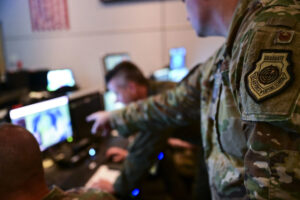
Air Force Secretary Frank Kendall has directed the Space Force to look broadly at military requirements for overhead surveillance that could be met by commercial constellations of satellites in low Earth orbit.
The post Space Force to examine U.S.
European Union advances broadband constellation despite negative assessments

The European Union is moving ahead with its proposed broadband constellation despite two negative internal assessments.
The post European Union advances broadband constellation despite negative assessments appeared first on SpaceNews.
How well does concrete work in space?
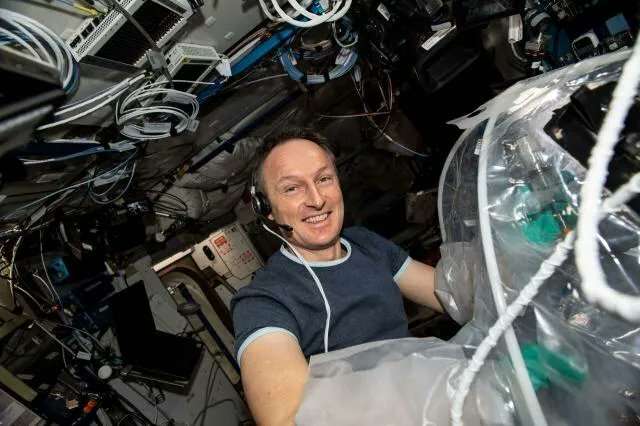
Concrete is not the first material one usually thinks of when exploring space. Nor is it the focus of much cutting-edge research. The most common building material has been used by humanity for thousands of years. But surprisingly, little is still known about some of its properties, due in no small part to the limitations of the environments it can be tested in. Now, this most ubiquitous of materials will be tested in a new environment—the microgravity aboard the International Space Station.
The experiment, part of the "Cosmic Kiss" mission, will have German astronaut Matthias Maurer hand-mixing concrete in microgravity using a specially designed mixer no larger than the size of his hand and a giant inflatable bag. That obviously will not lead to much concrete, but its properties will be particularly telling to scientists.


