
Supporting life beyond earth could be possible - thanks to graphene innovation
 Advanced manufacturing experts from Manchester have revealed what human life in space could look like - with a graphene-enhanced space habitat developed to meet anticipated demand for human settlements beyond Earth.
A community of specialists at The University of Manchester have teamed up with global architect firm Skidmore, Owings and Merrill (SOM) to research the design and manufacturing
Advanced manufacturing experts from Manchester have revealed what human life in space could look like - with a graphene-enhanced space habitat developed to meet anticipated demand for human settlements beyond Earth.
A community of specialists at The University of Manchester have teamed up with global architect firm Skidmore, Owings and Merrill (SOM) to research the design and manufacturing Rocky Exoplanets Are Even Stranger Than We Thought
 Astronomers have discovered thousands of planets orbiting stars in our galaxy - known as exoplanets. However, it's difficult to know what exactly these planets are made of, or whether any resemble Earth. To try to find out, astronomer Siyi Xu of NSF's NOIRLab partnered with geologist Keith Putirka of California State University, Fresno, to study the atmospheres of what are known as polluted whit
 The Road to Launch and Beyond for NASA's James Webb Space Telescope
 Now that NASA's James Webb Space Telescope has safely arrived at its launch site in French Guiana, on the northeastern coast of South America, technical teams have begun making progress on the final checklist of preparations before liftoff later this year.
These preparations are expected to last 55 days from the observatory's arrival by ship to the day of launch.
After Webb arrived a
Now that NASA's James Webb Space Telescope has safely arrived at its launch site in French Guiana, on the northeastern coast of South America, technical teams have begun making progress on the final checklist of preparations before liftoff later this year.
These preparations are expected to last 55 days from the observatory's arrival by ship to the day of launch.
After Webb arrived a Gravitational 'kick' may explain the strange shape at the center of Andromeda
 When two galaxies collide, the supermassive black holes at their cores release a devastating gravitational "kick," similar to the recoil from a shotgun. New research led by CU Boulder suggests that this kick may be so powerful it can knock millions of stars into wonky orbits.
The research, published Oct. 29 in The Astrophysical Journal Letters, helps solve a decades-old mystery surrounding
When two galaxies collide, the supermassive black holes at their cores release a devastating gravitational "kick," similar to the recoil from a shotgun. New research led by CU Boulder suggests that this kick may be so powerful it can knock millions of stars into wonky orbits.
The research, published Oct. 29 in The Astrophysical Journal Letters, helps solve a decades-old mystery surrounding Simulations in 3D improve understanding of energetic-particle radiation and help protect space assets
 A team of researchers used 3D particle simulations to model the acceleration of ions and electrons in a physical process called magnetic reconnection. The results could contribute to the understanding and forecasting of energetic particles released during magnetic reconnection, which could help protect space assets and advance space exploration.
"For the first time ever, we can use 3D simu
A team of researchers used 3D particle simulations to model the acceleration of ions and electrons in a physical process called magnetic reconnection. The results could contribute to the understanding and forecasting of energetic particles released during magnetic reconnection, which could help protect space assets and advance space exploration.
"For the first time ever, we can use 3D simu Hubble remains in safe mode after latest glitch
NASA’s Hubble Space Telescope, offline for more than a week because of an issue with its instruments, is likely to remain out of service for another week as engineers investigate the problem.
NASA, Space Force see growing opportunities to use commercial space services
NASA’s chief economist Alexander MacDonald said aggressive competition for space agency contracts is “one of the most exciting things that we're seeing.”
NASA creates new technology and policy office in leadership reshuffle

NASA Headquarters has created a new office devoted to technology and policy issues, part of a restructuring that includes creating a new space security position at the civil space agency.
ESA and GHGSat support new International Methane Emissions Observatory
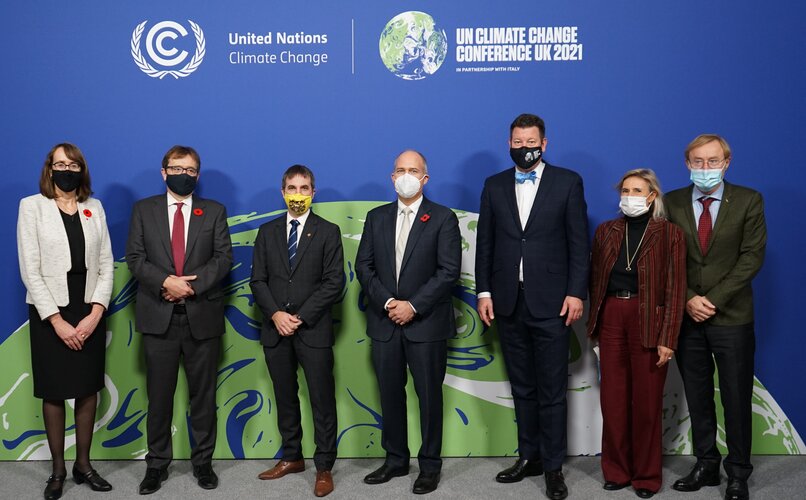
In the first 20 years of reaching the atmosphere, methane has more than 80 times the warming power of carbon dioxide. Reducing emissions of this extremely potent gas is, therefore, one of the fastest ways of slowing the rate of global warming, at least in the short term – and at COP26, more than 100 countries have just signed up to the Global Methane Pledge, which aims to limit emissions by 30% compared with 2020 levels.
With both public and commercial satellite data playing key roles in assessing progress on climate action, ESA and GHGSat are supporting the United Nations Environment
Meltwater runoff from Greenland becoming more erratic
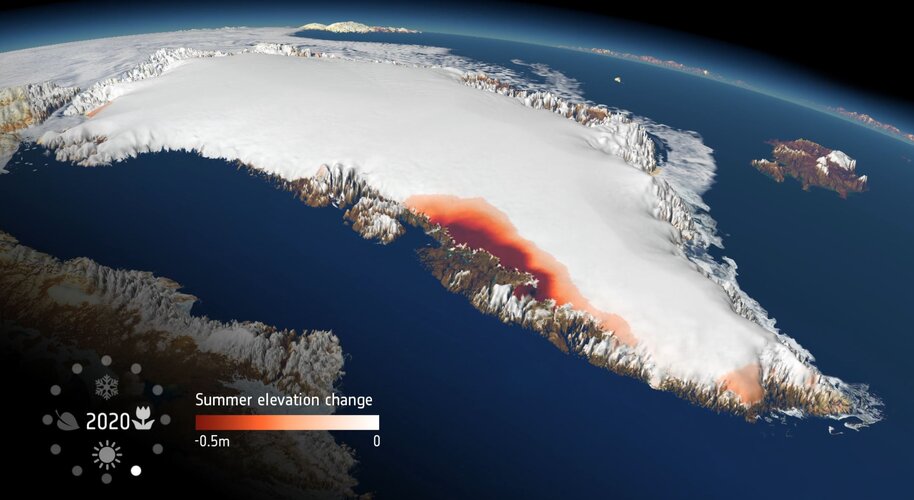
As world leaders and decision-makers join forces at COP26 to accelerate action towards the goals of the Paris Agreement, new research, again, highlights the value of satellite data in understanding and monitoring climate change. This particular new research, which is based on measurements from ESA’s CryoSat mission, shows that extreme ice melting events in Greenland have become more frequent and more intense over the past 40 years, raising sea levels and the risk of flooding worldwide.