

SpaceML.org: A new resource to accelerate AI application in space science and exploration
"SpaceML helped accelerate impact by bringing in a team of citizen scientists who deployed an interpretable Active Learning and AI-powered meteor classifier to automate insights, allowing the astronomers focused research for the SETI CAMS project," said Siddha Ganju, Self Driving and Medical Instruments AI Architect, Nvidia (founding member of SpaceML's CAMS and Worldview Search Initiatives). "During SpaceML we (1) standardized the processing pipeline to process the decade long meteor dataset collected by CAMS, and, established the state of the art meteor classifier with a unique augmentation strategy; (2) enabled active learning in the CAMS pipeline to automate insights; and, (3) updated the NASA CAMS Meteor Shower Portal which now includes celestial reference points and a scientific communication tool. And the best thing is that future citizen scientists can partake in the CAMS project by building on the publicly accessible trained models, scripts, and web tools.
Scientists detect signatures of life remotely
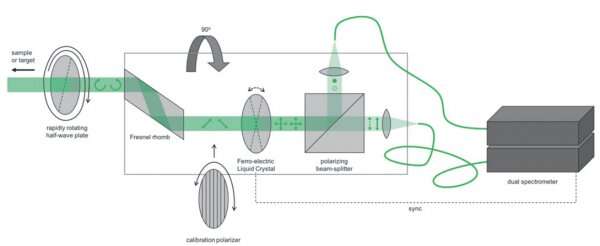
It could be a milestone on the path to detecting life on other planets: Scientists under the leadership of the University of Bern and of the National Center of Competence in Research (NCCR) PlanetS detect a key molecular property of all living organisms from a helicopter flying several kilometers above ground. The measurement technology could also open up opportunities for remote sensing of the Earth.
Left hands and right hands are almost perfect mirror images of each other. But whatever way they are twisted and turned, they cannot be superimposed onto each other. This is why the left glove simply won't fit the right hand as well as it fits the left. In science, this property is referred to as chirality.
Just like hands are chiral, molecules can be chiral, too. In fact, most molecules in the cells of living organisms, such as DNA, are chiral. Unlike hands, however, that usually come in pairs of left and right, the molecules of life almost exclusively occur in either their "left-handed" or their "right-handed" version.
Op-ed | NOAA is stalling U.S. space traffic management
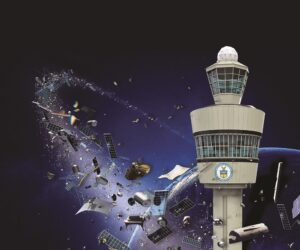
As demonstrated by the uncontrolled reentry of a Chinese rocket last month, irresponsible space activities can put billions of dollars and human life at risk. Recognizing the reality of increasing space activities and the need for the national security community to focus its resources on security threats, the Trump administration issued Space Policy Directive 3 (SPD-3), “National Space Traffic Management Policy” in 2018.
SES strengthens Amazon Web Services cloud partnership

TAMPA, Fla. — SES has expanded its partnership with Amazon Web Services (AWS), enabling satellite customers to connect directly to its cloud-based applications.
According to SES, it is the first satellite operator to pass technical and business reviews for directly connecting with AWS cloud services, without going through a virtual private network (VPN).
Turkey invites Russia to take part in construction of country's spaceport
 Earlier this year, media reported that Ankara was planning to build a spaceport in Somalia as part of a $1 billion investment in the nation's nascent space programme. Turkish authorities did not confirm this information, but President Recep Tayyip Erdogan did announce in February that Turkey would make a hard landing on the Moon by the year 2023.
Russia is invited to participate in the dev
Earlier this year, media reported that Ankara was planning to build a spaceport in Somalia as part of a $1 billion investment in the nation's nascent space programme. Turkish authorities did not confirm this information, but President Recep Tayyip Erdogan did announce in February that Turkey would make a hard landing on the Moon by the year 2023.
Russia is invited to participate in the dev Orchids in orbit: Seeds tested in space
 Almost 30 grams of Nanjing orchid seeds were carried into space for breeding tests, accompanying three Chinese astronauts in China's Shenzhou XII manned spaceship, which was launched on Thursday. The seeds will be in space for three months.
A red orchid variety, Hongcao, features red buds and seedlings, a popular variant from Nanjing county of Fujian province.
It was selected and bre
Almost 30 grams of Nanjing orchid seeds were carried into space for breeding tests, accompanying three Chinese astronauts in China's Shenzhou XII manned spaceship, which was launched on Thursday. The seeds will be in space for three months.
A red orchid variety, Hongcao, features red buds and seedlings, a popular variant from Nanjing county of Fujian province.
It was selected and bre Study of young chaotic star system reveals planet formation secrets
 A team of scientists using the Atacama Large Millimeter/submillimeter Array (ALMA) to study the young star Elias 2-27 have confirmed that gravitational instabilities play a key role in planet formation, and have for the first time directly measured the mass of protoplanetary disks using gas velocity data, potentially unlocking one of the mysteries of planet formation. The results of the research
 Researchers discover orbital patterns of trans-Neptunian objects
 Trans-Neptunian Objects (TNOs), small objects that orbit the sun beyond Neptune, are fossils from the early days of the solar system which can tell us a lot about its formation and evolution.
A new study led by Mohamad Ali-Dib, a research scientist at the NYU Abu Dhabi Center for Astro, Particle, and Planetary Physics, reports the significant discovery that two groups of TNOs with differen
Trans-Neptunian Objects (TNOs), small objects that orbit the sun beyond Neptune, are fossils from the early days of the solar system which can tell us a lot about its formation and evolution.
A new study led by Mohamad Ali-Dib, a research scientist at the NYU Abu Dhabi Center for Astro, Particle, and Planetary Physics, reports the significant discovery that two groups of TNOs with differen SpaceML.org aims to accelerate AI application in space science and exploration
 The SETI Institute and Frontier Development Lab are announcing the launch of SpaceML.org. SpaceML is a resource that makes AI-ready datasets available to researchers working in space science and exploration, enabling rapid experimentation and reproducibility.
The SpaceML Repo is a machine learning toolbox and community managed resource to enable researchers to more effectively engage in AI
The SETI Institute and Frontier Development Lab are announcing the launch of SpaceML.org. SpaceML is a resource that makes AI-ready datasets available to researchers working in space science and exploration, enabling rapid experimentation and reproducibility.
The SpaceML Repo is a machine learning toolbox and community managed resource to enable researchers to more effectively engage in AI How a supermassive black hole originates
 Supermassive black holes, or SMBHs, are black holes with masses that are several million to billion times the mass of our sun. The Milky Way hosts an SMBH with mass a few million times the solar mass. Surprisingly, astrophysical observations show that SMBHs already existed when the universe was very young. For example, a billion solar mass black holes are found when the universe was just 6% of i


