

Deciphering city navigation AI advances GNSS error detection
 Urban environments pose unique challenges for Global Navigation Satellite Systems (GNSS), with tall buildings, vehicles, and other obstacles often disrupting signals and causing Non-Line-of-Sight (NLOS) errors. To address this, researchers have developed an Artificial Intelligence (AI)-driven solution using the Light Gradient Boosting Machine (LightGBM), offering a new level of precision in iden
 SSTL partners with LatConnect 60 for SWIR payload development
 SSTL has announced the signing of a letter of intent with LatConnect 60 (LC60) to collaborate on the development of space-based Short-Wave Infra-Red (SWIR) payloads. This partnership builds on the HERCHI project, which SSTL has undertaken with the support of the UK Space Agency.
The agreement strengthens the ongoing collaboration between SSTL and LC60, which has already seen both companies
SSTL has announced the signing of a letter of intent with LatConnect 60 (LC60) to collaborate on the development of space-based Short-Wave Infra-Red (SWIR) payloads. This partnership builds on the HERCHI project, which SSTL has undertaken with the support of the UK Space Agency.
The agreement strengthens the ongoing collaboration between SSTL and LC60, which has already seen both companies Ovzon and SSC strengthen partnership to advance sovereign space capabilities
 Ovzon and Swedish Space Corporation (SSC) have expanded their collaboration with a new teaming agreement aimed at bolstering sovereign space and satellite capabilities. The strengthened partnership builds on their successful collaboration and targets innovative solutions for Sweden, the Nordics, and NATO allies across various operational domains.
Sovereign space capabilities are critical f
Ovzon and Swedish Space Corporation (SSC) have expanded their collaboration with a new teaming agreement aimed at bolstering sovereign space and satellite capabilities. The strengthened partnership builds on their successful collaboration and targets innovative solutions for Sweden, the Nordics, and NATO allies across various operational domains.
Sovereign space capabilities are critical f Proba-3: Because it is hard
 Video:
00:02:02
Video:
00:02:02
Not because it is easy but because it is hard: this historic space phrase is pretty much the definition of ESA’s double-satellite Proba-3 mission, which will employ precise formation flying to produce artificial total solar eclipses in orbit, casting a shadow from one spacecraft to the other. No-one has ever flown a mission like this, up until now. So how is it going to work? Find out in this second trailer video.
Launch now scheduled for Thursday 5 December
Sierra Space partners with companies for space-based semiconductor manufacturing


Webb finds surprises in Spiderweb protocluster field
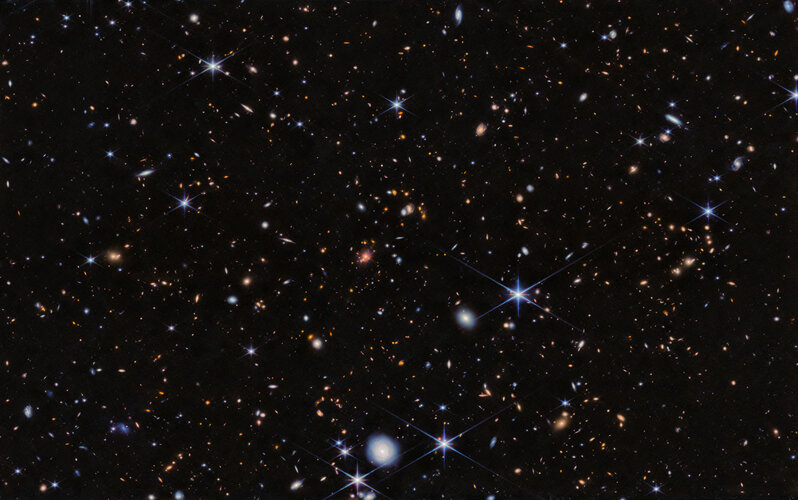
Using the NASA/ESA/CSA James Webb Space Telescope, an international team of astronomers have found new galaxies in the Spiderweb protocluster. Their characteristics reveal that new galaxies are forming in these large cosmic cities, with the finding that gravitational interactions in these dense regions are not as important as previously thought.
How American entrepreneurs can help win the space race against China

China debuts modified solid rocket with remote sensing satellite launch

Trump’s unfinished business: An independent Space Force


