
Wednesday, 06 March 2024 21:20
BrainChip Boosts Space Heritage with Launch of Akida into Low Earth Orbit
Los Angeles CA (SPX) Mar 05, 2024
 BrainChip Holdings Ltd (ASX: BRN, OTCQX: BRCHF, ADR: BCHPY), a leader in neuromorphic AI technology, has successfully launched its Akida AI system into low earth orbit on the Optimus-1 spacecraft. This event, facilitated by the Space Machines Company, marks a significant advancement in the use of AI for space technology applications.
The Akida technology is integrated into the ANT61 Brain
BrainChip Holdings Ltd (ASX: BRN, OTCQX: BRCHF, ADR: BCHPY), a leader in neuromorphic AI technology, has successfully launched its Akida AI system into low earth orbit on the Optimus-1 spacecraft. This event, facilitated by the Space Machines Company, marks a significant advancement in the use of AI for space technology applications.
The Akida technology is integrated into the ANT61 Brain
BrainChip Holdings Ltd (ASX: BRN, OTCQX: BRCHF, ADR: BCHPY), a leader in neuromorphic AI technology, has successfully launched its Akida AI system into low earth orbit on the Optimus-1 spacecraft. This event, facilitated by the Space Machines Company, marks a significant advancement in the use of AI for space technology applications.
The Akida technology is integrated into the ANT61 Brain
Published in
News
Wednesday, 06 March 2024 21:20
Building bionic jellyfish for ocean exploration
Pasadena CA (SPX) Mar 04, 2024
 Jellyfish can't do much besides swim, sting, eat, and breed. They don't even have brains. Yet, these simple creatures can easily journey to the depths of the oceans in a way that humans, despite all our sophistication, cannot.
But what if humans could have jellyfish explore the oceans on our behalf, reporting back what they find? New research conducted at Caltech aims to make that a realit
Jellyfish can't do much besides swim, sting, eat, and breed. They don't even have brains. Yet, these simple creatures can easily journey to the depths of the oceans in a way that humans, despite all our sophistication, cannot.
But what if humans could have jellyfish explore the oceans on our behalf, reporting back what they find? New research conducted at Caltech aims to make that a realit
Jellyfish can't do much besides swim, sting, eat, and breed. They don't even have brains. Yet, these simple creatures can easily journey to the depths of the oceans in a way that humans, despite all our sophistication, cannot.
But what if humans could have jellyfish explore the oceans on our behalf, reporting back what they find? New research conducted at Caltech aims to make that a realit
Published in
News
Wednesday, 06 March 2024 21:20
Tests show high-temperature superconducting magnets are ready for fusion
Boston MA (SPX) Mar 05, 2024
 In the predawn hours of Sept. 5, 2021, engineers achieved a major milestone in the labs of MIT's Plasma Science and Fusion Center (PSFC), when a new type of magnet, made from high-temperature superconducting material, achieved a world-record magnetic field strength of 20 tesla for a large-scale magnet. That's the intensity needed to build a fusion power plant that is expected to produce a net ou
In the predawn hours of Sept. 5, 2021, engineers achieved a major milestone in the labs of MIT's Plasma Science and Fusion Center (PSFC), when a new type of magnet, made from high-temperature superconducting material, achieved a world-record magnetic field strength of 20 tesla for a large-scale magnet. That's the intensity needed to build a fusion power plant that is expected to produce a net ou
Published in
News
Wednesday, 06 March 2024 21:20
Scientists at uOttawa reveal how light behaves in formless solids
Ottawa, Canada (SPX) Mar 01, 2024
 For a long time, it was thought that amorphous solids do not selectively absorb light because of their disordered atomic structure. However, a new uOttawa study disproves this theory and shows that amorphous solids actually exhibit dichroism, meaning that they selectively absorb light of different polarizations.
Researchers at the University of Ottawa have found that using helical light be
For a long time, it was thought that amorphous solids do not selectively absorb light because of their disordered atomic structure. However, a new uOttawa study disproves this theory and shows that amorphous solids actually exhibit dichroism, meaning that they selectively absorb light of different polarizations.
Researchers at the University of Ottawa have found that using helical light be
For a long time, it was thought that amorphous solids do not selectively absorb light because of their disordered atomic structure. However, a new uOttawa study disproves this theory and shows that amorphous solids actually exhibit dichroism, meaning that they selectively absorb light of different polarizations.
Researchers at the University of Ottawa have found that using helical light be
Published in
News

Wednesday, 06 March 2024 08:28
Exotrail deploys first satellite from orbital transfer vehicle


Published in
News
Wednesday, 06 March 2024 11:23
Study find potential benefits in AI–based systems for spotting hard-to-detect space debris
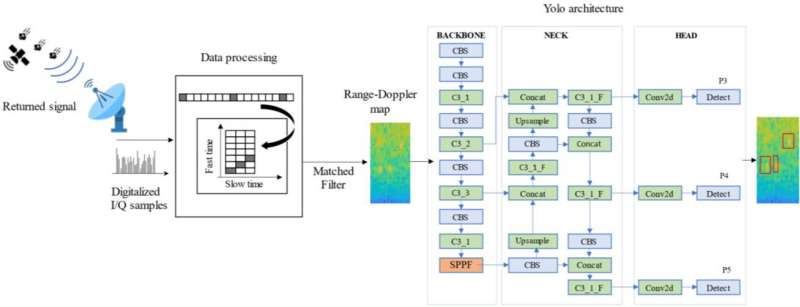
An increasing number of space objects, debris, and satellites in Low Earth Orbit poses a significant threat of collisions during space operations. The situation is currently monitored by radar and radio-telescopes that track space objects, but much of space debris is composed of very small metallic objects that are difficult to detect.
In a study published in IET Radar, Sonar & Navigation, investigators demonstrate the benefits of using deep learning—a form of artificial intelligence—for small space object detection by radar.
Published in
News
Wednesday, 06 March 2024 13:30
Rhea Space Activity to fly navigation payloads on lunar lander mission


Published in
News


Wednesday, 06 March 2024 12:00
Thaicom orders small GEO satellite from Astranis for a launch in 2025


Published in
News