

Webb spots quartz crystals in clouds of exoplanet WASP-17b
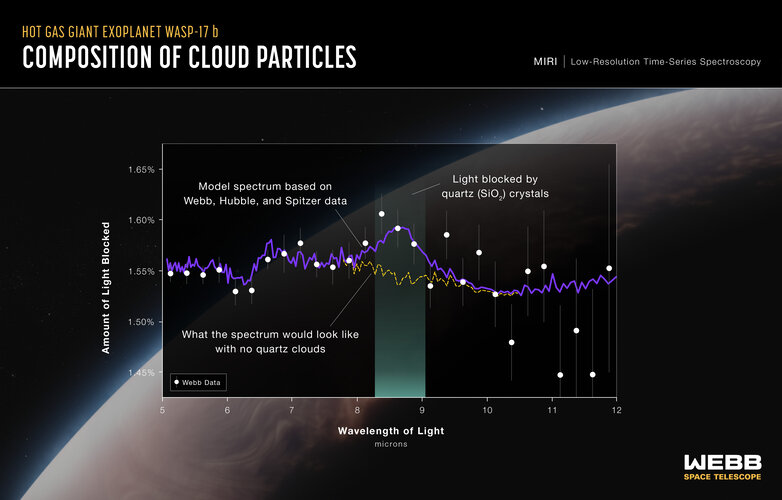 Image:
This is a transmission spectrum of the hot gas giant exoplanet WASP-17 b captured by the NASA/ESA/CSA James Webb Space Telescope's innovative Mid-Infrared Instrument (MIRI) on 12–13 March 2023. It reveals the first evidence for quartz (crystalline silica, SiO2) in the clouds of an exoplanet.
This marks the first time that SiO2 has been identified in an exoplanet, and the first time any specific cloud species has been identified in a transiting exoplanet.
The spectrum was made by measuring the change in brightness of 28 wavelength bands of mid-infrared light as the planet transited the star. Webb observed the WASP-17 system
Urban Sky raises $9.75 million for stratospheric imaging platform


Army exploring new options to tap commercial satellite networks
University of California and NASA Ames unveil plans for $2 billion Berkeley Space Center


Signatures of the Space Age: Spacecraft metals left in the wake of humanity's path to the stars
Satnav test on remote island lab
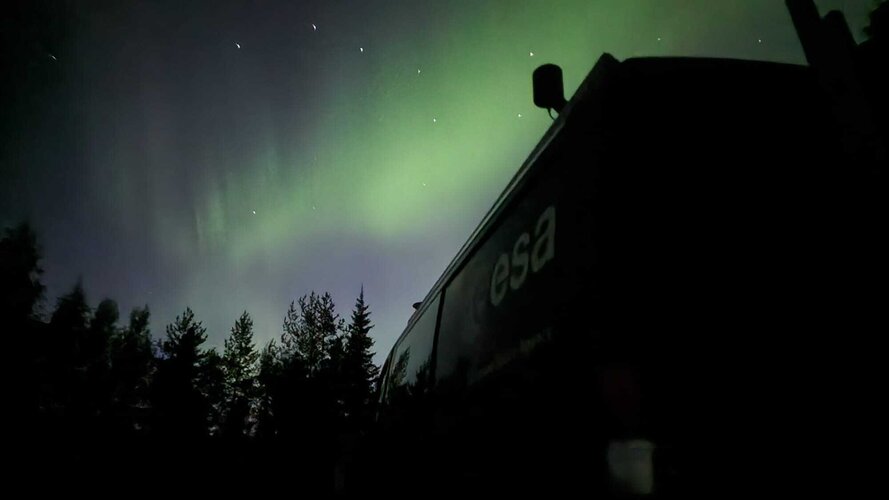
ESA’s navigation testbed vehicle participated in a campaign organised by Norwegian governmental authorities to assess the impact of jamming and spoofing on satnav systems and test innovative technologies for detection and mitigation.
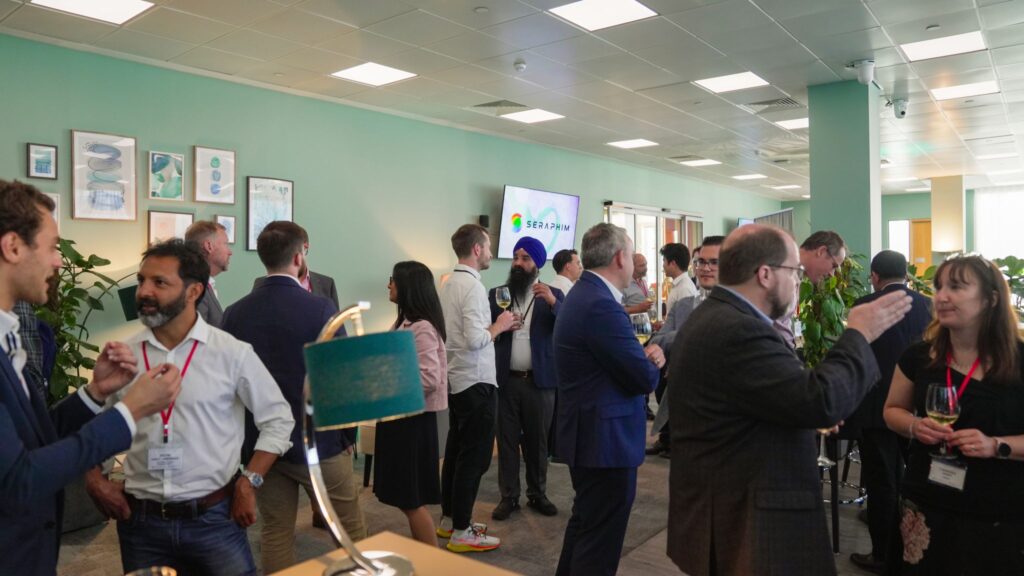
Seraphim unveils the 10 startups in its twelfth space accelerator
Lucy continues approach to Asteroid Dinkinesh for November 1 encounter
 Since NASA's Lucy spacecraft first imaged the asteroid Dinkinesh on Sept. 3, 2023, Lucy has traveled over 33 million miles (54 million km) and is now 4.7 million miles (7.6 million km) away from the small asteroid. However, as Dinkinesh continues on its orbit around the Sun, Lucy still has another almost 16 million miles (25 million km) to travel to its meet-up with the asteroid on Nov. 1.
 Hypervelocity impact experiments probe the origin of organics on the dwarf planet Ceres
 One of the most exciting findings from NASA's Dawn mission is that Ceres, the largest object in the asteroid belt that lies between Mars and Jupiter, hosts complex organics. The discovery of aliphatic molecules, which consist of carbon and hydrogen chains, in conjunction with evidence that Ceres has abundant water ice and may have been an ocean world, means this dwarf planet might have once harb
 Simulations of 'backwards time travel' can improve scientific experiments
 Physicists have shown that simulating models of hypothetical time travel can solve experimental problems that appear impossible to solve using standard physics.
If gamblers, investors and quantum experimentalists could bend the arrow of time, their advantage would be significantly higher, leading to significantly better outcomes.
Researchers at the University of Cambridge have shown
Physicists have shown that simulating models of hypothetical time travel can solve experimental problems that appear impossible to solve using standard physics.
If gamblers, investors and quantum experimentalists could bend the arrow of time, their advantage would be significantly higher, leading to significantly better outcomes.
Researchers at the University of Cambridge have shown 


