

Probing the origin and evolution of water-rich asteroids

More than half the work of the Emirates Mission to the Asteroid Belt is expected to be performed by UAE companies.
U.S. intelligence agency selects vendors for space debris tracking project

The Intelligence Advanced Research Projects Activity selected four vendors to develop technologies and new approaches for tracking small debris objects in space.
Startup iRocket signs agreement to develop and test hardware at U.S. Air Force facility

Innovative Rocket Technologies, known as iRocket, has signed an agreement with the Air Force Research Laboratory to jointly develop and test rocket propulsion hardware.
Voyager Space and Airbus create commercial space station joint venture

Voyager Space is joining forces with Airbus Defence and Space on a joint venture for the development of the Starlab commercial space station.
Virgin Galactic forecasts limited revenues from initial commercial flights

Even as Virgin Galactic enters regular commercial operations of its suborbital spaceplane, it is advising that those flights will generate only modest revenues for the near future.
Ursa Major gets additional funding for its 3D printing manufacturing facility

Rocket propulsion startup Ursa Major announced Aug.
Antares launches Cygnus to ISS

A Cygnus cargo spacecraft is on its way to the International Space Station after an Aug.
Astro Digital to integrate Astroscale in-orbit servicing docking plates

Small satellite builder Astro Digital plans to add an Astroscale docking plate to upcoming spacecraft to make it easier for them to use in-orbit services being developed by Astroscale and others.
Senate committee advances orbital debris removal bill

As the Senate advances a bill that would direct NASA to support missions to remove orbital debris, the agency is outlining the role it will take assisting the Commerce Department on a new space traffic coordination system.
China's Chang'e-7 will deploy a hopper that jumps into a crater in search of water ice
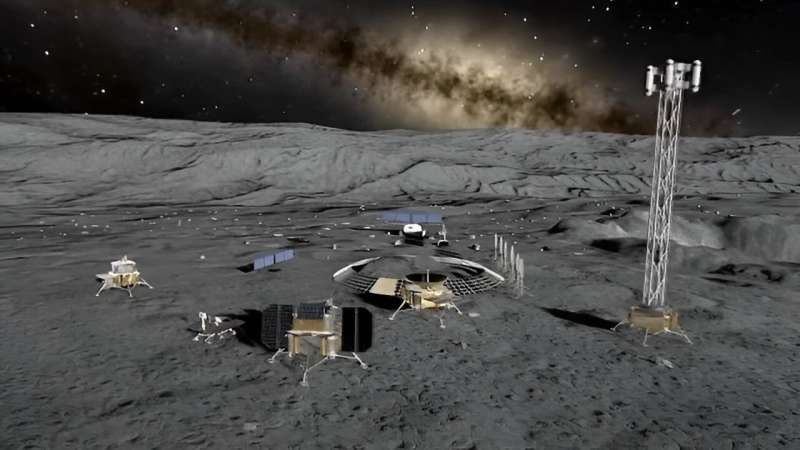
Researchers from the Chinese Academy of Sciences and the Chinese National Space Administration recently published a study in the journal Space: Science & Technology outlining how the upcoming Chang'e-7 mission, due to launch in 2026, will use a combination of orbital observations and in-situ analyses to help identify the location, amount, and dispersion of water-ice in the permanently-shadowed regions (PSRs) of the moon, specifically at the lunar south pole.
Once the Chang'e-7 orbiter successfully achieves lunar orbit, it will deploy a lander and mini-flying probe with both designed to perform in-situ analyses of lunar water-ice while the orbiter is expected to conduct remote observations using a variety of instruments.
The paper discusses how the mini-flying probe, which will be equipped with a water molecular analyzer to collect lunar surface frost water molecules, will be capable of flying from the sunlit regions on the lunar south pole to the dark bottom of the impact craters within the PSRs, which conventional lunar rovers were never designed to do, thus providing an enormous benefit to using this new robotic explorer.


