

Evidence of the amino acid tryptophan found in space
 Using data from the Spitzer space observatory, Dr Susana Iglesias-Groth, a researcher from The Instituto de Astrofisica de Canarias (IAC), has found evidence for the existence of the amino acid tryptophan in the interstellar material in a nearby star-forming region. The research is published in Monthly Notices of the Royal Astronomical Society.
High amounts of tryptophan were detected in t
Using data from the Spitzer space observatory, Dr Susana Iglesias-Groth, a researcher from The Instituto de Astrofisica de Canarias (IAC), has found evidence for the existence of the amino acid tryptophan in the interstellar material in a nearby star-forming region. The research is published in Monthly Notices of the Royal Astronomical Society.
High amounts of tryptophan were detected in t Space Force missile-warning satellites drawing congressional attention

Strategic communications and missile warning satellites “represent a fundamental departure from how DoD has historically carried out these critical missions,” says a new report by the Aerospace Corp.
NASA opens Earth Information Center amid budget uncertainty

NASA inaugurated a public center designed to highlight the information provided by its fleet of Earth science spacecraft, although future missions face budgetary challenges.
ULA’s Delta 4 Heavy launches classified spy satellite

United Launch Alliance launched a classified National Reconnaissance Office spy satellite on a Delta 4 Heavy rocket June 22 at 5:18 a.m.
 Image:
W-band on the run
Image:
W-band on the run Paris Air Show Live – Session on understanding Earth’s water and carbon cycles from space
 Video:
01:08:04
Video:
01:08:04
By using concrete examples of the water and carbon cycles, the speakers in this session focus on the grand science questions and how we can turn them into answers and solutions most useful to decision-makers at the front line of the climate crisis. Earth is a highly dynamic system where the transport and exchanges of energy and matter are influenced by a multitude of processes and feedback mechanisms. Untangling these complex processes to better understand how Earth works as a system is a major challenge; a challenge that satellites, with their global view, are ideally positioned to
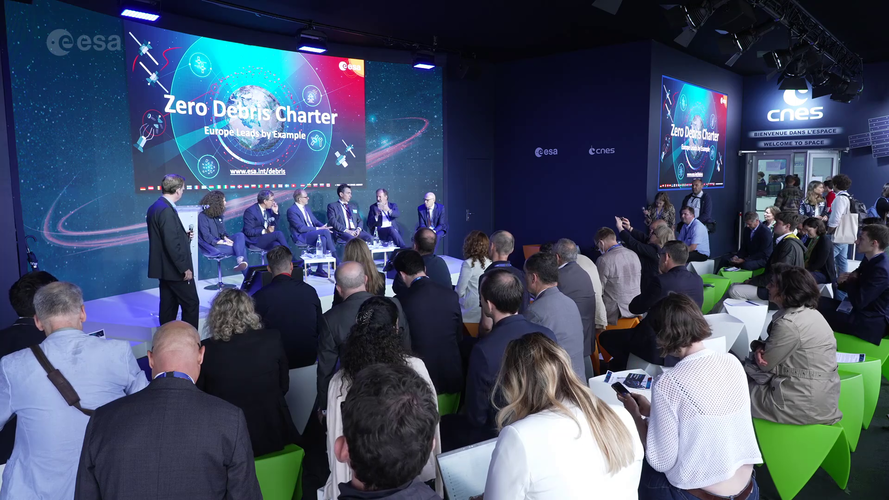
Paris Air Show Live - Press briefing on new European Zero Space Debris policy
 Video:
00:46:00
Video:
00:46:00
Watch the replay of the live session from Paris Air Show 2023 discussing the signature of a new European Zero Space Debris policy. ESA's aim is to totally stop the generation of debris in valuable orbits by 2030. This approach has been initiated by the Agency in response to the catastrophic degradation of the Low-Earth Orbit environment. Speakers will include ESA representatives -including its Director General- and leading industry players.
Relay system speeds vital data flow with 75,000 links
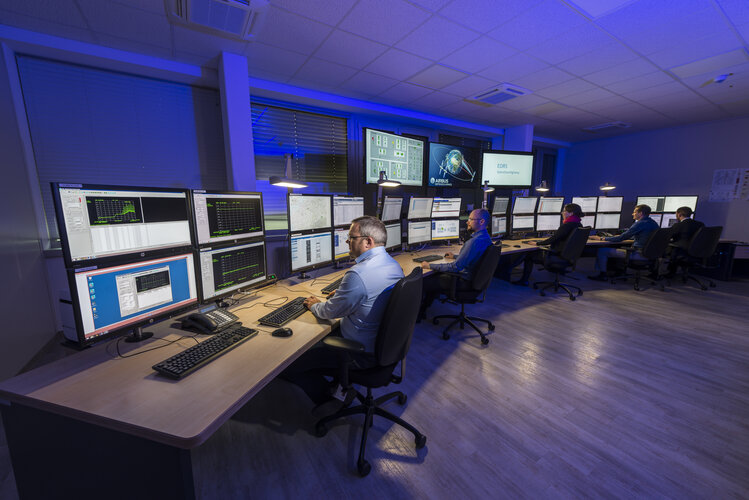
Life-saving data that enables European governments to respond rapidly to crises is flowing swiftly from space to Earth, thanks to the most sophisticated space-based laser communication network ever built.
SpiderOak demonstrates cybersecurity software on orbit

Cybersecurity specialist SpiderOak reported successful on-orbit testing June 22 of its OrbitSecure software running on a Ball Aerospace payload.
Video: BepiColombo's third Mercury flyby
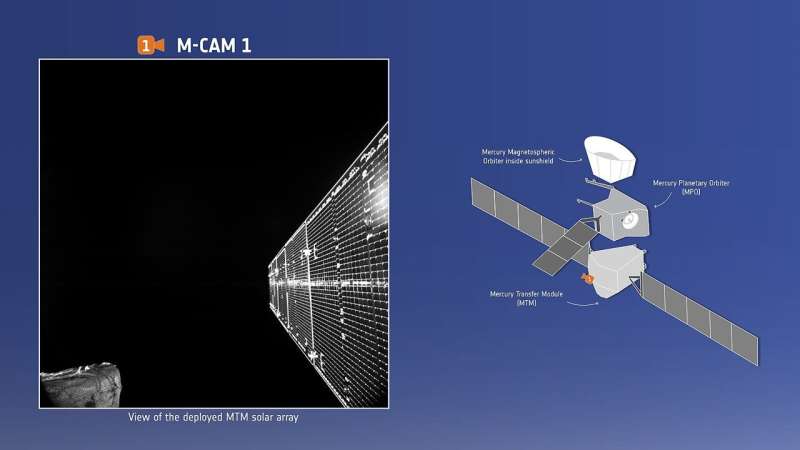
Watch Mercury appear from the shadows as the ESA/JAXA BepiColombo spacecraft sped by the planet's night side during its 19 June 2023 close flyby, and enjoy a special flyover of geologically rich terrain.
In the first part of the movie, composed of 217 images captured by BepiColombo's monitoring camera M-CAM 3, the planet's illuminated side quickly appears in the spacecraft's field of view, showing off a bounty of geological features on its surface. The planet's terminator—the divide between day and night—becomes more distinctive from afar, adding to the beauty of the image sequence. At one point Mercury momentarily appears to hang between the spacecraft's body and antenna before the spacecraft speeds away.
The image sequence starts from 19:46:25 UTC on 19 June 2023, at an altitude of 1,789 km above the planet's surface, and ends at 20:34:25 UTC on 20 June 2023, when BepiColombo was 331,755 km away.


