

China launches new crew for space station, with eye to putting astronauts on moon before 2030
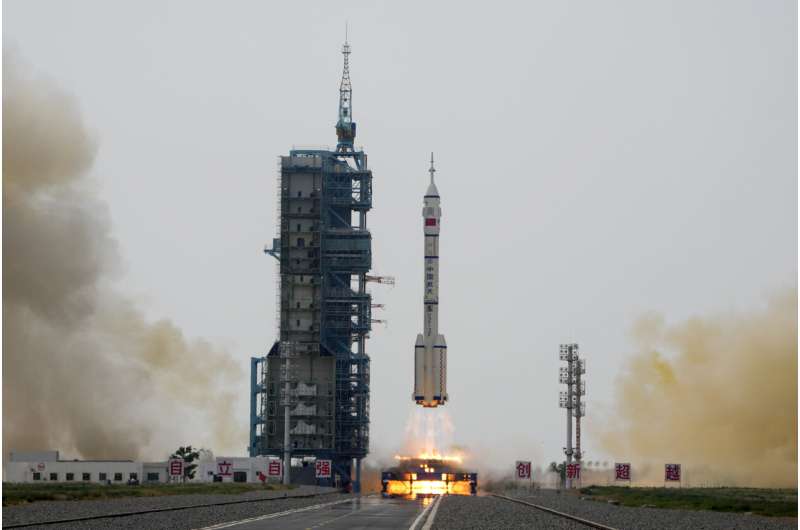
China launched a new three-person crew for its orbiting space station on Tuesday, with an eye to putting astronauts on the moon before the end of the decade.
The Shenzhou 16 spacecraft lifted off from the Jiuquan launch center on the edge of the Gobi Desert in northwestern China atop a Long March 2-F rocket just after 9:30 a.m. (0130 GMT) Tuesday.
The crew, including China's first civilian astronaut, will overlap briefly with three now aboard the Tiangong station, who will then return to Earth after completing their six-month mission.
Webb maps surprisingly large plume jetting from Saturn’s moon Enceladus

Interaction between moon’s plumes and Saturn’s ring system explored with Webb
A water vapour plume from Saturn’s moon Enceladus spanning more than 9600 kilometres — long enough to stretch across the Eurasian continent from Ireland to Japan — has been detected by researchers using the NASA/ESA/CSA James Webb Space Telescope. Not only is this the first time such water ejection has been seen over such an expansive distance, but Webb is also giving scientists a direct look, for the first time, at how this emission feeds the water supply for the entire system of Saturn and its rings.
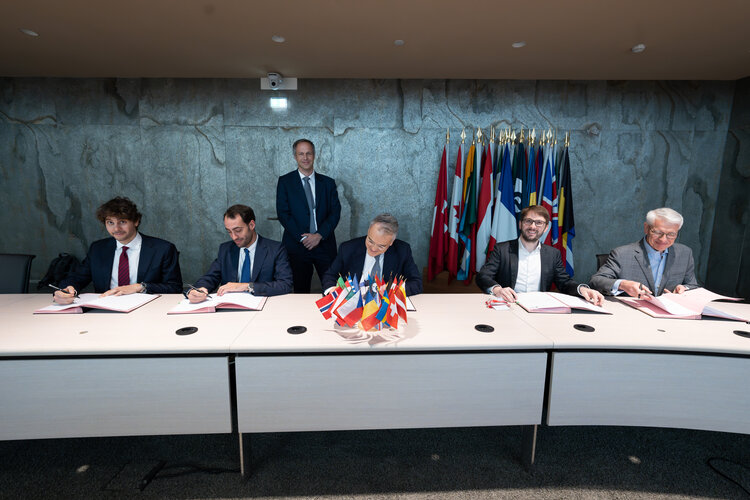
Signature of industrial contracts for the consolidation of the common building blocks for future European reusable launch systems
DARPA launches initiative to help tech companies work on classified programs

DARPA's Strategic Technology Office launched an initiative called Bridges to help companies get security clearances to work on classified programs.
Researchers propose a deep neural network-based 4-quadrant analog sun sensor calibration
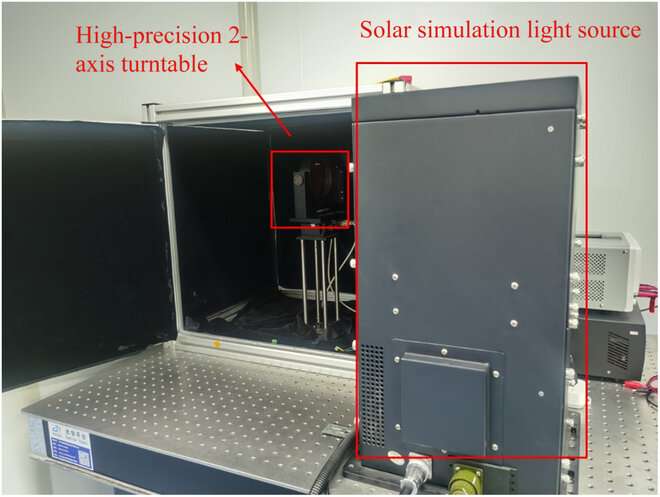
A spacecraft can estimate the attitude state by comparing external measurements from attitude sensors with reference information. CubeSats tend to use 4-quadrant analog solar sensors which have the advantages of extremely low power consumption, minimal volume, low complexity, low cost, and high reliability as attitude sensors, considering the limitation of satellite volume and payload. The performance of the sensor can be importantly improved by the calibration procedure and compensation model.
However, the various error sources affecting the calibration of the 4-quadrant sun sensor lead to a complicated process of compensation model establishment. Deep learning, which is widely used in the aerospace field in recent years, is able to approximate any continuous function on a bounded closed set, providing new ideas for solving the traditional problem.
In a research paper recently published in Space: Science & Technology, authors from Northwestern Polytechnical University, German Aerospace Center, and Dalian University of Technology together propose a method to calibrate sun sensors by deep learning, which not only is able to integrate the influence of various errors but also avoids the need of analyzing and modeling every single error.
Spain signs Artemis Accords

Spain is the latest European nation to sign the Artemis Accords, a central element of a new American strategic framework for space diplomacy.
Telesat orders prototype satellite to continue LEO broadband tests

Telesat plans to launch another low Earth orbit prototype satellite in the coming months to continue tests after an aging demonstrator for its delayed broadband constellation ran out of fuel.
Northrop Grumman’s deep-space radar passes critical design review

A deep-space radar developed by Northrop Grumman for the U.S. Space Force passed a critical design review, the company announced May 30.
Register for ESA’s first Earth observation commercialisation event

Registration is now open for ESA’s first-ever Earth Observation Commercialisation Forum. Taking place at ESA Headquarters in Paris from 30 to 31 October 2023, investors, institutions, entrepreneurs and companies of any size from the Earth observation sector will now be able to come together and discuss the commercial potential and challenges of Earth observation, together with the technical, industrial and risk-capital support available to European companies.
Launch signals wider-opening space sector for China
 Traditionally, China's astronauts are selected from among fighter plane pilots with ample flying experience, as they can control the machinery and have the training to stay calm should an emergency arise in space.
Yet among the three astronauts aboard Shenzhou XVI, which is taking them to Tiangong, China's space station, is Gui Haichao, a professor from Beihang University. He is the first
Traditionally, China's astronauts are selected from among fighter plane pilots with ample flying experience, as they can control the machinery and have the training to stay calm should an emergency arise in space.
Yet among the three astronauts aboard Shenzhou XVI, which is taking them to Tiangong, China's space station, is Gui Haichao, a professor from Beihang University. He is the first 


