

Webb finds water, and a new mystery, in rare main-belt comet
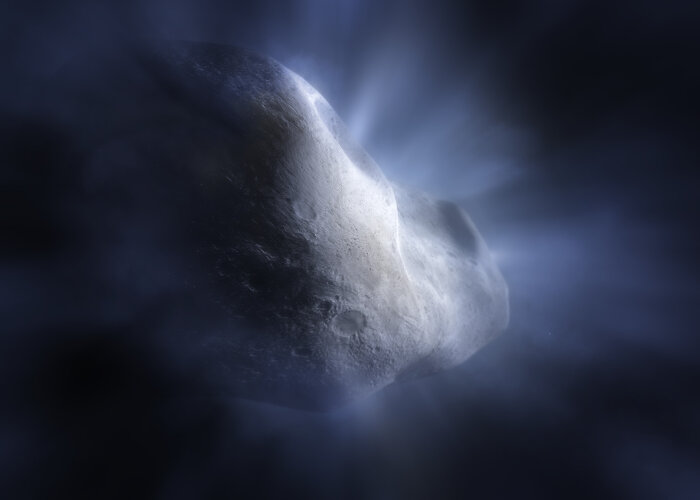
The NASA/ESA/CSA James Webb Space Telescope has enabled another long-sought scientific breakthrough, this time for Solar System scientists studying the origins of the water that has made life on Earth possible. Using Webb’s NIRSpec (Near-Infrared Spectrograph) instrument, astronomers have confirmed gas – specifically water vapour – around a comet in the main asteroid belt for the first time, proving that water from the primordial Solar System can be preserved as ice in that region. However, the successful detection of water comes with a new puzzle: unlike other comets, Comet 238P/Read had no detectable carbon dioxide.
Space Force general: ‘No pushback’ from Congress on 2024 budget priorities

Italy awards $256 million contract for 2026 in-orbit servicing mission

Italy’s space agency has awarded local companies 235 million euros ($256 million) in pandemic relief funds for an in-orbit servicing demo in 2026, the group’s leader Thales Alenia Space announced May 15.
The space industry needs COPUOS to rethink its approach to decision-making

The United Nations Committee on the Peaceful Uses of Outer Space (COPUOS) can’t advance the governance necessary to meet the needs of today’s space sector.
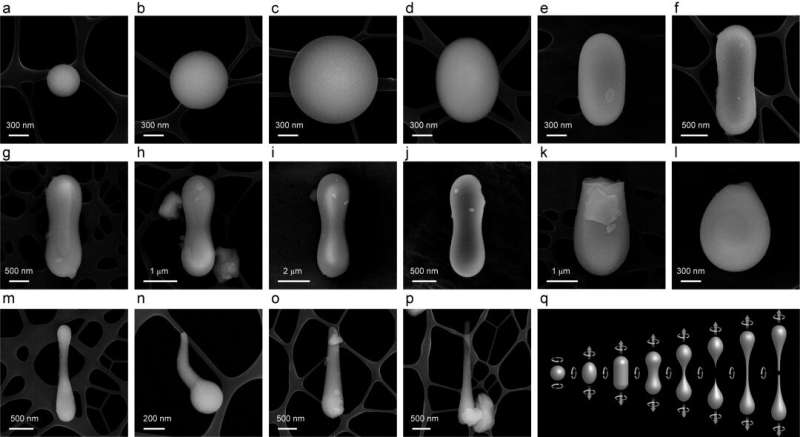
Glass fibers in lunar regolith could help build structures on the moon
Through the Artemis Program, NASA plans to send the first astronauts to the moon in over 50 years. Before the decade is over, this program aims to establish the infrastructure that will allow for a "sustained program of lunar exploration and development." The European Space Agency (ESA) also has big plans, which include the creation of a moon Village that will serve as a spiritual successor to the International Space Station (ISS). China and Roscosmos also came together in June 2021 to announce that they would build the International Lunar Research Station (ILRS) around the lunar south pole.
In all cases, space agencies plan to harvest local resources to meet their construction and long-term needs—a process known as in-situ resource utilization (ISRU).
NASA calls end to Lunar Flashlight mission after some tech successes
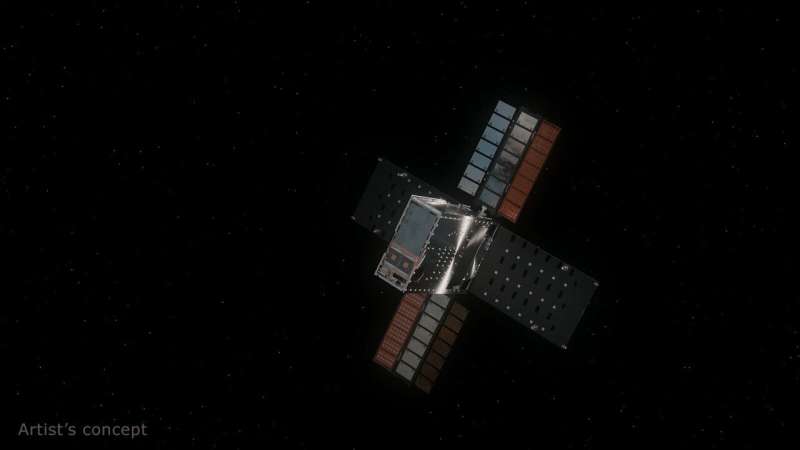
While the CubeSat couldn't reach the lunar South Pole to help seek ice, it fulfilled several technology goals that will empower future missions for the benefit of humanity.
NASA's Lunar Flashlight launched on Dec. 11, 2022, to demonstrate several new technologies, with an ultimate goal to seek out surface ice in the permanently shadowed craters of the moon's South Pole. Since then, the briefcase-size satellite's miniaturized propulsion system—the first of its kind ever flown—proved unable to generate enough thrust to get into lunar orbit, despite months of effort by the operations team.
Sales rocket for Zenno's fuel-free satellite pointing system
 Zenno Astronautics (Zenno) reports has surpassed $75M in product sales (USD 48M) for its world-first superconducting magnetorquer for spacecraft attitude control, the Z01.
Built on Zenno's proprietary superconducting magnet technology, Z01 is a fuel-free satellite pointing system designed to significantly increases the range of capabilities for attitude control in space, including fully au
Zenno Astronautics (Zenno) reports has surpassed $75M in product sales (USD 48M) for its world-first superconducting magnetorquer for spacecraft attitude control, the Z01.
Built on Zenno's proprietary superconducting magnet technology, Z01 is a fuel-free satellite pointing system designed to significantly increases the range of capabilities for attitude control in space, including fully au Space Forge enables reusable satellites with new way of returning from space to Earth
 Space Forge reveals their patent protected design of a planet-friendly reusable re-entry system, which will enable the low cost and reliable return of satellites to Earth.
Although the cost of launching satellites into space has become lower through the use of reusability, all current commercial space return vehicles use ablative heat shields which require replacement after every flight. S
Space Forge reveals their patent protected design of a planet-friendly reusable re-entry system, which will enable the low cost and reliable return of satellites to Earth.
Although the cost of launching satellites into space has become lower through the use of reusability, all current commercial space return vehicles use ablative heat shields which require replacement after every flight. S Terran Orbital PTD-3 enables 200Gbits space-to-ground optical link
 Terran Orbital Corporation (NYSE: LLAP) announced a significant achievement in space-to-ground communication, successfully enabling a 200 gigabits per second optical link through the Pathfinder Technology Demonstrator 3 (PTD-3) satellite. The NASA satellite hosts the TeraByte InfraRed Delivery (TBIRD) payload, funded by NASA's Space Communications and Navigation (SCaN) and developed by MIT Linco
 LiveEO and Capella Space offer fast, high-res SAR imaging to asset managers
 LiveEO, a market leader in Earth observation analytics and solutions for high-value infrastructure and energy asset monitoring, has announced a partnership with Capella Space, the world's leading provider of high-resolution synthetic aperture radar (SAR) imagery. As the first certified Capella Analytics Partner, LiveEO will integrate all-weather, 24/7 SAR imagery from Capella Space into its adva


