

Propelling ASCENT into commercial markets

Daniel Cavender has worked extensively with ASCENT, the non-toxic propellant developed by the Air Force Research Laboratory.
The post Propelling ASCENT into commercial markets appeared first on SpaceNews.
Breaking out of the space echo chamber

As space advocates, we are simply terrible at communicating our perspective. Our collective dysphasia makes it harder for space companies to raise money and dramatically more difficult to sustain support in Washington.
Virgin to launch commercial spaceflights in June
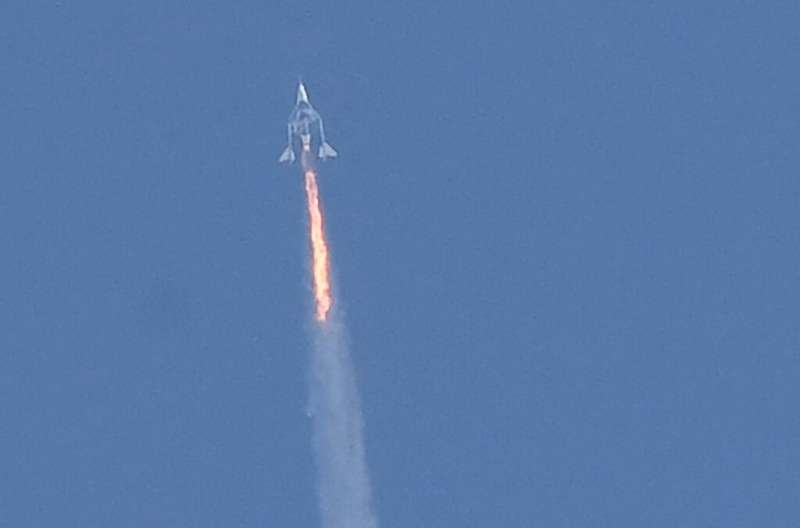
Space tourism company Virgin Galactic announced Monday that it is resuming flights with a mission this month, its first in nearly two years, and the launch of commercial trips in June.
The Unity 25 mission will take place in late May with four company employees on board, said Virgin Galactic, which was founded by British billionaire Richard Branson, who took part in the firm's last spaceflight in July 2021.
"Unity 25 is the final assessment of the full spaceflight system and astronaut experience before commercial service opens in late June," Virgin Galactic said in a statement.
Unity 25 will be the company's fifth trip into space, defined as 50 miles (80 kilometers) above sea level.
Unlike other companies that use vertical-launch rockets, Virgin Galactic uses a carrier aircraft that takes off from a runway, gains high altitude, and drops a rocket-powered plane that soars into space before gliding back to Earth.
Thirsty on the moon? Just throw some regolith in the microwave
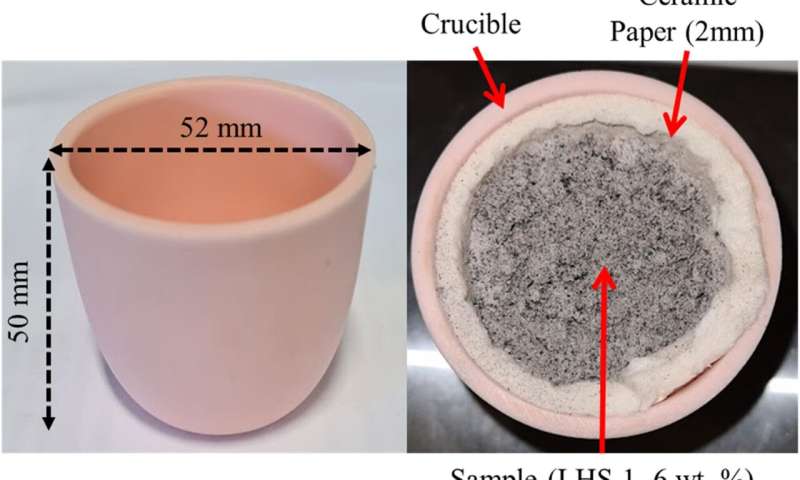
No matter where we go in the universe, we're going to need water. Thus far, human missions to Earth orbit and the moon have taken water with them. But while that works for short missions, it isn't practical in the long term. Water is heavy, and it would take far too much fuel to bring sufficient water to sustain long-term bases on the moon or Mars. So we'll have to use the water we can extract locally.
Fortunately, water is a common molecule in the universe. Even the moon has plenty of water to sustain a lunar colony. The only real challenge is how to extract it. As a recent study published in Acta Astronautica shows, that might be as easy as popping things into a microwave oven.
Although water is present in tiny quantities all over the moon, it is most concentrated in the polar regions.
The Euclid spacecraft will transform how we view the 'dark universe'
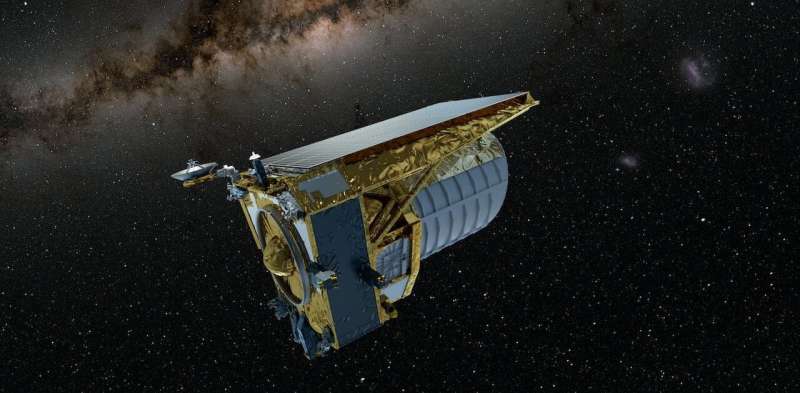
The European Space Agency's (ESA) Euclid satellite completed the first part of its long journey into space on May 1, 2023, when it arrived in Florida on a boat from Italy. It is scheduled to lift off on a Falcon 9 rocket, built by SpaceX, from Cape Canaveral in early July.
Euclid is designed to provide us with a better understanding of the "mysterious" components of our universe, known as dark matter and dark energy.
Unlike the normal matter we experience here on Earth, dark matter neither reflects nor emits light. It binds galaxies together and is thought to make up about 80% of all the mass in the universe.
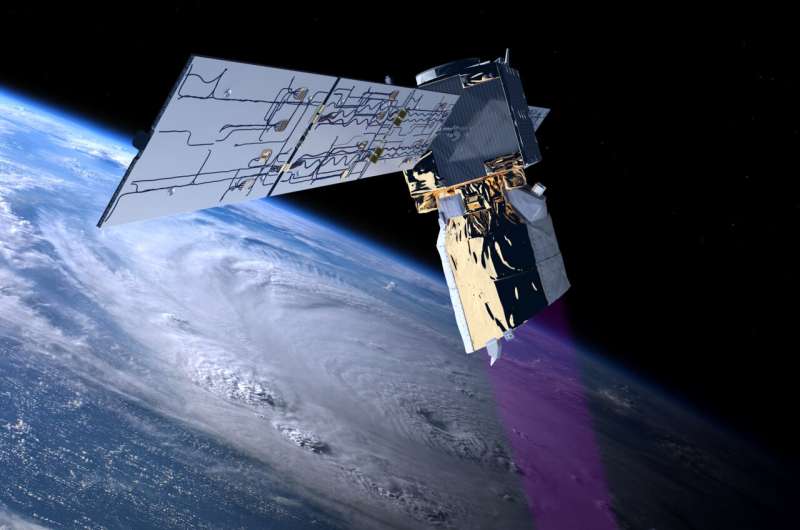
Space Force reviewing bids from satellite manufacturers for Space Test Program

The U.S. Space Force is reviewing bids from satellite manufacturers competing to produce and integrate experiments for the Space Test Program.
Team Continues to Troubleshoot Propulsion for NASA's Lunar Flashlight
 NASA's Lunar Flashlight operations team continues to work on remedying the CubeSat's underperforming propulsion system. They developed a method to get one of the CubeSat's four thrusters to deliver more thrust; however, the small spacecraft will need additional, more consistent thrust in the next few days to reach its revised target orbit.
Devised by team members at NASA's Jet Propulsion L
NASA's Lunar Flashlight operations team continues to work on remedying the CubeSat's underperforming propulsion system. They developed a method to get one of the CubeSat's four thrusters to deliver more thrust; however, the small spacecraft will need additional, more consistent thrust in the next few days to reach its revised target orbit.
Devised by team members at NASA's Jet Propulsion L Momentus achieves first orbit raise with pioneering propulsion system
 Momentus Inc. (NASDAQ: MNTS) has successfully achieved the first orbital raise of its Vigoride-5 spacecraft using its pioneering Microwave Electrothermal Thruster (MET) that uses distilled water as propellant.
The successful maneuvers raised the altitude of the Vigoride Orbital Service Vehicle (OSV) by more than 3 kilometers, taking into account the atmospheric drag that the spacecraft must ove
Momentus Inc. (NASDAQ: MNTS) has successfully achieved the first orbital raise of its Vigoride-5 spacecraft using its pioneering Microwave Electrothermal Thruster (MET) that uses distilled water as propellant.
The successful maneuvers raised the altitude of the Vigoride Orbital Service Vehicle (OSV) by more than 3 kilometers, taking into account the atmospheric drag that the spacecraft must ove China's reusable experimental spacecraft successfully lands
 A reusable experimental spacecraft on Monday successfully returned to its scheduled landing site at the Jiuquan Satellite Launch Center in northwest China, marking an important milestone in the nation's quest for reusable space technology.
The spacecraft, which has not yet been officially named, completed a 276-day in-orbit operation before its successful landing. This achievement indicate
A reusable experimental spacecraft on Monday successfully returned to its scheduled landing site at the Jiuquan Satellite Launch Center in northwest China, marking an important milestone in the nation's quest for reusable space technology.
The spacecraft, which has not yet been officially named, completed a 276-day in-orbit operation before its successful landing. This achievement indicate 


