

Another giant leap into space: Successful launch of Lumelite-4 to enhance maritime communications
 A microsatellite for maritime communications developed by the Satellite Technology And Research Centre (STAR) under the National University of Singapore's College of Design and Engineering (NUS CDE), and A*STAR's Institute for Infocomm Research (I2R), has been successfully launched from the Satish Dhawan Space Centre in Sriharikotta, India, on Saturday, 22 April 2023 at 4.50pm (Singapore time).
 Arianegroup, Eutelsat And Magellium Selected To Improve French Space Surveillance Capabilities
 ArianeGroup, Eutelsat and Magellium have won a contract from the French space agency (CNES), as part of the space component of the France 2030. Investing for the Future plan, with the aim of enhancing space surveillance capabilities in order to substantially improve the security of space operations.
The consortium will provide CNES with a Space Situational Awareness (SSA) data service thro
ArianeGroup, Eutelsat and Magellium have won a contract from the French space agency (CNES), as part of the space component of the France 2030. Investing for the Future plan, with the aim of enhancing space surveillance capabilities in order to substantially improve the security of space operations.
The consortium will provide CNES with a Space Situational Awareness (SSA) data service thro China plans full reusability for its super heavy Long March 9 rocket

China is planning to make a fully reusable version of its Long March 9 rocket designed to launch infrastructure and deep space missions.
Italy’s post-pandemic space industry boost

An Italian Earth observation project funded by pandemic relief euros has ordered at least 34 satellites and a pair of Vega launches in recent months.
NASA's Voyager will do more science with new power strategy
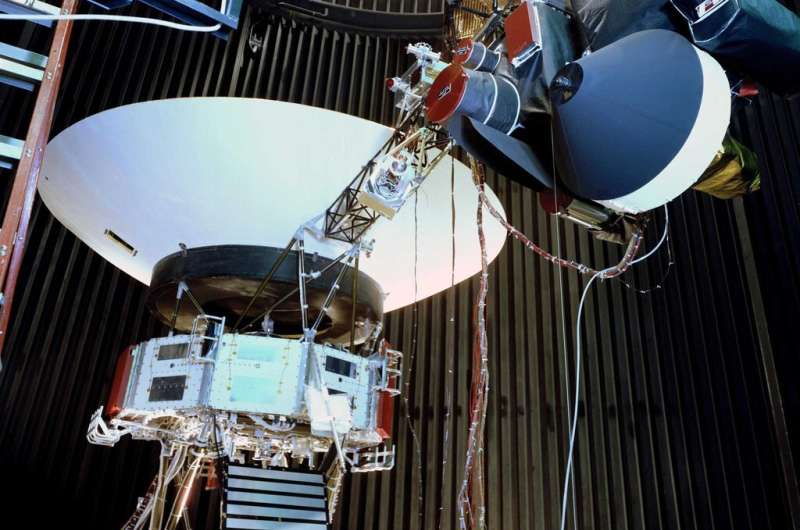
The plan will keep Voyager 2's science instruments turned on a few years longer than previously anticipated, enabling yet more revelations from interstellar space.
Launched in 1977, the Voyager 2 spacecraft is more than 12 billion miles (20 billion kilometers) from Earth, using five science instruments to study interstellar space.
Sustainability in space—can you teach old satellites new tricks?

We've all heard that we should "Reduce, Reuse, Recycle" to save the planet, but what about applying any of the "three R's" to space?
Researchers at USC Viterbi's Information Sciences Institute (ISI) are tackling this challenge—looking at how to reuse physical items that are already in space, namely, old satellites.
Legacy Satellites
There are currently several thousand satellites orbiting Earth. Many have already completed their missions or have outlived their primary lifespans—these are "legacy satellites." And while some of them may have broken hardware and will eventually run out of energy, leave orbit, and burn out in space, others are physically in good condition. So, the question becomes: what to do with them?
Alefiya Hussain, ISI Research Team Leader explained, "This project is looking at ways to possibly reuse satellites for different things. We are collaborating with the software company Tangram Flex to figure out how we can replace the software components within the satellites to re-purpose them."
She continued, "The approach we've taken is to look inside the satellite and say, this particular piece of software did this particular function before, can we actually replace that function to make it do something else as a path to repurposing it?"
Could you be ESA’s official merchandise supplier?

ESA is inviting companies with an interest in merchandising to submit a tender to become the space agency’s official ESA-branded merchandise supplier.
Spain’s Satlantis expands into thermal imagery with UK investment

Spanish Earth observation satellite provider Satlantis has bought a majority stake in British university spin-out SuperSharp to expand into the thermal imaging market.
Light Steering Technologies claims $1.25 million Air Force contract

New Hampshire startup Light Steering Technologies won a $1.25 million U.S. Air Force contract for angular pointing technology with small satellite applications.
Raytheon rethinks strategy to compete in military satellite market


