

The ozone layer: a hole new world
 Video:
00:08:47
Video:
00:08:47
In the 1980s, scientists discovered a gaping hole in Earth's ozone layer, caused by humanmade chemicals. But thanks to the historical Montreal Protocol, the world came together to take bold action to save our planet. Decades later, we can see the steady recovery of the ozone hole. How did we do it? And what does space have to do with it? Join us as we explore the journey of the ozone hole, from its alarming discovery to the incredible strides made to fix it, and how satellites are helping us track its recovery.
ESA’s forest satellite robust for launch
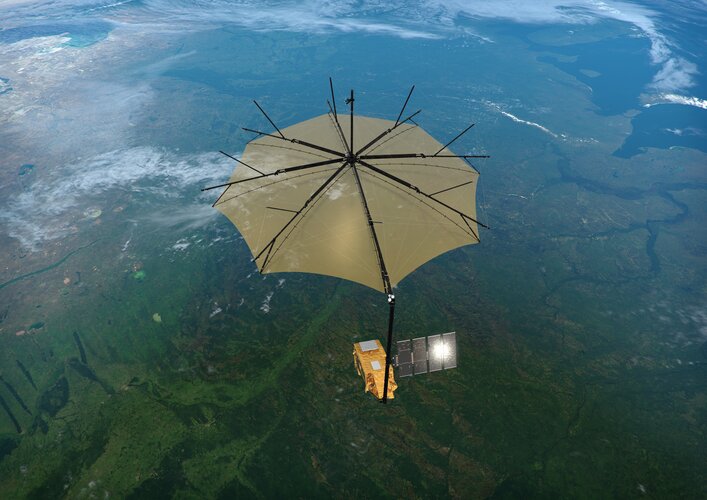
Over the last few months, ESA’s Earth Explorer Biomass satellite has been going through a punishing series of tests to make sure that it will survive the unavoidable blasts of noise and shuddering during liftoff. Engineers have now also tested that it will unfold its solar wing in the correct sequence. Coming through all of this with flying colours, Biomass is a few steps closer to its mission in orbit: to deliver completely new information on our precious forests and the carbon they store.
China launches high-capacity communications satellite after 39-day pause

China sent the Zhongxing-26 communications satellite into orbit Feb.
The next space frontier: your backyard

Sidney N. Nakahodo is a founder and general partner of Seldor and lecturer of international and public affairs at Columbia University.
Rivada says it has launches covered for a constellation against the clock

Rivada Space Networks has secured the launches and financing it needs to deploy 300 satellites by a mid-2026 regulatory deadline, an executive said Feb.
The coming Chinese megaconstellation revolution

China’s response to Starlink and OneWeb first became apparent in 2020 in filings for a nearly 13,000-satellite megaconstellation with the International Telecommunication Union in Geneva.
Polaris Dawn private astronaut mission preparing for summer launch

A billionaire-backed series of private astronaut missions is now planning its first launch this summer that will include the first spacewalk on a commercial spaceflight.
Russia launches Soyuz rescue mission to ISS after leak dilemma
 Russia launched an unmanned Soyuz spacecraft to the International Space Station on Thursday to replace one that leaked coolant after it was struck by a meteoroid last year, stranding two cosmonauts and a NASA astronaut in space.
The Soyuz MS-23 spacecraft was launched with 948 pounds of supplies for the astronauts from the Baikonur Cosmodrome in Kazakhstan at 7:24 p.m. EST, which was br
Russia launched an unmanned Soyuz spacecraft to the International Space Station on Thursday to replace one that leaked coolant after it was struck by a meteoroid last year, stranding two cosmonauts and a NASA astronaut in space.
The Soyuz MS-23 spacecraft was launched with 948 pounds of supplies for the astronauts from the Baikonur Cosmodrome in Kazakhstan at 7:24 p.m. EST, which was br SuperCam Gains New Artificial Intelligence Capabilities with AEGIS Upgrade
 As Perseverance celebrates its second anniversary on Mars, our team is reflecting on the rover's remarkable journey so far. In the past two years, Perseverance has collected 18 Martian samples, traversed over 9 miles, transmitted over 200,000 images to Earth, supported the Ingenuity helicopter with its 42 flights, and much more.
Now, after spending nearly 6 weeks creating the Three Forks s
As Perseverance celebrates its second anniversary on Mars, our team is reflecting on the rover's remarkable journey so far. In the past two years, Perseverance has collected 18 Martian samples, traversed over 9 miles, transmitted over 200,000 images to Earth, supported the Ingenuity helicopter with its 42 flights, and much more.
Now, after spending nearly 6 weeks creating the Three Forks s ULA announces May launch of first Vulcan

The first launch of United Launch Alliance’s Vulcan Centaur rocket is now scheduled for no earlier than May 4, a date the company says is based on remaining tests of the rocket and its main engines as well as launch windows for its primary payload.


