

Searching for a Drill Site Near Encanto: Sols 3735-3736
 Curiosity successfully followed her tracks and is back near the Encanto drill site! With a beautiful workspace in view, the science and operations team had a busy day of planning on the "Marker band" surface. We assessed potential drill targets, selected targets for contact science, and planned imaging.
When evaluating the rocks in the area for the best possible drill site, the team focuse
Curiosity successfully followed her tracks and is back near the Encanto drill site! With a beautiful workspace in view, the science and operations team had a busy day of planning on the "Marker band" surface. We assessed potential drill targets, selected targets for contact science, and planned imaging.
When evaluating the rocks in the area for the best possible drill site, the team focuse Asteroid impact in slow motion
 Asteroid impacts are catastrophic events that create huge craters and sometimes melt parts of Earth's bedrock." Nevertheless, craters are often difficult to detect on Earth, because erosion, weathering and plate tectonics cause them to disappear over millions of years," Langenhorst explains. Therefore, minerals that undergo characteristic changes due to the force of the impact often serve as evi
 How to reverse unknown quantum processes
 In the world around us processes appear to follow a certain time-direction: dandelions eventually turn into blowballs. However, the quantum realm does not play by the same rules. Physicists from the University of Vienna and IQOQI Vienna have now shown that for certain quantum systems the time-direction of processes can be reversed. This demonstration of a so-called rewinding protocol has been pu
 Distortion-free structured light
 An exciting prospect in modern optics is to exploit patterns of light - how the light looks in its many degrees of freedom - often referred to as "structured light." Each distinct pattern could form an encoding alphabet for optical communication, or might be used in manufacturing to enhance performance and productivity. Unfortunately, patterns of light get distorted when they pass through noisy
 In search of the invisible galaxy
 A mysterious and very distant object, in a universe as it was 'just' two billion years after the Big Bang, that hides from even the most advanced instruments. Its features have finally been described by a team from SISSA in a recently published study reported in The Astrophysical Journal.
An extremely remote celestial body in a still young Universe, one sixth the size of the present one. A
A mysterious and very distant object, in a universe as it was 'just' two billion years after the Big Bang, that hides from even the most advanced instruments. Its features have finally been described by a team from SISSA in a recently published study reported in The Astrophysical Journal.
An extremely remote celestial body in a still young Universe, one sixth the size of the present one. A ESA’s Cheops finds an unexpected ring around dwarf planet Quaoar
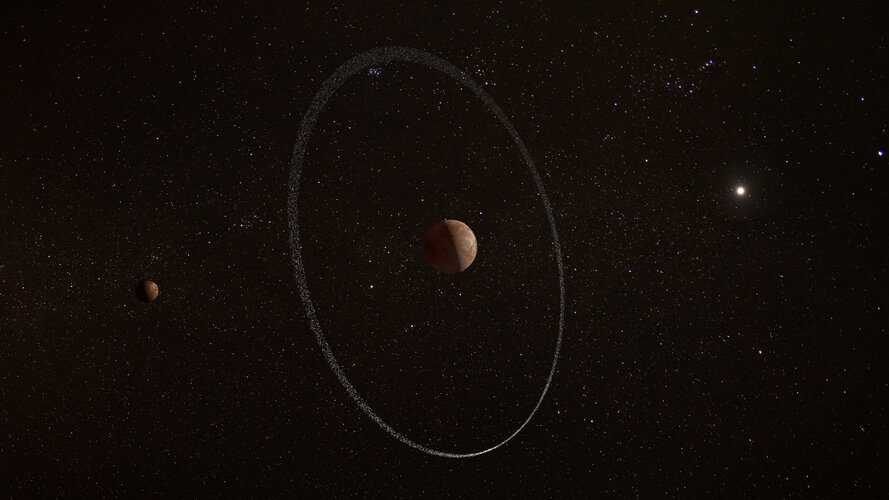
During a break from looking at planets around other stars, ESA’s CHaracterising ExOPlanet Satellite (Cheops) mission has observed a dwarf planet in our own Solar System and made a decisive contribution to the discovery of a dense ring of material around it.
The dwarf planet is known as Quaoar. The presence of a ring at a distance of almost seven and a half times the radius of Quaoar, opens up a mystery for astronomers to solve: why has this material not coalesced into a small moon?
Small launch industry warns of “bloodletting”

While demand for launches of smallsats is higher than ever, industry officials warned that price pressures and lack of access to capital could cause many companies to go out of business in the near future.
Firefly’s first U.S. Space Force launch targeted for May

The chief executive of Firefly Aerospace Bill Weber said Feb.
Shotwell says SpaceX ready for Starship static-fire test

SpaceX will attempt a static-fire test of all 33 engines in its Starship booster as soon as Feb. 9, a test that could allow the company to attempt an orbital launch a month later.
Maxar receives $192 million contract to supply imagery to U.S. allies

The National Geospatial-Intelligence Agency awarded Maxar a five-year $192 million contract to provide satellite imagery to U.S.


