

Electrons in the fast lane
 Ever wondered what makes your computer and your other electronic gadgets slow or fast in their performance? It is the time it takes electrons, some of the tiniest particles of our microcosm, to stream out from minute leads inside the transistors of electronic microchips and to form pulses. Methods to speed up this process are central for advancing electronics and their applications to ultimate p
 ISRO completes investigation into SSLV launch failure

ISRO says it has identified and corrected the problem that doomed the first flight of a small launch vehicle as it gears up for a second attempt.
Virgin Orbit raises $10 million as financial stopgap

Virgin Orbit said Feb. 1 it raised $10 million from another Virgin affiliate, a move that provides only a short-term fix to its financial difficulties.
European startup gets $44 million for space station transportation vehicles

European startup The Exploration Company has raised $44 million to develop reusable orbital vehicles for flying goods and people to space.
UAE 'Sultan of Space' grapples with Ramadan fast on ISS
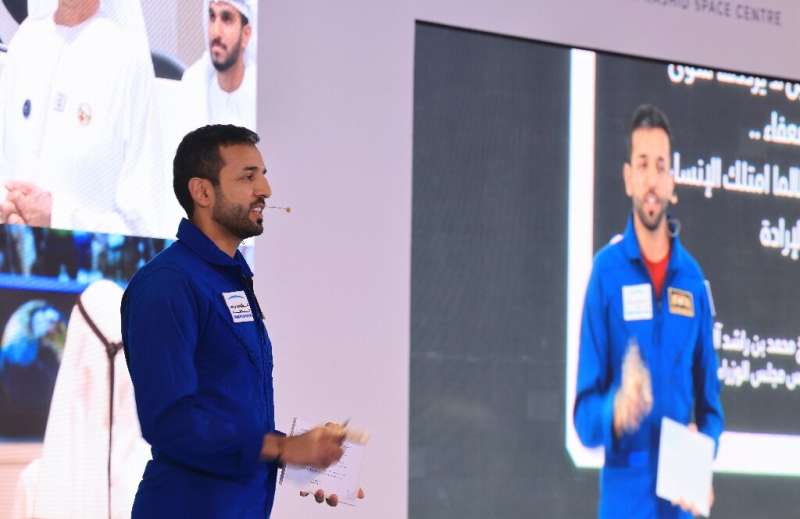
The second Emirati to journey into space, martial arts enthusiast Sultan AlNeyadi, weighed up Thursday performing Ramadan in orbit—and promised to pack his jiu-jitsu suit for the ride.
AlNeyadi, 41, dubbed the "Sultan of Space" by his alma mater, will blast off on February 26 for the International Space Station (ISS) aboard a SpaceX Falcon 9 rocket.
During his six months in orbit—a record time for any Arab astronaut—AlNeyadi said he would like to observe the holy month of Ramadan, when Muslims typically fast from dawn to sunset.
But space travel presents unique challenges.
"The ISS travels quickly... meaning it orbits around the Earth in 90 minutes," he told reporters in Dubai.
Hydrosat wins Air Force contract for thermal infrared data analytics

Hydrosat won a $1.2 million Air Force contract to investigate uses of thermal infrared data for national security applications.
Soon every spacecraft could navigate the solar system autonomously using pulsars
If you want to know where you are in space, you'd better bring along a map. But it's a little more complicated than riding shotgun on a family road trip.
Spacecraft navigation beyond Earth orbit is usually carried out by mission control. A series of radio communication arrays across the planet, known as the Deep Space Network, allows operators to check in with space probes and update their navigational status. The system works, but it could be better. What if a spacecraft could autonomously determine its position, without needing to phone home? That's been a dream of aerospace engineers for a long time, and it's getting close to fruition.
Pulsars are the key.
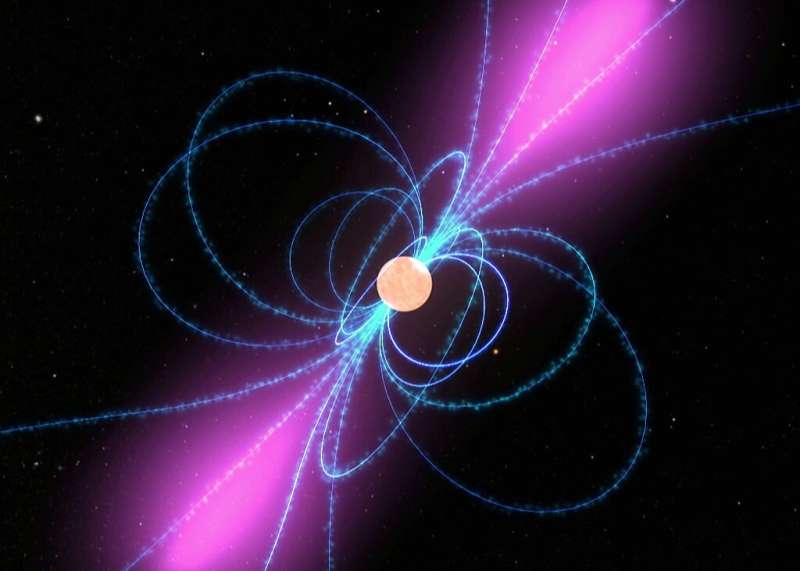
Pulsars are rotating neutron stars—the ultra-dense cores of exploded supergiant stars—which emit jets of electromagnetic radiation from their poles. They act like interstellar lighthouses that repeatedly wash radio signals over Earth in a dependable rhythm. The first pulsar was discovered by Jocelyn Bell in 1967 and was nicknamed LGM-1 (Little Green Men 1), because until a second one was discovered, extraterrestrial intelligence couldn't be ruled out as the pulsar's cause.
First step toward predicting lifespan of electric space propulsion systems
 Electric space propulsion systems use energized atoms to generate thrust. The high-speed beams of ions bump against the graphite surfaces of the thruster, eroding them a little more with each hit, and are the systems' primary lifetime-limiting factor. When ion thrusters are ground tested in an enclosed chamber, the ricocheting particles of carbon from the graphite chamber walls can also redeposi
 The bubbling universe: A previously unknown phase transition in the early universe
 Think of bringing a pot of water to the boil: As the temperature reaches the boiling point, bubbles form in the water, burst and evaporate as the water boils. This continues until there is no more water changing phase from liquid to steam.
This is roughly the idea of what happened in the very early universe, right after the Big Bang, 13.7 billion years ago.
The idea comes from partic
Think of bringing a pot of water to the boil: As the temperature reaches the boiling point, bubbles form in the water, burst and evaporate as the water boils. This continues until there is no more water changing phase from liquid to steam.
This is roughly the idea of what happened in the very early universe, right after the Big Bang, 13.7 billion years ago.
The idea comes from partic Astronauts use spacewalk to continue upgrade of ISS solar arrays
 Astronauts from NASA and Japan Aerospace Exploration Agency stepped out from the International Station to begin a spacewalk early Thursday to complete work started by another work team almost two weeks ago - part of a project to upgrade the station's power generation systems.
NASA's Nicole Mann and JAXA's Koichi Wakata were tasked with finishing work on a mounting platform on one of th
Astronauts from NASA and Japan Aerospace Exploration Agency stepped out from the International Station to begin a spacewalk early Thursday to complete work started by another work team almost two weeks ago - part of a project to upgrade the station's power generation systems.
NASA's Nicole Mann and JAXA's Koichi Wakata were tasked with finishing work on a mounting platform on one of th 


