China aims to establish new global partnership in space exploration, innovation: CNSA
 China is aiming to establish a new global partnership in space exploration and innovation, in an effort to build a community with shared future for humanity in outer space, according to a statement issued by the China National Space Administration on Monday.
The statement was issued during the United Nations/China Global Partnership Workshop on Space Exploration and Innovation, which opene
China is aiming to establish a new global partnership in space exploration and innovation, in an effort to build a community with shared future for humanity in outer space, according to a statement issued by the China National Space Administration on Monday.
The statement was issued during the United Nations/China Global Partnership Workshop on Space Exploration and Innovation, which opene Chen Dong sets national record for longest time in space
 Chen Dong has set a new record for the most cumulative days living and working in space by a Chinese astronaut.
The China Manned Space Agency said on Tuesday that the two-time space traveler, who is onboard China's orbiting Tiangong space station, has become the first Chinese to stay in orbit for more than 200 days.
Together with two other astronauts, Liu Yang and Cai Xuzhe, Chen was
Chen Dong has set a new record for the most cumulative days living and working in space by a Chinese astronaut.
The China Manned Space Agency said on Tuesday that the two-time space traveler, who is onboard China's orbiting Tiangong space station, has become the first Chinese to stay in orbit for more than 200 days.
Together with two other astronauts, Liu Yang and Cai Xuzhe, Chen was Sidus Space signs MOU with Capital C for maritime satellite development
 Sidus Space, Inc. (NASDAQ:SIDU), a Space-as-a-Service company focused on mission critical hardware manufacturing combined with commercial satellite design, manufacture, launch, and data collection, has signed a Memorandum of Understanding ("MOU") with Capital C.
As part of the agreement, Sidus will assist in developing, delivering, and maintaining surveillance and tracking systems with sof
Sidus Space, Inc. (NASDAQ:SIDU), a Space-as-a-Service company focused on mission critical hardware manufacturing combined with commercial satellite design, manufacture, launch, and data collection, has signed a Memorandum of Understanding ("MOU") with Capital C.
As part of the agreement, Sidus will assist in developing, delivering, and maintaining surveillance and tracking systems with sof EchoStar and Maxar amend agreement for Hughes JUPITER 3 satellite production
 EchoStar Corporation (Nasdaq: SATS) has announced an amended agreement with Maxar Technologies (NYSE:MAXR) (TSX:MAXR) for production of the EchoStar XXIV satellite, also known as JUPITER 3. The satellite, designed for EchoStar's Hughes Network Systems division, is under production at Maxar's facility in Palo Alto, CA. The amended agreement compensates EchoStar for past production delays by provi
 NASA's Orion spacecraft set to enter lunar orbit
 NASA's Artemis 1 Orion spacecraft is expected to begin its orbit around the moon on Friday afternoon, following its launch earlier in the week.
Orion will perform an engine burn at 4:52 p.m. EST on Friday, which should send it into a distant retrograde orbit around the moon. The distant term refers to the altitude. The spacecraft will orbit approximately 50,000 miles above the lunar sur
NASA's Artemis 1 Orion spacecraft is expected to begin its orbit around the moon on Friday afternoon, following its launch earlier in the week.
Orion will perform an engine burn at 4:52 p.m. EST on Friday, which should send it into a distant retrograde orbit around the moon. The distant term refers to the altitude. The spacecraft will orbit approximately 50,000 miles above the lunar sur Exploring the duality of gravity and gauge theory
 The gauge/gravity duality states that gravity and quantum spacetime emerge from a quantum gauge theory, which lives at the boundary between both theories. Over the past 25 years, this duality, with concrete instances uncovered by string theory, has revolutionised our understanding of systems ranging from black holes, to matter made up of strongly interacting quantum particles featuring intricate
 DAF outlines space acquisition philosophy, priorities, tenets
 Honorable Frank Calvelli, Assistant Secretary of the Air Force for Space Acquisition and Integration, released a memorandum Oct. 31 that aims to cement the Department of the Air Force's space acquisition top priorities, philosophy, and tenets.
The document highlights DAF's need to prioritize driving speed into acquisitions, building resilient space architectures, and integrating the space
Honorable Frank Calvelli, Assistant Secretary of the Air Force for Space Acquisition and Integration, released a memorandum Oct. 31 that aims to cement the Department of the Air Force's space acquisition top priorities, philosophy, and tenets.
The document highlights DAF's need to prioritize driving speed into acquisitions, building resilient space architectures, and integrating the space Rocket Lab to launch remaining NASA TROPICS satellites
NASA has selected Rocket Lab to launch the remaining four cubesats of a constellation to monitor tropical weather systems after the first two were lost in an Astra launch failure.
The post Rocket Lab to launch remaining NASA TROPICS satellites appeared first on SpaceNews.
Equipment defect delays first commercial Vega C flight
Arianespace said Nov. 25 it is delaying the first commercial flight for Europe’s upgraded Vega C rocket by nearly a month to replace defective equipment.
The post Equipment defect delays first commercial Vega C flight appeared first on SpaceNews.
King of rockets, NASA's SLS could soon be usurped by SpaceX's Starship
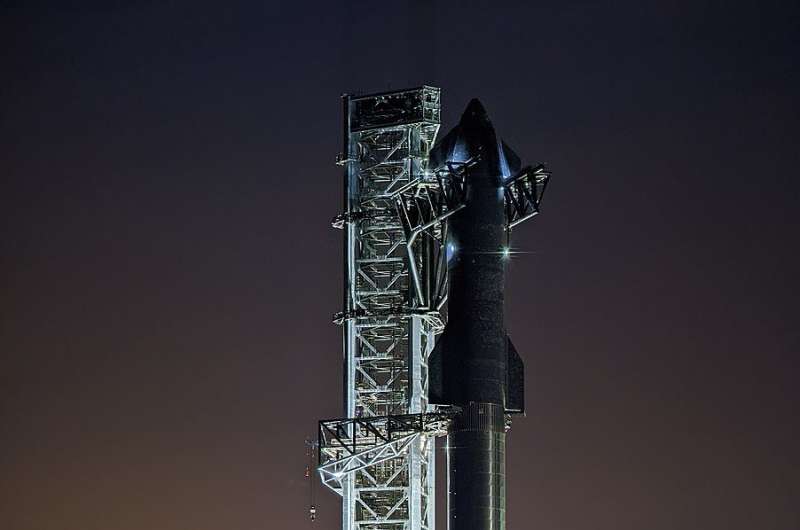
NASA's Space Launch System roared off the launchpad at Kennedy Space Center and into the record books, for now.
The SLS rocket, using a combination of two solid rocket boosters with a core stage consisting of four repurposed RS-25 engines from the space shuttle program, produced 8.8 million pounds of thrust to lift the Orion spacecraft into orbit and help send it on its way to the moon for the uncrewed Artemis I mission.
Its success makes it the most powerful rocket to ever blast into space, besting the power of the Saturn V rockets used during the Apollo moon missions five decades ago, which produced 7.5 million pounds of thrust.
The Soviet Union attempted to launch a rocket called the N-1 on four attempts from 1969-1972 that produced 10.2 million pounds of thrust, but they all failed midflight and never made it to space.
That makes SLS the space rocket king, and its performance was close to perfection, said NASA Artemis mission manager Mike Sarafin.