China launches Zhongxing-1E military communications satellite
China launched a Long March 7A rocket Tuesday, successfully inserting the Zhongxing-1E satellite into geosynchronous transfer orbit.
Competition is growing in the space-data-relay sector
Companies reveal plans for optical and RF data relay networks to address growing demand from satellite operators for high-speed data transfer.
The post Competition is growing in the space-data-relay sector appeared first on SpaceNews.
Slingshot Aerospace rolls out free space-traffic control service

Slingshot Aerospace, a space data analytics company, announced Sept. 13 it is offering a free version of its space traffic control software to satellite operators
The post Slingshot Aerospace rolls out free space-traffic control service appeared first on SpaceNews.
Speedcast nets first Starlink reseller deal for enterprise and maritime

Remote communications provider Speedcast has become the first company to sign a distribution deal to resell SpaceX’s Starlink broadband services to enterprise and maritime customers.
The post Speedcast nets first Starlink reseller deal for enterprise and maritime appeared first on SpaceNews.
Where do high-energy particles that endanger satellites, astronauts and airplanes come from?

For decades, scientists have been trying to solve a vexing problem regarding the weather in outer space: At unpredictable times, high-energy particles bombard the Earth and objects outside the Earth's atmosphere with radiation that can endanger the lives of astronauts and destroy satellites' electronic equipment. These flare-ups can even trigger showers of radiation strong enough to reach passengers in airplanes flying over the North Pole. Despite scientists' best efforts, a clear pattern of how and when flare-ups will occur has remained enduringly difficult to identify.
This week, in a paper in The Astrophysical Journal Letters, authors Luca Comisso and Lorenzo Sironi of Columbia's Department of Astronomy and the Astrophysics Laboratory, have used supercomputers to simulate when and how high-energy particles are born in turbulent environments like that on the atmosphere of the sun. This new research paves the way for more accurate predictions of when dangerous bursts of these particles will occur.
"This exciting new research will allow us to better predict the origin of solar energetic particles and improve forecasting models of space weather events, a key goal of NASA and other space agencies and governments around the globe," Comisso said.
Harpoons, robots and lasers: How to capture defunct satellites and other space junk and bring it back to Earth
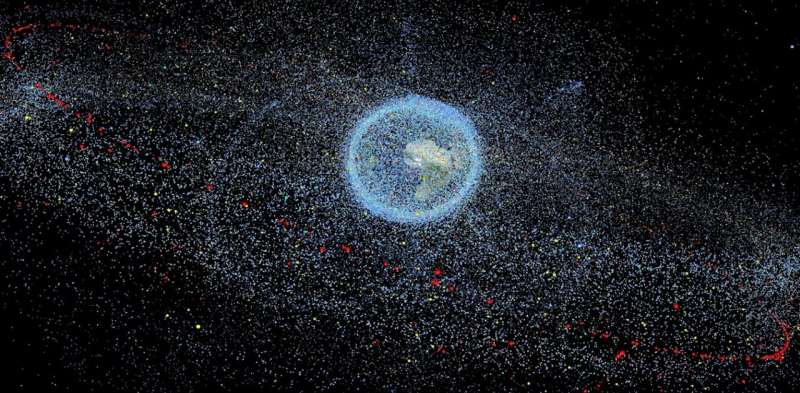
More than half of the thousands of satellites in orbit are now defunct, and this accumulation of floating space debris has been described as a "fatal problem" for current and future space missions and human space travel.
An estimated 130 million objects smaller than 1cm and 34,000 larger than 10cm are traveling in orbit at speeds of thousands of kilometers per hour, according to the European Space Agency (ESA). A report presented at this year's European conference on space debris suggests the amount of space junk could increase fifty-fold by 2100.
While many fragments of space junk are small, they travel so fast their impact has enough energy to disable a satellite or cause significant damage to space stations.
Both the Hubble Telescope and the Solar Maximum Mission (SMM) satellites had coin-sized holes punched into them by flying debris and a mirror on Nasa's James Webb space telescope was damaged by micrometeoroids.
Most satellites were not designed with the end of their usefulness in mind.
The future of space exploration – ESA at IAC 2022
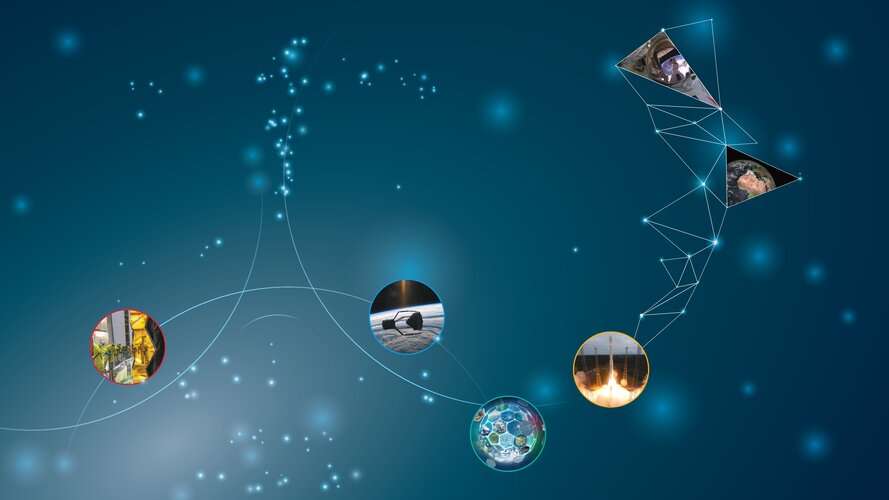
Join us at the ESA stand at the 73rd International Astronautical Congress (IAC 2022), taking place from 18 to 22 September at the Paris Convention Centre in Paris. A week of lively interactions awaits the world space community, this year under the theme 'Space for @ll'. The congress will open its doors to the general public on 21 September.
Op-ed | Whither Mars or Wither Mars?
Are we on a good path toward developing and implementing a human mission to explore Mars?
The post Op-ed | Whither Mars or Wither Mars? appeared first on SpaceNews.
Space Force nominee sees growing threats to U.S. satellites from rival powers
Lt. Gen. B. Chance Saltzman testified at a confirmation hearing Sept. 13 to be the next chief of space operations of the U.S. Space Force
Arianespace and OneWeb reach settlement for suspended launches
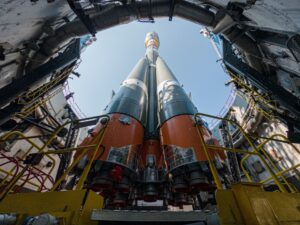
Arianespace said Sept. 13 it has reached a settlement deal that could revive a launch services agreement with OneWeb that was suspended following Russia’s invasion of Ukraine.
The post Arianespace and OneWeb reach settlement for suspended launches appeared first on SpaceNews.