

China's Tianwen-1 has imaged the entire surface of Mars, completing its primary mission
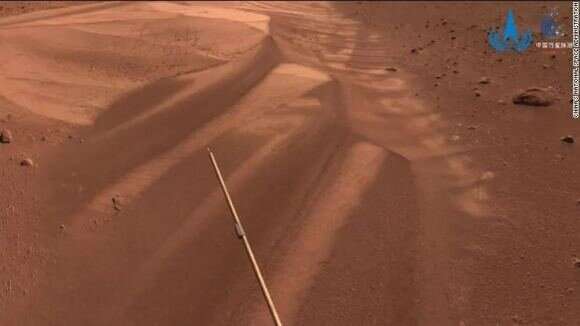
After exploring Mars for more than a year, China's Tianwen-1 space probe has successfully taken images covering the entire Red Planet, China's National Space Administration (CNSA) announced on June 29. Tianwen-1, which translates to "quest for heavenly truth," consists of six separate spacecraft: an orbiter, two deployable cameras, lander, remote camera, and Zhurong rover. The images in question were taken by the orbiter while circling Mars 1,344 times, capturing images of the Red Planet from every angle while Zhurong explored the surface. in the statement, CNSA said the probe has now completed all of its tasks, which included taking medium-resolution images covering the entire planet.
Tianwen-1 was launched on July 23, 2020, amidst the turmoil of the COVID-19 global pandemic.
A swarm of swimming robots to search for life under the ice on Europa
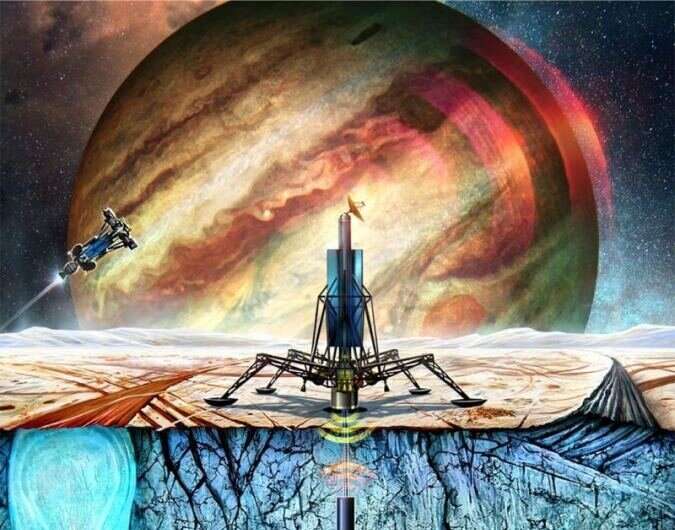
When Galileo pointed his telescope at Jupiter 400 years ago, he saw three blobs of light around the giant planet, which he at first thought were fixed stars.
Uncontrolled rocket descents pose a 10% risk of killing one or more people over the next ten years

OneWeb backs up Starlink 5G interference warning
Plans to use the 12 GHz band for terrestrial 5G would severely disrupt non-geostationary orbit (NGSO) broadband across the United States, OneWeb said July 11 in analysis supporting an earlier study from SpaceX.
The post OneWeb backs up Starlink 5G interference warning appeared first on SpaceNews.
First JWST images excite and relieve astronomers
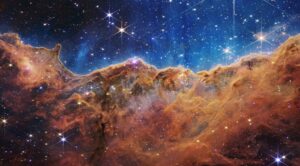
NASA released the long-anticipated first science observations from the James Webb Space Telescope July 12, the culmination of decades of work and the start of a new era in astrophysics.
The post First JWST images excite and relieve astronomers appeared first on SpaceNews.
Baby stars, dancing galaxies: NASA shows new cosmic views
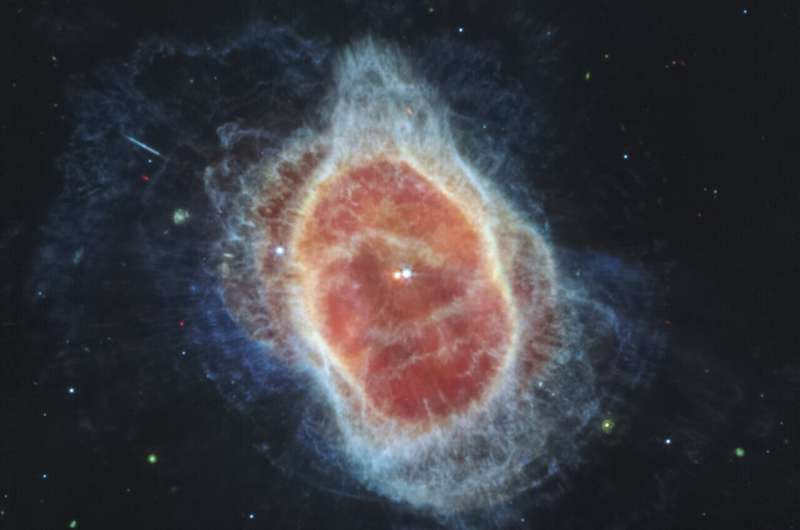
A sparkling landscape of baby stars. A foamy blue and orange view of a dying star. Five galaxies in a cosmic dance. The splendors of the universe glowed in a new batch of images released Tuesday from NASA's powerful new telescope.
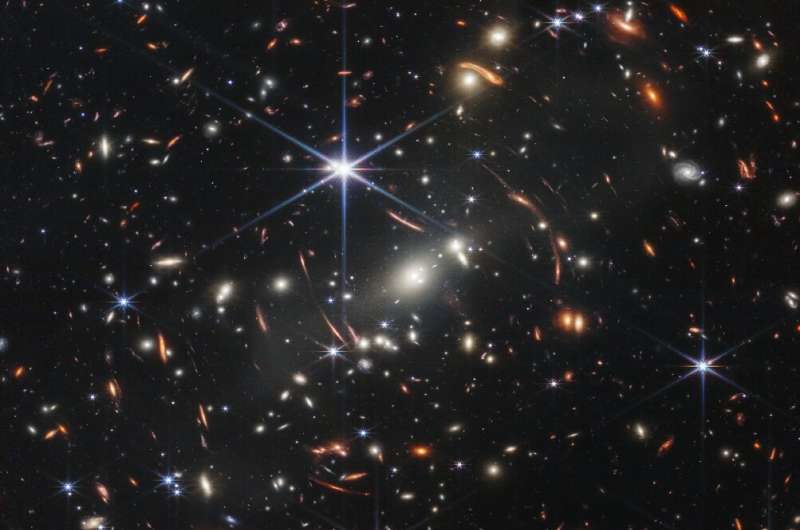
The unveiling from the $10 billion James Webb Space Telescope began Monday at the White House with a sneak peek of the first shot—a jumble of distant galaxies that went deeper into the cosmos than humanity has ever seen.
Webb Telescope: What will scientists learn?
The James Webb Space Telescope's first images aren't just breathtaking—they contain a wealth of scientific insights and clues that researchers are eager to pursue.
Here are some of the things scientists now hope to learn.
Into the deep
Webb's first image, released Monday, delivered the deepest and sharpest infrared image of the distant universe so far, "Webb's First Deep Field."
The white circles and ellipses are from the galaxy cluster in the foreground called SMACS 0723, as it appeared more than 4.6 billion years ago—roughly when our Sun formed too.
The reddish arcs are from light from ancient galaxies that has traveled more than 13 billion years, bending around the foreground cluster, which acts as a gravitational lens.
NASA's Webb reveals steamy atmosphere of distant planet in detail
 NASA's James Webb Space Telescope has captured the distinct signature of water, along with evidence for clouds and haze, in the atmosphere surrounding a hot, puffy gas giant planet orbiting a distant Sun-like star.
The observation, which reveals the presence of specific gas molecules based on tiny decreases in the brightness of precise colors of light, is the most detailed of its kind to d
NASA's James Webb Space Telescope has captured the distinct signature of water, along with evidence for clouds and haze, in the atmosphere surrounding a hot, puffy gas giant planet orbiting a distant Sun-like star.
The observation, which reveals the presence of specific gas molecules based on tiny decreases in the brightness of precise colors of light, is the most detailed of its kind to d Hopping space dust may influence the way asteroids look and move
 Like corn kernels popping in a frying pan, tiny grains of dust may hop around on the surface of asteroids, according to a new study from physicists at CU Boulder.
That popcorn-like effect may even help to tidy up smaller asteroids, causing them to lose dust and look rough and craggy from space.
The researchers published their results July 11 in the journal Nature Astronomy. Their fin
Like corn kernels popping in a frying pan, tiny grains of dust may hop around on the surface of asteroids, according to a new study from physicists at CU Boulder.
That popcorn-like effect may even help to tidy up smaller asteroids, causing them to lose dust and look rough and craggy from space.
The researchers published their results July 11 in the journal Nature Astronomy. Their fin Machine learning 'phones home' for famous Martian rock
 New Curtin-led research has pinpointed the exact home of the oldest and most famous Martian meteorite for the first time ever, offering critical geological clues about the earliest origins of Mars.
Using a multidisciplinary approach involving a machine learning algorithm, the new research - published in Nature Communications - identified the particular crater on Mars that ejected the so-ca
New Curtin-led research has pinpointed the exact home of the oldest and most famous Martian meteorite for the first time ever, offering critical geological clues about the earliest origins of Mars.
Using a multidisciplinary approach involving a machine learning algorithm, the new research - published in Nature Communications - identified the particular crater on Mars that ejected the so-ca 


