

Software problem delays NASA Psyche launch
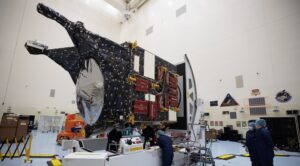
The launch of a NASA mission to the asteroid Psyche has been delayed at least a month and a half because of a problem with the spacecraft’s software, the agency confirmed May 23.
Forget about Mars, when will humans be flying to Saturn?
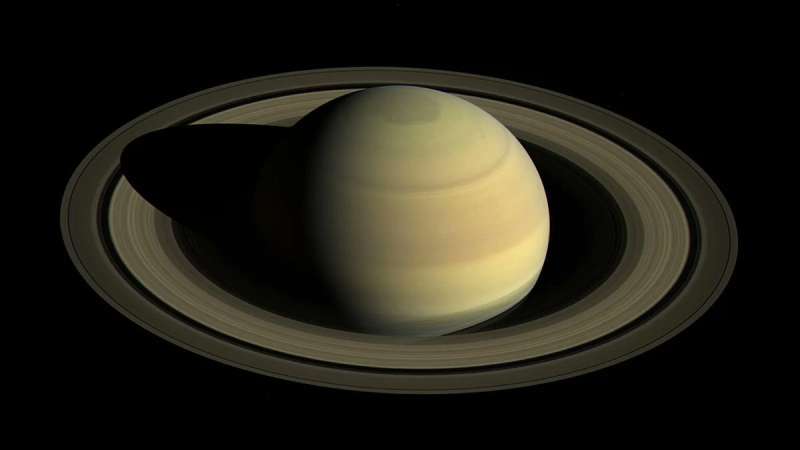
It might be hard to fathom now, but the human exploration of the solar system isn't going to stop at the moon and Mars. Eventually, our descendants will spread throughout the solar system—for those interested in space exploration, the question is only of when rather than if. Answering that question is the focus of a new paper released on arXiv by a group of researchers from the U.S., China, and the Netherlands. Their approach is highly theoretical, but it is likely more accurate than previous estimates, and it gives a reasonable idea of when we could expect to see humans in the outer solar system. The latest they think we could reach the Saturnian system is 2153.
How to even start such a calculation is complicated, so it's best to start at the basics, which in this case involves a bit of calculus. To understand when humans will reach further out in the solar system, the authors needed two variables—distance and time. In this case, distance is defined as the distance from Earth that humans have traveled, and time is defined as having started at the beginning of the space race in 1957 when no human had yet left Earth.
NASA is building a mission that will refuel and repair satellites in orbit
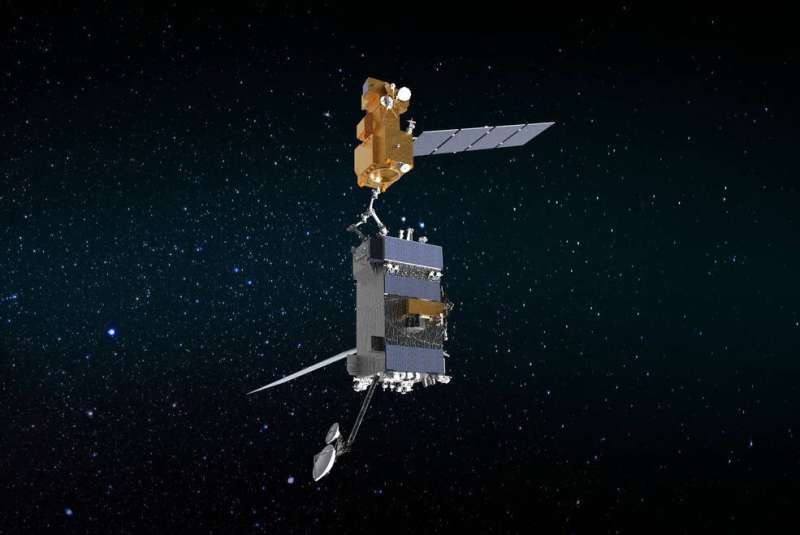
NASA is planning a mission to demonstrate the ability to repair and upgrade satellites in Earth orbit. The mission, called OSAM-1 (On-orbit Servicing, Assembly, and Manufacturing-1), will send a robotic spacecraft equipped with robotic arms and all the tools and equipment needed to fix, refuel or extend satellites' lifespans, even if those satellites were not designed to be serviced on orbit.
The first test flight of OSAM-1 is scheduled for launch no earlier than 2026 and will go to low Earth orbit to rendezvous, grapple and dock with Landsat 7, an Earth observing satellite that has been in orbit since 1999. The mission will conduct a first-of-its-kind refueling demonstration test, then relocate the satellite to a new orbit. While some parts of the mission are autonomous, human tele-operators will conduct much of the procedures and maneuvers remotely from Earth.
NASA says that repairing satellites—instead of just letting defunct spacecraft drift in Earth orbit—helps decrease space debris to create a more sustainable future for space exploration.
GHGSat joins ESA’s Third Party Mission Programme
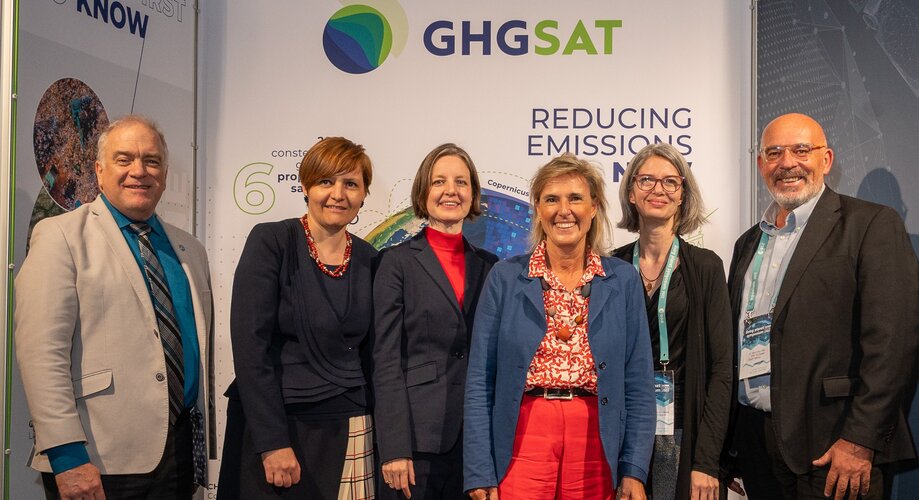
GHGSat, a leader in high-resolution greenhouse gas monitoring from space, has officially joined ESA’s prestigious Third Party Mission Programme. Announced today at the Living Planet Symposium currently taking place in Bonn, data from the company’s fleet of commercial satellites will be provided, free of charge, to researchers working in the fields of Earth science and climate change. Users will be able to access greenhouse gas measurements from sites all around the world.
NASA Awards Contract to National Academy of Sciences
 NASA has awarded a sole-source contract to the National Academy of Sciences of Washington to conduct studies on questions of national importance within the domain of NASA science and technology programs relating to space science, Earth science, and biological and physical science in space.
 AWS picks 10 startups for 2022 space accelerator
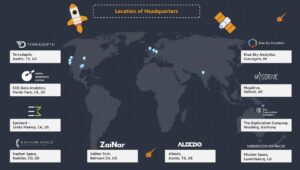
Amazon Web Services announced May 24 it has picked 10 startups to join its second annual space accelerator program, which helps early-stage companies learn how to grow their businesses with cloud and analytic technologies.
BlueHalo wins $1.4 billion contract to upgrade U.S. satellite control network
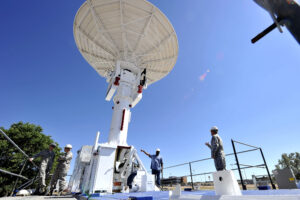
The Space Rapid Capabilities Office awarded BlueHalo a $1.4 billion contract to add satellite communications capacity to the ground network used by the U.S. military to command and control satellites .
Starlink’s RV service lets users jump the line for a price
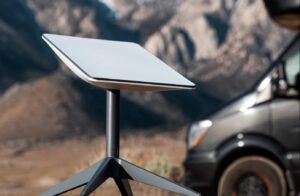
A new Starlink plan lets customers pay more to skip waitlists to connect to its broadband satellites without a fixed address, although connection speeds for other users will be prioritized.
The post Starlink’s RV service lets users jump the line for a price appeared first on SpaceNews.
Experts offer advice for space sector entrepreneurs

At the Space Tech Expo May 24, space industry executives and startup founders shared advice for fledgling startups.
The post Experts offer advice for space sector entrepreneurs appeared first on SpaceNews.
Space Systems Command refines front-door concept

The U.S. Space Systems Command is continuing to refine its concept for establishing a single point of contact for commercial innovators called the front door.
The post Space Systems Command refines front-door concept appeared first on SpaceNews.


