

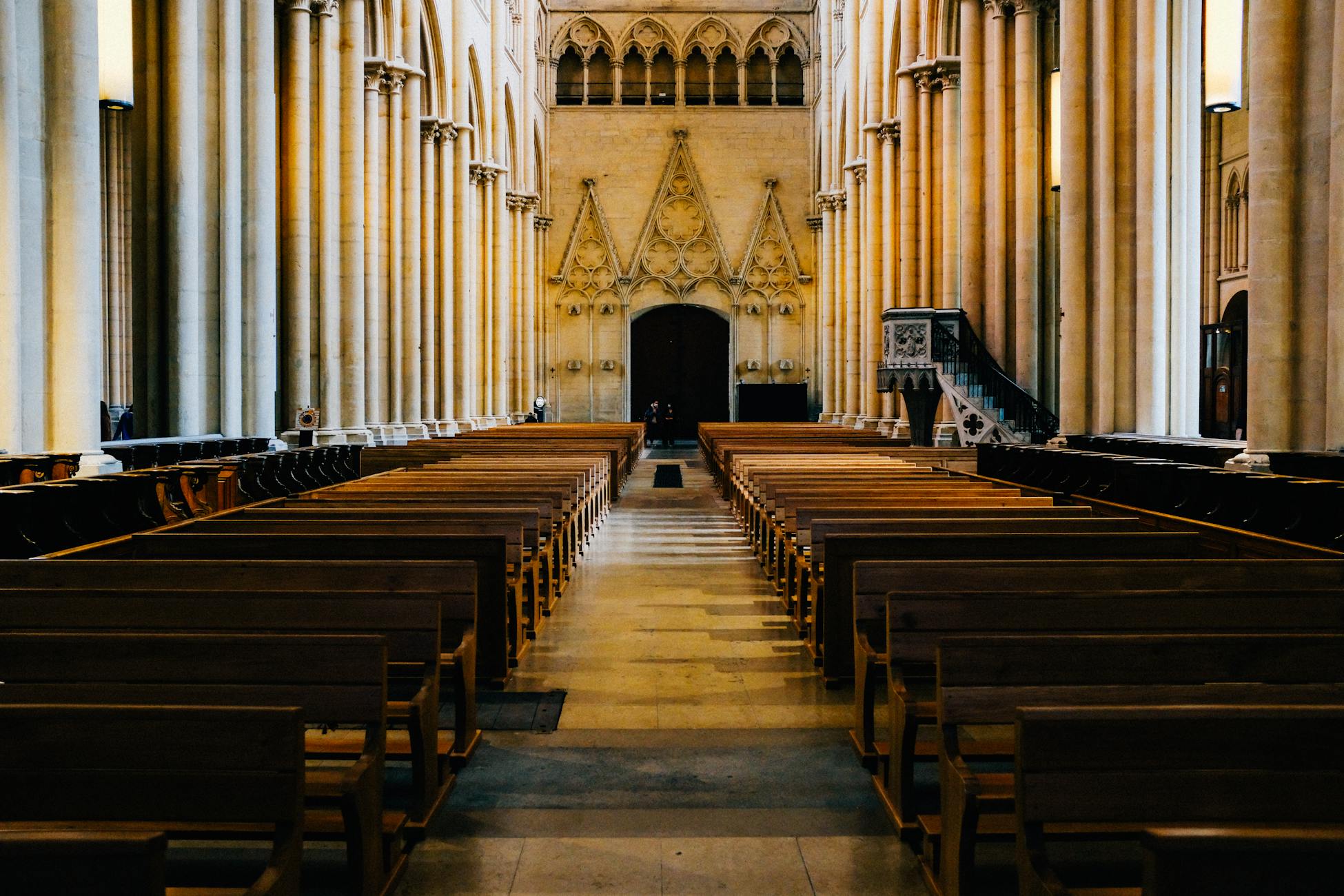
My grandmother’s service was three weeks ago, and somewhere between the second hymn and the eulogy I realized I was cataloguing the acoustics of the church. Not listening to the words. Cataloguing. Noting how the reverb softened the priest’s consonants, how the woman two pews ahead was crying in a register I associated with relief rather than loss, how my wife’s hand on my knee was applying slightly more pressure than usual. I was crying, too. But I was watching myself cry, the way you might watch footage of yourself from a surveillance camera, interested in the data but slightly removed from the subject.
Most people, I think, would call this composure. The ability to stay functional at a funeral, to handle logistics, to be the person who remembers to tip the funeral director and bring extra tissues for the cousin who always falls apart. The conventional wisdom treats this steadiness as a virtue, a sign of emotional maturity. That framing collapses when you notice that the person doing the watching never actually arrives at the grief. Forty-one years of funerals, and I have been present at none of them.
I started counting on the drive home. My grandfather when I was nine. A neighbor when I was twelve. A classmate at fifteen who died in a way nobody would explain to us. An uncle. A colleague. My wife’s mentor from law school. A man I had worked with for six years whose wife called me the morning after it happened because she wasn’t sure who else would know how to reach his professional contacts. At every single one of these, I now realize, I was performing the same specific act: observing my own emotional response with enough distance to assess whether it was appropriate to the circumstance, adequate to the deceased, proportionate to my relationship with the room.
The Observer Behind the Glass
Psychologists have a vocabulary for this, though none of the available words quite capture the precision of the experience. Intellectualization is the closest clinical term. The defense mechanism is the use of abstract thought to avoid the embodied experience of an emotion, a kind of cognitive sleight of hand where the feeling gets converted into an object of study before it can metabolize through the body. The person intellectualizing is not faking their emotion. They are genuinely having it. They are just having it at arm’s length, the way a sommelier might have a glass of wine — tasting, noting, assessing, never actually drinking.
What the clinical literature tends to miss is how early this habit starts, and how hard it is to detect from inside it. I didn’t invent my watchfulness at my grandmother’s funeral. I brought it there. I have been bringing it to every loss since I was a child, and the reason I could not see it until now is that the watching has always felt like me. Not like a coping mechanism. Not like a wall. Like the actual shape of my interior.
This is what this essay is about: the particular loneliness of realizing that your entire emotional life has been conducted through a pane of glass, and that you were the one who installed it.
The Contract You Sign Before You Can Read
Children who grow up in households where emotional expression is unevenly distributed learn very early to read the weather. If one parent is the designated feeler — the one who falls apart, the one whose moods organize the room — the other family members begin to specialize. Someone becomes the fixer. Someone becomes the peacekeeper. Someone becomes the observer, the one who stays calm enough to narrate what’s happening so that the feeler doesn’t have to do it alone. I have written before about constant self-monitoring as a survival habit, but I underestimated how deep it runs. It does not just shape how you present yourself to others. It shapes how you are present to yourself.
The observer child learns a specific contract. You may have emotions, but you must know what they are before you express them. You must label them, measure them, confirm that they are proportionate to the circumstance, and only then — after the internal audit is complete — may you allow them outward. This is not taught explicitly. It is absorbed from watching what happens to the feeler when they do not perform this audit. The feeler gets overwhelmed. The feeler gets criticized. The feeler becomes the reason the dinner ends early.
So the observer learns to pre-digest. By the time a tear is permitted to reach the surface, it has been processed through three layers of cognition: is this sad enough to cry about, is crying appropriate here, what will crying communicate to the people watching. Feelings that never get fully experienced do not actually go away but instead accumulate, translating themselves into physical symptoms, rumination, and an eventual estrangement from one’s own interior life. The observer is not avoiding feeling. The observer is deferring it. Indefinitely.
The Funeral as Diagnostic
What makes funerals such clean diagnostic instruments is that they are one of the few remaining social contexts in which visible grief is not only permitted but expected. The usual alibi for composure — that the situation does not warrant a display — does not apply. If you cannot cry freely at a funeral, you cannot cry freely anywhere. And if you find yourself, as I did, cataloguing acoustics and assessing the relative tear production of other mourners, you are receiving information about the rest of your life that you have probably been refusing to hear.
I thought about my grandfather’s funeral on the drive home. I was nine. I remember looking at my mother, who was not crying, and deciding that I also would not cry, and then noticing my own decision and feeling something that at nine I did not have the word for but which I now recognize as loneliness. Not because no one was there. Because I had just made myself not there. I had chosen, at nine years old, to meet the first significant loss of my life as a spectator.
Every funeral after that was a rehearsal of the same performance. My uncle, whom I had loved specifically and well, died when I was twenty-six, and I remember standing at the reception afterward making conversation with his coworkers about his career, a career I had always found slightly tragic in its smallness, and feeling the same observer-self assembling sentences that would honor him without lying. I was proud, at the time, of my composure. I mistook it for love.

What Calm Actually Is
Regulation implies that an emotion was present and was skillfully managed — felt in the body, named, given room, and then released. Avoidance implies that the emotion was never actually permitted to arrive. From the outside, the two can look identical. The person appears calm. Their voice stays level. They handle the logistics. But internally, one person has moved through something and the other has stood beside it, taking notes.
That is what I have been doing. Taking notes. At every funeral, every deathbed, every difficult conversation with a friend whose life was falling apart, I have been the person with the clipboard. It is a form of emotional avoidance that disguises itself as reliability, because the observer-self is almost always useful. People want you at their funerals. People want you at their hospital bedsides. The observer can be trusted to say the right thing, to manage the family member who is spiraling, to remember the detail about the deceased that will make the eulogy land. What no one notices — what I did not notice — is that the observer is not mourning. The observer is working.
The Cost Nobody Mentions
My wife told me, last year, that living with me sometimes felt like being loved by someone watching from a window. I wrote an essay about it. I thought I understood what she meant. I did not. What I understood was the diagnosis. What I did not understand was that the same glass she was describing sits between me and my own life, and that every time I have failed to fully grieve someone, I have been failing to fully have known them. Grief is not separable from love. The grief you cannot feel is the love you cannot access.
I think this is why my grandmother’s funeral finally broke the pattern — not enough to dissolve it, but enough to make it visible. She was the last person alive who had known me before I became the observer. She had photographs of me at four, before the glass went up, when I was still a child who cried when things hurt and laughed when things were funny and did not conduct an internal audit between the stimulus and the response. At her service, I think some small part of me understood that the version of me she had loved was being buried with her, and that if I did not find a way to grieve her the grief would simply join the others, stacked in whatever interior warehouse I have been filling since I was nine.
I did not find a way. I sat in the pew and catalogued the acoustics. But on the drive home I noticed what I had done, and the noticing itself felt different from the watching — sharper, closer, with something that resembled heat behind it. The observer observing the observer. Perhaps that is where the glass first develops a crack. I do not know. I am not yet on the other side of anything.
What I Am Not Going to Do
I am not going to end this essay with a plan. I have spent my entire life making plans, and one of the things I have come to suspect about the observer habit is that it loves plans, because plans are another form of the same move — a way of converting a raw experience into a manageable object before it can touch you. If I announce that I am going to therapy, or that I am going to sit with my feelings, or that I am going to do the work, the announcement itself will become the replacement for the thing announced. I know this about myself. It is, in its own way, another note from the clipboard.
What I can say is that I am forty-one, and I have attended perhaps a dozen funerals, and I have not been to any of them. I can say that the people I have lost deserved a version of me that was willing to be undone by losing them, and that I gave them, instead, a version that stayed intact. I can say that noticing this now, three weeks after burying the last person who knew me before the watching started, is either the beginning of something or the most sophisticated iteration yet of the same old avoidance. I genuinely do not know which. The observer in me is already drafting arguments for both.
My wife is asleep down the hall. The house is quiet. I am sitting at the kitchen counter with the espresso machine cold beside me, writing this, and I notice that I am writing instead of crying, and I notice that I am noticing, and somewhere beneath all of the noticing there is a nine-year-old boy at his grandfather’s funeral who made a decision he did not know he was making and has been paying for it ever since. I would like to tell him he can cry now. I am not sure he would believe me. I am not sure, yet, that I would be telling the truth.