
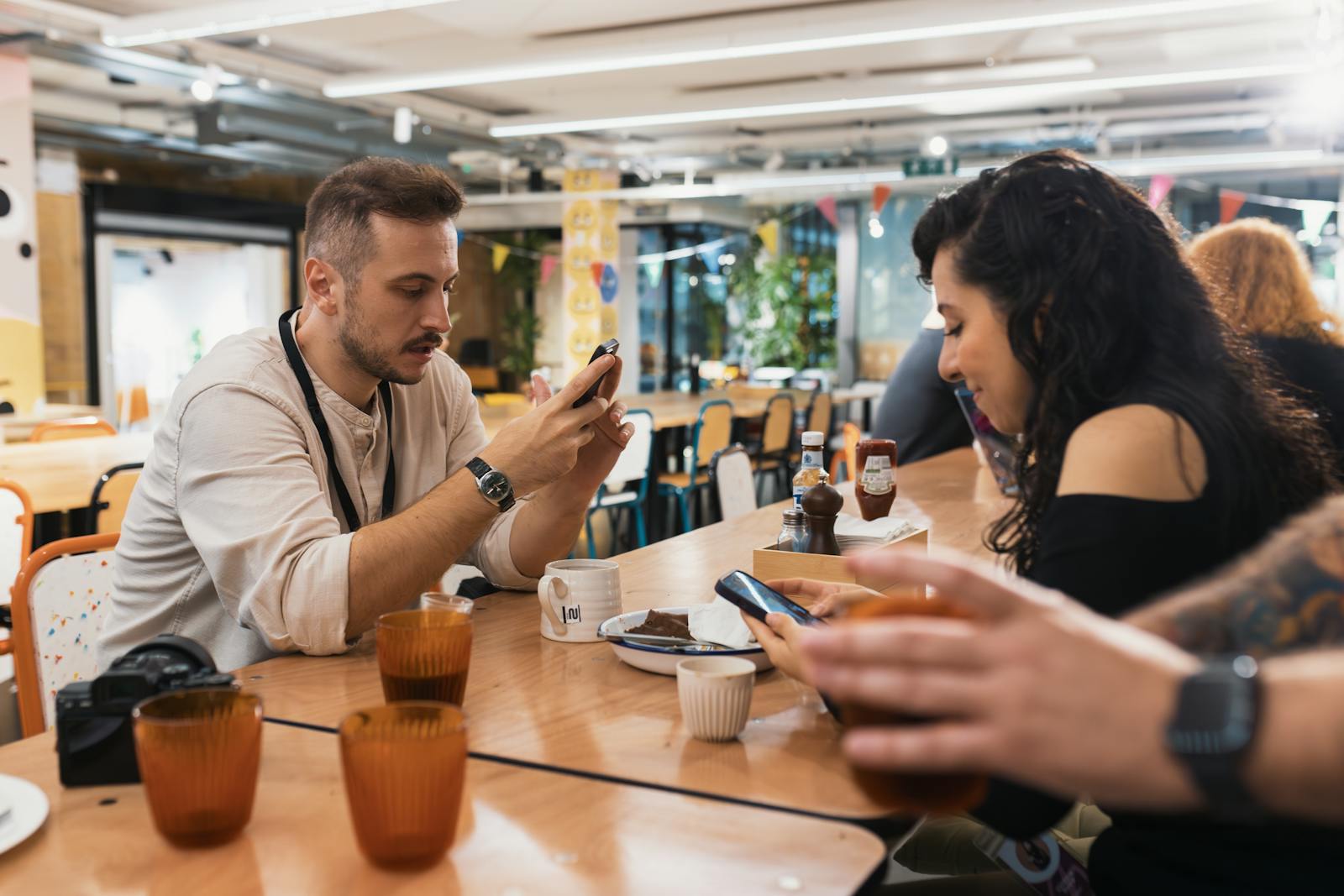
The phone face-down on the table is a small act of resistance most people perform without naming it. It looks like a courtesy, and sometimes it is. But underneath that little gesture is usually a longer story about who learned, somewhere along the way, that being constantly reachable was a deal they never actually agreed to.
Watch closely the next time you are in a restaurant. Some people place their phone screen-up beside their water glass, glancing at it the way a sailor checks the horizon. Others slide it into a pocket. And then there is a third category — the people who, almost ritualistically, set the phone face-down before they sit. They are not hiding messages. They are quietly resisting a culture that has decided their attention belongs to whoever wants it.
The gesture is older than the technology
Long before smartphones, there were people who unplugged the landline during dinner, who refused to answer the door after a certain hour, who treated their attention as something to be given rather than extracted. The face-down phone is the modern version of that same instinct. The hardware changed. The psychology did not.
What is new is the volume. Smartphone owners now interact with their devices frequently throughout the day, and a study of more than a thousand college students found smartphone overuse before bed correlates with sleep disturbance and procrastination. The device is not neutral. It is a steady drip of other people’s priorities, arriving in your pocket on their schedule.
Turning the phone face-down is one of the few moments in a day where someone says, quietly and without announcement, not right now.
What the gesture actually communicates
People assume the face-down phone is about secrecy. A partner sees it and wonders what is being hidden. A colleague reads it as evasion. The interpretation says more about the observer than the person doing it.
For most people who do this consistently, the motive is the opposite of secretive. They are trying to be more present, not less honest. The screen-down position removes the visual pull of notifications, and even a face-up, silent phone fragments cognitive performance simply by sitting in view. The brain keeps a small process running in the background, monitoring the device. Flipping it over closes that process.
So the gesture is, functionally, a tiny act of cognitive housekeeping. It says: I want my attention back.
The relational expectation the phone produced
Phones did not just change how we communicate. They rewrote what people expect from each other. A text sent at 9:47 pm is presumed to land. A reply that takes six hours starts to feel like a verdict. The norm has shifted from responding when convenient to expecting immediate replies, and that shift has crept into friendships, families, and workplaces without ever being formally negotiated.
This is the dynamic the face-down phone is quietly resisting. Not the device itself, but the relational expectation it has produced. The expectation that other people’s urgency is now your problem.
Maybe it was a parent who called repeatedly until they answered. A friend group where silence got punished. A partner whose moods could not tolerate a delayed reply. A workplace where availability was confused with loyalty. The phone became, over time, an instrument someone else played. The face-down placement is what happens when a person finally figures out that they get to decide when to pick the instrument back up.
The exhaustion behind the habit
I want to be careful not to romanticize this. Many people who keep their phones face-down are not enlightened minimalists. They are tired.
They are the dependable friend, the reliable employee, the parent whose group chats never stop. They have spent years being the person other people reach for when they need something, and the phone is the artery through which that reaching travels. Turning it over is less a philosophy than a small act of self-preservation.
This pattern overlaps with what I have come to think of as the quiet exhaustion of being the dependable one. Dependable people get more messages. They have learned that responsiveness, once demonstrated, becomes assumed. The face-down phone is one of the few tools they have to claw back a sliver of the day.
Why it shows up at meals especially
Mealtimes carry a particular weight. They are one of the few remaining structured occasions where humans agree to sit across from each other for an extended period. The impulse to protect this time from screens is increasingly common, recognizing the cost of a divided dinner table.
Adults intuit this without needing formal guidance. The face-down phone at a restaurant or kitchen table is a small acknowledgment that this hour belongs to the people physically present. The flip is a vow.
Couples who do this consistently often find that their conversations get longer and stranger. Topics emerge that would not have surfaced in a fragmented exchange. This is not surprising. Real conversation requires uninterrupted runway, and the phone, even silent, even face-up, is a constant micro-interruption.
The misreading from the other side
Partners and family members sometimes interpret the face-down habit as withdrawal. They feel cut out. The instinct is to ask: what are you hiding?
It is almost always the wrong question. The better question is: what are you protecting, and from whom?
The answer usually has nothing to do with the person asking. It has to do with everyone else — the work emails, the family group chat, the friend in crisis, the news alerts, the slow accretion of demands that the device delivers in a steady stream. The face-down phone is not a wall around a secret. It is a small gate around a finite supply of attention.
The link to authenticity
I think this is part of why the gesture has become quietly meaningful to people who notice it. It is one of the few visible markers, in a culture of constant performance, that someone has decided to stop performing availability.
Space Daily has covered how genuinely authentic people tend to stop editing themselves for the room. The face-down phone is a tiny version of that. It says: I am not editing my presence right now. I am here, and only here, until I decide otherwise.
It is not a grand declaration. Most people who do it could not articulate why. They just know that something improves when the screen is not staring at them.

What the research actually shows
This is not just intuition. Researchers studying what they call “the mere presence effect” have found that a phone visible on a table, even silent, even untouched, measurably reduces the quality of the conversation happening over it. Participants in studies report feeling less connected, less empathetic, and less satisfied with the interaction when a phone is in view, compared to identical conversations conducted without one. The effect persists even when neither person checks the device.
Andrew Przybylski and Netta Weinstein, the researchers behind some of this work, describe the phone as a kind of psychological gravity well — pulling a portion of attention toward absent others even when no one looks at it. Flipping the phone over does not eliminate this entirely, but it reduces the visible cue, and the cue is most of the cost.
The gesture is not a cure. But it is a small, repeatable signal to your own nervous system that you are not on call.
The quiet politics of the gesture
When someone places their phone face-down at the start of a conversation, they are making a small political statement they may not even register. They are saying: the people in this room outrank the people in this device. They are saying: my time is finite, and I have decided how to spend the next hour.
This sounds obvious. It is increasingly rare.
The people who do this consistently are not virtuous. They are not better than anyone else. But they have usually figured out, often through some painful chapter, that being constantly reachable was a deal they never actually agreed to. They were drafted into it. The face-down phone is them, quietly, undrafting themselves.
It is one of the smallest visible boundaries a person can set. And like most real boundaries, it does not need to be announced to work.
Photo by Matheus Bertelli on Pexels