

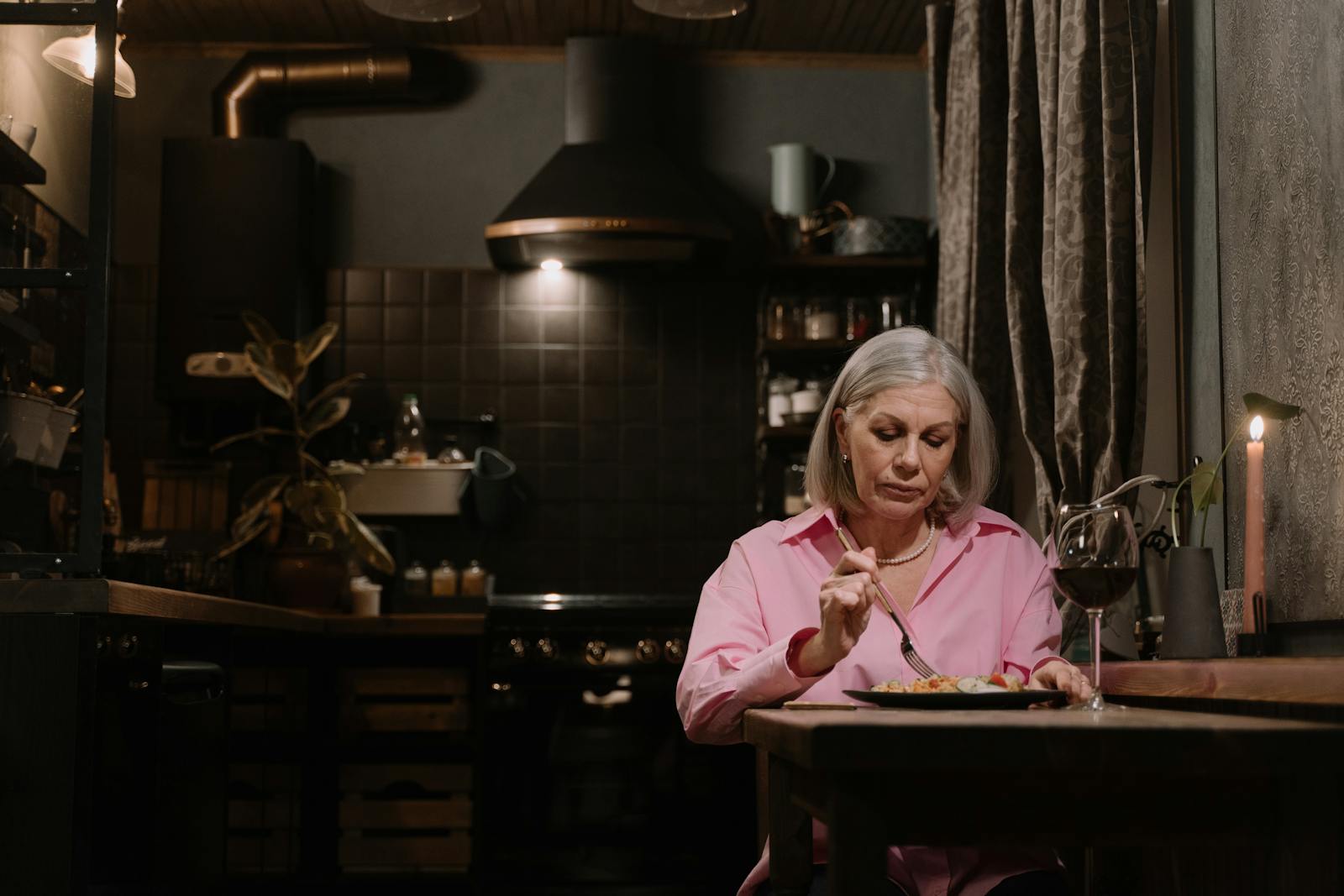
There’s a particular quiet in a kitchen at 11 p.m. when the dishes are done, the child is asleep, and the person who spent the day holding everything together finally sits down. The light is too bright. The hum of the refrigerator is too loud. And the feeling that surfaces is not peace — it’s the low vibration of something unprocessed, waiting for a quieter moment to speak. That moment is what a lot of people call healing. It is closer to containment.
Self-sufficiency is one of the most socially rewarded traits in adult life. It gets you promoted, praised, trusted with other people’s problems. It also happens to be the most effective camouflage ever invented for unresolved pain.
The difference between not needing help and not asking for it
Healing and high-functioning look almost identical from the outside. Both involve showing up, keeping commitments, managing moods, staying productive. The distinction lives entirely in the interior — in what happens when no one is watching, in how the body feels when the day ends, in whether the silence is restful or electric.
People who have genuinely processed something tend to talk about it plainly. They can describe what hurt, what they did about it, what they learned. People who have only gotten better at hiding it tend to change the subject, make a joke, or redirect to the other person. The redirect is the tell.
What looks like resilience is often a sophisticated avoidance system. Psychologists have described how every emotion becomes a double emotion once you’ve trained yourself to see feelings as dangerous — first you feel the thing, then you feel bad for feeling the thing. The person who prides themselves on never burdening anyone is often running this loop constantly, just silently.
Why self-sufficiency gets mistaken for growth
There’s a cultural script that says healing means independence. You leave the bad relationship, you stop calling the friend who drains you, you build a life where you don’t need anyone to rescue you. All of that can be real progress. It can also be the beginning of a different problem, where independence quietly hardens into isolation and isolation gets rebranded as strength.
The difference matters because the outcomes diverge sharply over time. Real healing tends to increase a person’s capacity for connection. Camouflaged pain tends to decrease it. If you’re five years into your “healing journey” and your circle has gotten smaller, your conversations shallower, and your tolerance for vulnerability lower, something has gone sideways.
My wife practices immigration law, and one thing we talk about often is the gap between how policy reads on paper and how it lands on an actual person’s life. Psychology has a similar gap. On paper, self-reliance is healthy. In a specific person’s nervous system, it might be a trauma response with good PR.
The tells that something is still unhealed
A few patterns tend to cluster in people who have mistaken management for resolution. They cancel plans when emotionally taxed and call it self-care, when the pattern is actually avoidance. Research on avoidance behavior suggests that when you cancel because of anxiety, you reinforce the idea that the situation was dangerous, and over time your brain starts flagging similar situations as threats. Self-care becomes a closing door.
They procrastinate on anything that requires sitting with uncertainty. Mental health experts have pointed out that completing emotionally difficult tasks requires the brain to tolerate suppression and delay gratification, and when that capacity is underdeveloped, procrastination fills the gap. The person looks lazy. They’re not lazy. They’re flinching.
They over-function in crises and under-function in calm. Put them in a hospital waiting room and they’ll coordinate the family, call the insurance company, make the coffee. Put them on a quiet Sunday afternoon with nothing to do and they’ll feel like they’re coming apart. Crisis is easier than stillness because crisis doesn’t require feeling.
What the research actually says about suppression
The picture is more complicated than the usual therapy-culture line that all suppression is bad. A University of Cambridge study trained 120 volunteers to suppress thoughts about negative events worrying them and found that the thoughts became less vivid and the participants’ mental health improved — a finding that runs counter to decades of clinical orthodoxy. Short-term suppression, done deliberately, can help.
What doesn’t help is chronic suppression dressed up as functionality. The difference is whether you’re choosing to put something down for a moment so you can drive to work, or whether you’ve built an entire identity around never picking it up again. The first is regulation. The second is what psychologists mean when they talk about emotion regulation being widely misunderstood — not as a synonym for control, but as the flexible capacity to engage with feelings rather than just manage their surface.
Moral emotions research published in Frontiers in Psychology suggests that feelings like guilt and shame, when chronically unaddressed, mediate the relationship between life stress and mental health symptoms. You can get very good at functioning around these emotions without ever letting them metabolize, and the body keeps the tab.
The social cost of looking fine
One of the cruelest parts of this pattern is that it works. People stop asking if you’re okay because you’ve trained them not to. Being trusted often means people stop checking on you because they assumed you didn’t need it. Capability is read as sufficiency. Sufficiency is read as “doing fine.” Doing fine gets you left alone.
This is how you end up as the person everyone calls in a bad week and no one calls on a Tuesday. There’s a version of this pattern — the quiet cruelty of emotional utility without emotional intimacy — where you become a resource rather than a relationship. It happens slowly. It’s almost never anyone’s fault in particular. And it leaves the self-sufficient person with a strange, unnamed ache that looks nothing like what they thought loneliness was supposed to feel like.
The ache is not that you have no one. The ache is that the people you have don’t know the version of you that would need them.
Emotional contagion and the cost of always being the calm one
There’s a fascinating line of research on something psychologists call emotional contagion — the unconscious tendency to absorb the feelings of the people around you. A study from the Institut universitaire de gériatrie de Montréal found that older adults highly vulnerable to emotional contagion were 8.5 to 10 times more likely to show symptoms of anxiety or anxious depression than less vulnerable peers, independent of their social support or coping strategies.
The people who become everyone’s emotional anchor are often high on this trait. They feel other people’s distress in their own body. Then they manage both — the other person’s feeling and their own reaction to it — while presenting as steady. That’s not healing. That’s labor. And it accumulates.
Psychoeducator Marie-Josée Richer, who led that research, described emotional contagion as an adaptive response that happens through unconscious mimicry of facial expressions and postures. The adaptive part matters. It’s the foundation of empathy. But for someone who has made self-sufficiency their identity, it becomes a one-way channel: other people’s feelings come in, their own feelings never come out.
Why movement sometimes helps more than insight
One of the more useful findings in recent emotion research is that the body often processes what the mind can’t talk itself into. Regular physical activity has documented effects on mood regulation and emotional well-being, not because exercise is a substitute for dealing with feelings, but because it seems to lower the threshold at which feelings can be felt without overwhelming the system.
This is worth knowing because a lot of self-sufficient people resist therapy or hard conversations but will agree to a run. The run doesn’t replace the conversation. But it can make the conversation possible later, by taking enough charge out of the nervous system that the person can actually stay in their body while the hard thing gets said.
What real healing tends to look like
It’s quieter than performance healing. It doesn’t announce itself on social media. It often looks like small, undramatic admissions — telling a friend you’re actually not okay this week, letting your partner see you cry without immediately apologizing for it, answering “how are you” with something other than “busy, good.”
It involves a tolerance for being witnessed. Self-sufficient people are often excellent at observing and terrible at being observed. Real progress usually shows up as a small increase in the capacity to be on the receiving end of care without deflecting it or paying it back within 24 hours.
It also involves the slow recognition that some things don’t need to be solved, just acknowledged. A grief does not require a productivity framework. A disappointment does not require a silver lining. The pressure to turn every painful experience into a growth narrative is itself a form of suppression — a refusal to let the thing be what it is before conscripting it into a story about your resilience.
The honest version of the question
The useful thing to ask is not “am I healed?” It’s “what would I do with a hard feeling if one showed up right now?” If the answer is some version of “manage it, contain it, wait it out, get back to work,” that’s worth noticing. It doesn’t mean you’re broken. It means your current system is built for containment, not metabolism, and those are different engineering problems.
Most of the people I know who actually got better did so slowly, without much fanfare, often by letting one or two people see the version of themselves they’d spent years editing out. It’s less impressive than the self-sufficiency narrative. It’s also more durable.
The test isn’t whether you can handle things alone. You’ve already proved that, probably dozens of times. The test is whether you still can’t remember the last time you didn’t have to.
Photo by MART PRODUCTION on Pexels