

A Hyderabad-based startup just closed a roughly $55 million seed round to put a data center in low Earth orbit. TakeMe2Space, founded by SaaS entrepreneur Ronak Kumar Samantray, secured the funding led by Chiratae Ventures with participation from Unicorn India Ventures, Artha Venture Fund and SeaFund, as announced publicly in January. The bet: that the economics of AI compute and the geopolitics of data sovereignty are converging fast enough to make orbital infrastructure a real market rather than a slide-deck fantasy.
The company has already flown a cubesat on India’s PSLV and plans to launch a larger cubesat carrying an Nvidia Jetson module on a SpaceX Falcon 9 rideshare later this year, according to SpaceNews.
The pitch: build the unit cell of a gigawatt orbital data center
Samantray’s argument to investors is structural. The AI industry has settled on high-power racks as the standard building block of hyperscale compute on the ground. If orbital data centers are going to exist at gigawatt scale one day, someone has to prove the module works in vacuum, in radiation, and in economics first.
It’s a familiar strategy borrowed from terrestrial cloud: build the smallest viable unit, prove it at scale, then replicate. The difference is that every watt in orbit has to be generated by solar arrays, dissipated through radiators, and shielded from radiation. Nobody has yet run a large-scale compute load continuously in LEO.
Why agriculture and insurance come first
TakeMe2Space is not chasing hyperscalers as its first customers. It is targeting Earth observation workloads where the data never needs to leave orbit intact — agricultural yield models, crop insurance loss assessments, mining surveys, environmental monitoring. Run the AI inference on the satellite, downlink only the answer, skip the bandwidth bill.
The company’s OrbitLab platform lets customers upload models and pay per use, reportedly offering significant cost reductions for Earth observation workflows, Samantray told The New Indian Express. Customers have successfully run AI inference on the first cubesat, a modest but meaningful proof of the commercial model.
The company is reportedly targeting meaningful annual revenue by 2027, backed by in-orbit compute and storage across a satellite constellation. That’s a small business by hyperscaler standards. It is also a plausible one, which matters more.
The case for orbital compute
Three arguments converge in TakeMe2Space’s favor, and they’re worth consolidating because taken individually each one is interesting but insufficient — taken together, they start to look like a market thesis.
First, bandwidth economics. Earth observation satellites generate enormous volumes of raw data. Downlinking all of it for terrestrial processing is expensive and slow. Running inference at the edge — where the edge happens to be orbit — and transmitting only results inverts the cost structure. This is the same logic that drove edge computing on the ground, applied to a domain where the distance penalty is measured in dollars per megabit of RF spectrum rather than milliseconds of latency.
Second, resilience. Terrestrial data centers have started showing up on target lists, and in 2026 this is harder to dismiss as paranoia. Reports have emerged of cloud infrastructure in the Middle East sustaining damage from regional strikes, and the broader vulnerability of Gulf-based AI infrastructure has become a serious policy conversation. Media reports indicate that concerns about attacks on regional data infrastructure have prompted active debate about whether data centers now require missile defense, with defense contractors already pitching interceptor systems to Gulf governments. Orbital storage won’t replace terrestrial hyperscale. But it offers what risk management professionals call uncorrelated failure modes — the concept that gets attention from enterprise CIOs and sovereign customers when the alternative is catastrophic ground-based failure.
Third, the civilizational trajectory. Every prior era of human expansion has been accompanied by the buildout of information infrastructure — telegraph lines, undersea cables, cellular networks. If persistent human and robotic presence beyond Earth is the 21st-century project, the compute layer supporting it will have to live where the activity does. Latency from Mars ranges from several minutes to over 20 minutes one way depending on orbital positions. According to Samantray, humanity’s expansion into space will necessarily require large-scale compute infrastructure beyond Earth. That framing is either marketing or genuine belief, probably both — but it’s worth taking seriously on its own terms.
None of these arguments alone justifies a $55 million seed round. All three together, with a working cubesat already in orbit, start to justify the next conversation.
The founder’s credibility and the vertical integration bet
Samantray is not a first-time founder learning satellite engineering on the fly. He reportedly sold his previous SaaS company, NowFloats Technologies, to Reliance Industries. That exit bought him the credibility — and, presumably, the capital — to spend time standing up a space-hardware company in Hyderabad before raising institutional money.
TakeMe2Space designs and manufactures every component of its satellites in-house except for solar cells and propulsion. The logic is standard for Indian deep-tech: labor costs are low, domestic supply chains for electronics are improving, and vertical integration protects margins when launch prices fall.
The team is reportedly scaling up, with ground station and assembly partnerships spanning India, the US and Australia. That geography matters. It signals the company is not building for the Indian market alone.
Execution risk and competitive dynamics
The next funding target is ambitious but not absurd. Scaling up orbital compute capability represents a significant leap from a compute-demonstration constellation to a commercial one. Solar arrays at that scale, radiators sized for continuous inference workloads, and the optical intersatellite links needed to move data between nodes all drive the capex.
The risk is that larger, better-capitalized competitors reach the same milestone first. US firms have announced orbital data center ambitions at comparable or larger scales, and Chinese state-affiliated space programs continue to advance compute satellite capabilities. Hyperscalers themselves are beginning to pay attention — a dynamic Space Daily has covered in the context of Amazon’s broader push into satellite-adjacent markets.
TakeMe2Space’s advantage, if it has one, is cost structure. Indian engineering salaries and PSLV rideshare pricing let the company test hardware iterations for a fraction of what US competitors spend. The disadvantage is capital depth. A significant Series A round would be routine for a Silicon Valley deep-tech startup but represents a meaningful raise for an Indian space company at this stage.
Will it actually work?
The upcoming cubesat with the Jetson module is the next real data point. It will tell customers and investors whether TakeMe2Space can run meaningful inference workloads on hardware built to commercial AI specifications rather than space-grade embedded processors. If it works, the next-phase constellation becomes fundable. If it doesn’t, the larger vision stays a slide.
Here’s what I think: TakeMe2Space’s timing is nearly right, but the approach carries a structural tension that the seed round doesn’t resolve. The Earth observation edge-compute market — agriculture, insurance, mining — is real, growing, and underserved. That business can probably sustain a small constellation and generate the revenue targets the company is advertising. But the jump from a profitable niche running crop models to a gigawatt orbital data center serving sovereign backup and deep-space compute is not a scaling problem. It’s a category change, requiring different capital, different customers, and different regulatory relationships. The $55 million buys the proof that orbital inference works. It does not buy the proof that orbital infrastructure scales. Samantray’s best path is the unsexy one: dominate the agricultural-intelligence-in-orbit niche, generate cash, and let the geopolitical tailwinds — which are real and accelerating — pull the larger market into existence around him rather than trying to push into it prematurely. If the Jetson cubesat flies and performs, TakeMe2Space will have something almost no competitor can claim: a working commercial product in orbit, built cheaply, with paying customers. In deep tech, that’s not a $55 million bet. That’s a foundation.
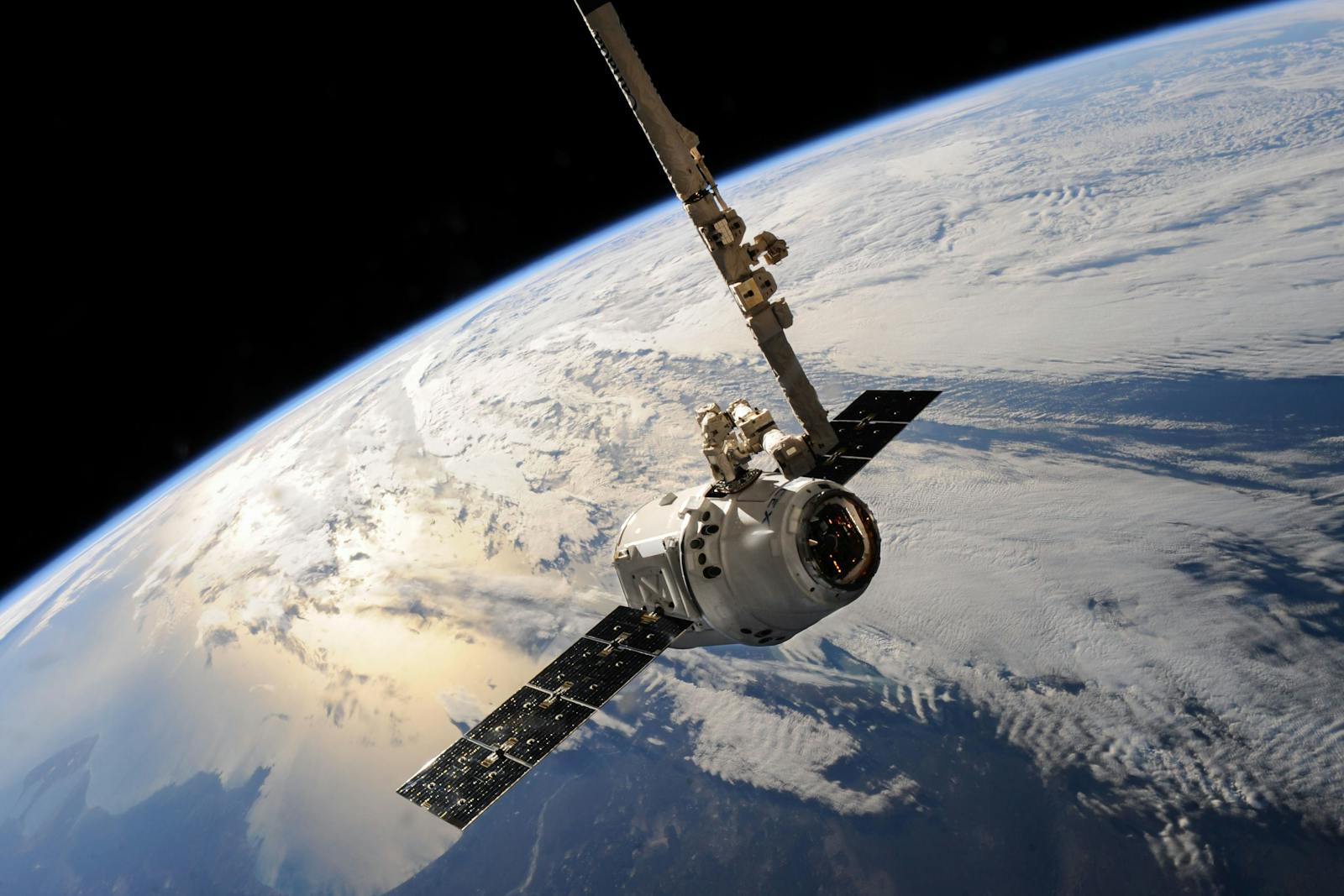
Photo by SpaceX on Pexels