
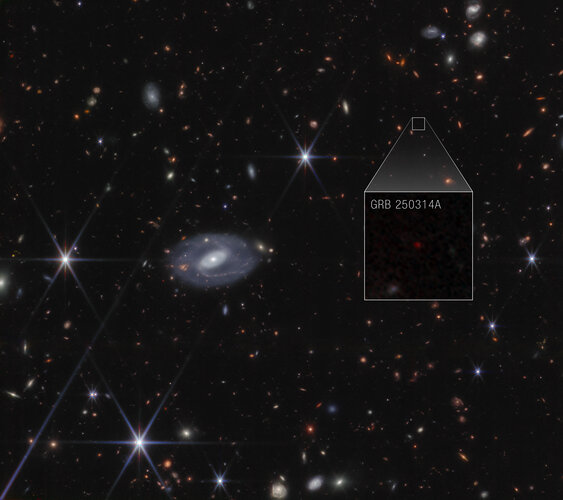

With this observation, Webb also broke its own record: The previous chart-topping supernova existed when the Universe was 1.8 billion years old.
“Only Webb could directly show that this light is from a supernova – a collapsing massive star,” said Andrew Levan, the lead author of one of two new papers in Astronomy and Astrophysics Letters and professor at Radboud University in Nijmegen, Netherlands, and the University of Warwick in the United Kingdom. “This observation also demonstrates that we can use Webb to find individual stars when the Universe was only 5% of its current age.”
While a gamma-ray burst typically lasts for seconds to minutes, a supernova rapidly brightens over several weeks before it slowly dims. In contrast, this supernova brightened over months. Since it exploded so early in the history of the Universe, its light was stretched as the cosmos expanded over billions of years. As light is stretched, so is the time it takes for events to unfold. Webb’s observations were intentionally taken three and a half months after the gamma-ray burst ended, since the underlying supernova was expected to be brightest at that time.
“Webb provided the rapid and sensitive follow-up we needed,” said Benjamin Schneider, a co-author and a postdoctoral researcher at the Laboratoire d'Astrophysique de Marseille in France.
Gamma-ray bursts are incredibly rare. Those that last a few seconds may be caused by two neutron stars, or a neutron star and a black hole colliding. Longer bursts like this one, which lasted around 10 seconds, are frequently linked to the explosive deaths of massive stars.